Acacia leptocarpa
| Slender-fruited wattle | |
|---|---|
 | |
| In Burrum Coast National Park | |
Scientific classification  | |
| Kingdom: | Plantae |
| Clade: | Embryophytes |
| Clade: | Tracheophytes |
| Clade: | Angiosperms |
| Clade: | Eudicots |
| Clade: | Rosids |
| Order: | Fabales |
| Family: | Fabaceae |
| Subfamily: | Caesalpinioideae |
| Clade: | Mimosoid clade |
| Genus: | Acacia |
| Species: | A. leptocarpa |
| Binomial name | |
| Acacia leptocarpa | |
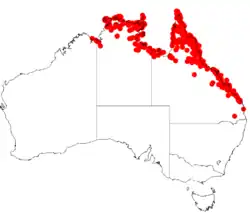 | |
| Occurrence data from AVH | |
| Synonyms[1] | |


Acacia leptocarpa, commonly known as slender-fruited wattle,[2] mangarr mangal,[3] malakmalak, matngala or wagiman in Australian Aboriginal languages,[4] is a species of flowering plant in the family Fabaceae and is endemic to northern Australia. It is a tree, rarely a shrub, with dark grey to almost black bark, narrowly elliptic, sickle-shaped, shortened phyllodes, spikes heads of yellow to golden yellow flowers and curved, curled or twisted pods constricted between and raised over the seeds.
Description
Acacia leptocarpa is a tree that typically grows to a height of up to 15 m (49 ft), rarely a shrub to 4 m (13 ft), and has dark grey to almost black, 'ironbark' type bark and glabrous branchlets with lenticels. The phyllodes are narrowly elliptic, markedly sickle-shaped, shortened at both ends, mostly 110–200 mm (4.3–7.9 in) long and 10–35 mm (0.39–1.38 in) wide, thinly leathery with three prominent veins and a conspicuous gland near the base of the phyllode. The flowers are yellow to golden yellow and borne in spikes 35–95 mm (1.4–3.7 in) long. Flowering occurs from May to October, and the pods are curved, coiled or twisted, 80–150 mm (3.1–5.9 in) long, 2–35 mm (0.079–1.378 in) wide, thinly leathery to papery, glabrous and slightly or variably constricted between, and raised over the seeds. The seeds are 3–4 mm (0.12–0.16 in) long and dark brown with a massive, yellow-orange aril that is longer than the seed.[2][3][4]
Acacia leptocarpa resembles A. cowleana and A. elachantha but has glabrous and thinner phyllodes and longer, more curved pods. It is thought to be allied with A. tropica and A. cretata. The seed pods appear very similar to those of A. gardneri.[5]
Taxonomy
Acacia leptocarpa was first formally described in 1842 by the George Bentham in Hooker's London Journal of Botany, from an unpublished manuscript by Allan Cunningham of specimens collected between the Endeavour River and Cape Flinders in Queensland in 1820.[5][6][7] The specific epithet (leptocarpa) means 'thin-fruited'[8] referring to the thin seed pods.[9]
Distribution and habitat
This species of wattle is mostly found in open forest, occasionally in monsoon forest and rainforest margins from Carlton Hill Station in the Kimberley region of Western Australia and eastwards across the Top End of the Northern Territory including its offshore islands, to Cape York Peninsula and south to southern Central Queensland where it is found along the margins of watercourses and swampy areas[10] growing in sandy or rocky soils occasionally around laterite in open Eucalyptus or Melaleuca woodland.[5]
See also
References
- 1 2 "Acacia leptocarpa". Australian Plant Census. Retrieved 30 July 2026.
- 1 2 Tindale, Mary D.; Kodela, Phillip G. Kodela, Phillip G. (ed.). "Acacia leptocarpa". Flora of Australia. Australian Biological Resources Study, Department of Climate Change, Energy, the Environment and Water: Canberra. Retrieved 30 July 2026.
- 1 2 "Acacia leptocarpa". FloraBase. Western Australian Government Department of Biodiversity, Conservation and Attractions.
- 1 2 "Acacia leptocarpa". Northern Territory Government. Retrieved 31 July 2026.
- 1 2 3 "Acacia leptocarpa". World Wide Wattle. Western Australian Herbarium. Retrieved 18 August 2019.
- ↑ "Acacia leptocarpa". Australian Plant Name Index. Retrieved 31 July 2026.
- ↑ Bentham, George (1842). "Notes on Mimoseae, with a synopsis of species". London Journal of Botany. 1: 376. Retrieved 31 July 2026.
- ↑ George, Alex S.; Sharr, Francis A. (2023). Western Australian Plant Names and Their Meanings - A Glossary (fifth ed.). Kardinya: Four Gables Press. p. 244. ISBN 9780645629538.
- ↑ "Acacia leptocarpa" (PDF). World Agroforestry. Retrieved 9 November 2019.
- ↑ F.A.Zich; B.P.M.Hyland; T.Whiffen; R.A.Kerrigan (2020). "Acacia leptocarpa". Australian Tropical Rainforest Plants Edition 8 (RFK8). Centre for Australian National Biodiversity Research (CANBR), Australian Government. Retrieved 21 June 2021.