Acacia leptalea
| Chinocup wattle | |
|---|---|
 | |
| In the Australian National Botanic Gardens | |
Scientific classification  | |
| Kingdom: | Plantae |
| Clade: | Embryophytes |
| Clade: | Tracheophytes |
| Clade: | Angiosperms |
| Clade: | Eudicots |
| Clade: | Rosids |
| Order: | Fabales |
| Family: | Fabaceae |
| Subfamily: | Caesalpinioideae |
| Clade: | Mimosoid clade |
| Genus: | Acacia |
| Species: | A. leptalea |
| Binomial name | |
| Acacia leptalea | |
| Synonyms[2] | |
| |
Acacia leptalea, commonly known as Chinocup wattle,[1] is a species of flowering plant in the family Fabaceae and is endemic to a small area in the south-west of Western Australia. It is a dense, rounded shrub with more or less straight, terete phyllodes, spherical heads of golden yellow flowers and hairy, slightly sticky pods.
Description
Acacia leptalea is a dense, rounded shrub that typically grows to a height of 0.5–2.0 m (1.6–6.6 ft) and has hairy branchlets and raised leaf bases. It has sometimes crowded, more or less straight, terete or slightly compressed phyllodes 5–8 mm (0.20–0.31 in) long and 0.3–0.4 mm (0.012–0.016 in) wide with a narrowed, off-centred point on the tip. The phyllodes have no discernible veins and no glands. The flowers are borne in a spherical head in axils on a hairy, pale yellow peduncle 3–4 mm (0.12–0.16 in) long with 25 golden yellow flowers. Flowering occurs in July, and the pods are hairy, slightly sticky, up to 25 mm (0.98 in) long, 4–5 mm (0.16–0.20 in) wide and slightly sticky, the valves curved to s-shaped after releasing the seeds. The seeds are egg-shaped, 3.0–3.5 mm (0.12–0.14 in) long, and shiny brown with a slightly club-shaped aril near the end.[3][4][5][6]
Taxonomy
Acacia leptalea was first formally described in 1999 by Bruce Maslin in the journal Nuytsia from specimens collected near Nyabing in 1989.[3][7] The specific epithet (leptalea) means 'thin or delicate', referring to the phyllodes.[4]
Distribution and habitat
This species of wattle is only known from near Nyabing, where it grws in sand or sandy loam on an undulating plain, in open mallee woodland with a dense understorey.[4][6]
Conservation status
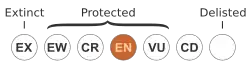
Acacia leptalea is listed as 'endangered' under the Australian Government Environment Protection and Biodiversity Conservation Act 1999[1] and as 'Threatened Flora (Declared Rare Flora — Extant)' by the Western Australian Government Department of Biodiversity, Conservation and Attractions.[6]
See also
References
- 1 2 3 "SPRAT Profile - Acacia leptalea — Chinocup Wattle". Australian Government, Department of Climate Change, Energy, the Environment and Water. Retrieved 16 November 2018.
- 1 2 "Acacia leptalea". Australian Plant Census. Retrieved 29 July 2026.
- 1 2 Maslin, Bruce R. (1999). "Acacia miscellany 16. The taxonomy of fifty-five species of Acacia, primarily Western Australian, in section Phyllodineae (Leguminosae: Mimosoideae)". Nuytsia. 12 (3): 367–369. Retrieved 29 July 2026.
- 1 2 3 Maslin, Bruce R. "Acacia leptalea". Flora of Australia. Australian Biological Resources Study, Department of Climate Change, Energy, the Environment and Water: Canberra. Retrieved 29 July 2026.
- ↑ "Acacia leptalea Maslin". Wattle- Acacias of Australia. Lucid Central. Retrieved 2 July 2020.
- 1 2 3 "Acacia leptalea". FloraBase. Western Australian Government Department of Biodiversity, Conservation and Attractions.
- ↑ "Acacia leptalea". Australian Plant Name Index. Retrieved 29 July 2026.