Acacia lauta
| Tara wattle | |
|---|---|
 | |
| In the Australian National Botanic Gardens | |
Scientific classification  | |
| Kingdom: | Plantae |
| Clade: | Embryophytes |
| Clade: | Tracheophytes |
| Clade: | Angiosperms |
| Clade: | Eudicots |
| Clade: | Rosids |
| Order: | Fabales |
| Family: | Fabaceae |
| Subfamily: | Caesalpinioideae |
| Clade: | Mimosoid clade |
| Genus: | Acacia |
| Species: | A. lauta |
| Binomial name | |
| Acacia lauta | |
| Synonyms[1] | |
| |
Acacia lauta, commonly known as Tara wattle,[2] is a species of flowering plant in the family Fabaceae and is endemic to south-eastern Queensland, Australia. It is a sprawling shrub with branchlets usually covered with short, weak hairs, linear, curved or s-shaped phyllodes, spherical heads of golden yellow flowers and linear, glabrous pods.
Description
Acacia lauta is a sprawling shrub that typically grows to a height of up to 2 m (6 ft 7 in) and has branchlets covered with short, weak, wide-spreading hairs. Its phyllodes are spreading to inclined or sometimes erect, linear, shallowly curved, sometimes most or all s-shaped, occasionally a few straight, flat, 20–40 mm (0.79–1.57 in) long, 1–2.5 mm (0.039–0.098 in) wide with an excentric point on the tip, and one to three veins and a slightly raised midrib. The flowers are arranged in a spherical head on a peduncle 3–7 mm (0.12–0.28 in) long, each head with 25 to 30 golden yellow flowers. Flowering occurs in August and September, and the pods are linear, glabrous, up to 60 mm (2.4 in) long and about 4 mm (0.16 in) wide. The seeds are 4.5–5.0 mm (0.18–0.20 in) long with a cup-shaped aril.[2][3][4]
Taxonomy
Acacia lauta was first formally described in 1980 by Leslie Pedley in the journal Austrobaileya from specimens collected near Weranga, about 16 km (9.9 mi) east of Tara in 1966.[3][5]
Distribution and habitat
Tara wattle is only known from the type locality where it grows in deep sand in low, open woodland between Tara and Inglewood on the Darling Downs in south-east Queensland.[6]
Conservation Status
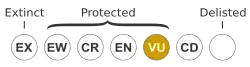
Acacia lauta is listed as 'vulnerable' under the Australian Government Environment Protection and Biodiversity Conservation Act 1999[7] and the Queensland Government Nature Conservation Act 1992.[8]
See also
References
- 1 2 "Acacia lauta". Australian Plant Census. Retrieved 24 July 2026.
- 1 2 Maslin, Bruce R.; Kodela, Phillip G. "Acacia lauta". Flora of Australia. Australian Biological Resources Study, Department of Climate Change, Energy, the Environment and Water: Canberra. Retrieved 24 July 2026.
- 1 2 Pedley, Leslie (1980). "A revision of Acacia Mill. in Queensland, Part 2". Austrobaileya. 1 (3): 257. Retrieved 24 July 2026.
- ↑ "Acacia lauta". Wattle - Acacias of Australia. Lucid Central. Retrieved 1 September 2019.
- ↑ "Acacia lauta". Australian Plant Name Index. Retrieved 24 July 2026.
- ↑ "Acacia lauta". World Wide Wattle. Western Australian Herbarium. Retrieved 16 June 2019.
- ↑ "Species Profile and Threats Database - Acacia lauta - Tara Wattle". Australian Government, Department of Climate Change, Energy, the Environment and Water. Retrieved 24 July 2026.
- ↑ "Tara wattle – Acacia lauta". WetlandInfo. Department of Environment and Science, Queensland. 20 October 2014. Retrieved 1 September 2019.