Acacia latipes
| Acacia latipes | |
|---|---|
 | |
| Subspecies latipes | |
Scientific classification  | |
| Kingdom: | Plantae |
| Clade: | Embryophytes |
| Clade: | Tracheophytes |
| Clade: | Angiosperms |
| Clade: | Eudicots |
| Clade: | Rosids |
| Order: | Fabales |
| Family: | Fabaceae |
| Subfamily: | Caesalpinioideae |
| Clade: | Mimosoid clade |
| Genus: | Acacia |
| Species: | A. latipes |
| Binomial name | |
| Acacia latipes | |
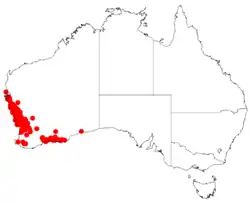 | |
| Occurrence data from AVH | |
| Synonyms[1] | |
| |
Acacia latipes is a species of flowering plant in the family Fabaceae and is endemic to the south-west of Western Australia. It is a shrub, with sessile, narrowly elliptic, linear or tapered phyllodes, spherical heads of golden yellow flowers and linear, leathery pods raised over the seeds.
Description
Acacia latipes is diffuse to dense, erect or prostrate shrub that typically grows to a height of 0.3–2 m (1–7 ft) and has angled branches that are sometimes more or less glaucous, sometimes covered with soft hairs. Its phyllodes are sessile, narrowly to widely elliptic to triangular, linear or tapered, 10–50 mm (0.39–1.97 in) long, 1–7 mm (0.039–0.276 in) wide, sharply pointed, rigid, glabrous and often glaucous. The phyllodes have three or four raised main veins. The flowers are borne in two to five spherical heads in axils on glabrous peduncles mostly 5–9 mm (0.20–0.35 in) long. The heads are 3–5.5 mm (0.12–0.22 in) in diameter with 24 to 67 golden yellow flowers. Flowering occurs from June to October, and the pods are linear, up to 60 mm (2.4 in) long, 3.5–6 mm (0.14–0.24 in) wide and leathery, raised over the seeds and more or less constricted between them. The seeds are widely elliptic to egg-shaped, 2.8–3.7 mm (0.11–0.15 in) long and mottled with a helmet-shaped aril.[2][3][4]
Taxonomy
Acacia latipes was first formally described by George Bentham in Hooker's London Journal of Botany from specimens collected by James Drummond in the Swan River Colony.[5][6]
In 1999, Richard Cowan and Bruce Maslin described two subspecies of S. latipes in the journal Nuytsia,[2] and the names are accepted by the Australian Plant Census:
- Acacia latipes Benth. subsp. latipes[7] has straight to slightly curved, narrowly oblong to widely elliptic, triangular, linear or tapered phyllodes, mostly 3.5–8 times longer than wide and often glaucous or subglaucous.[2][8][9]
- Acacia latipes subsp. licina R.S.Cowan & Maslin[10] has phyllodes normally curved upwards, elongated linear, rarely straight, 23 to 40 times longer than wide and not glaucous.[2][11][12]
Distribution and habitat
Acacia latipes grows in sand, sandy loam, granite, laterite or limestone on sandplains, hills and flats.[3][4]
- Subspecies latipes occurs from Hamelin to Quairading with scattered populations from near Lake King to east of Scaddan in the Avon Wheatbelt, Esperance Plains, Geraldton Sandplains, Jarrah Forest, Mallee and Swan Coastal Plain bioregions.[8][13]
- Subspecies licina occurs from Port Gregory to near Three Springs in the Avon Wheatbelt and Geraldton Sandplains bioregions.[11][14]
Conservation status
Acacia latipes and subsp. latipes are listed as 'not threatened' by the Government of Western Australia Department of Biodiversity, Conservation and Attractions,[4] but subsp. licina is listed as "Priority Three"[14] meaning that it is poorly known and known from only a few locations but is not under imminent threat.[15]
See also
References
- 1 2 "Acacia latipes". Australian Plant Census. Retrieved 22 July 2026.
- 1 2 3 4 Cowan, Richard S.; Maslin, Bruce R. (1999). "Acacia miscellany 18. The taxonomy of miscellaneous species with sharply pungent phyllodes in Acacia section Plurinerves (Leguminosae: Mimosoideae)". Nuytsia. 12 (3): 462–465. Retrieved 22 July 2026.
- 1 2 Cowan, Richard S. "Acacia latipes". Flora of Australia. Australian Biological Resources Study, Department of Climate Change, Energy, the Environment and Water: Canberra. Retrieved 22 July 2026.
- 1 2 3 "Acacia latipes". FloraBase. Western Australian Government Department of Biodiversity, Conservation and Attractions.
- ↑ "Acacia latipes". Australian Plant Name Index. Retrieved 22 July 2026.
- ↑ Bentham, George (1842). Hooker, William Jackson (ed.). "Notes on Mimoseae, with a synopsis of species". London Journal of Botany. 1: 334. Retrieved 22 July 2026.
- ↑ "Acacia latipes subsp. latipes". Australian Plant Census. Retrieved 22 July 2026.
- 1 2 Cowan, Richard S. "Acacia latipes subsp. latipes". Flora of Australia. Australian Biological Resources Study, Department of Climate Change, Energy, the Environment and Water: Canberra. Retrieved 22 July 2026.
- ↑ Cowan, Richard S. "Acacia latipes subsp. latipes". Australian Biological Resources Study. Retrieved 22 July 2026.
- ↑ "Acacia latipes subsp. licina". Australian Plant Census. Retrieved 22 July 2026.
- 1 2 Cowan, Richard S. "Acacia latipes subsp. licina". Flora of Australia. Australian Biological Resources Study, Department of Climate Change, Energy, the Environment and Water: Canberra. Retrieved 22 July 2026.
- ↑ Cowan, Richard S. "Acacia latipes subsp. licina". Australian Biological Resources Study. Retrieved 22 July 2026.
- ↑ "Acacia latipes subsp. latipes". FloraBase. Western Australian Government Department of Biodiversity, Conservation and Attractions.
- 1 2 "Acacia latipes subsp. laricina". FloraBase. Western Australian Government Department of Biodiversity, Conservation and Attractions.
- ↑ "Conservation codes for Western Australian Flora and Fauna" (PDF). Government of Western Australia Department of Parks and Wildlife. Retrieved 22 June 2026.