Acacia lanuginophylla
| Woolly wattle | |
|---|---|
 | |
Scientific classification  | |
| Kingdom: | Plantae |
| Clade: | Embryophytes |
| Clade: | Tracheophytes |
| Clade: | Angiosperms |
| Clade: | Eudicots |
| Clade: | Rosids |
| Order: | Fabales |
| Family: | Fabaceae |
| Subfamily: | Caesalpinioideae |
| Clade: | Mimosoid clade |
| Genus: | Acacia |
| Species: | A. lanuginophylla |
| Binomial name | |
| Acacia lanuginophylla | |
 | |
| Occurrence data from Australasian Virtual Herbarium | |
| Synonyms[2] | |
| |

Acacia lanuginophylla or woolly wattle,[1] is a species of flowering plant in the family Fabaceae and is endemic to a small area in the south-west of Western Australia. It is a dense shrub with branchlets densely covered with woolly white hairs, narrowly elliptic to narrowly oblong phyllodes, spherical heads of golden yellow flowers, and oblong, thinly crusty pods, densely covered with woolly white hairs.
Description
Acacia lanuginophylla is a dense to open, domed, erect or spreading shrub that typically grows to a height of 0.5–1.2 m (2–4 ft) and has its branchlets densely covered with woolly white hairs. Its phyllodes are narrowly elliptic to narrowly oblong, 15–40 mm (0.59–1.57 in) long, 3.5–10 mm (0.14–0.39 in) wide, greyish green with three main veins and densely covered with woolly white hairs. There is a gland 2–6 mm (0.079–0.236 in) above the pulvinus. Flowering occurs from July to October, and the pods are oblong, up to 25 mm (0.98 in) long, 6–7 mm (0.24–0.28 in) wide, thinly crusty and densely covered with woolly white hairs. The seeds are about 3 mm (0.12 in) long and tan with an aril near the end.[3][4][5][6]
Taxonomy
Acacia lanuginophylla was first formally described in 1990 by Richard Sumner Cowan and Bruce Maslin in the journal Nuytsia, based on Charles Gardner's 1939 description in Hooker's Icones Plantarum of specimens collected on Mount Holland.[7][8][9] The specific epithet (lanuginophylla) means 'wool-leaved'.[10]
Distribution and habitat
Woolly wattle grows along drainage lines on flats in san or gravelly soils in low, open scrub and is only known from near Lake Biddy north of Newdegate and Lake Lockhart, about 30 km (19 mi) south, in the Coolgardie and Mallee bioregions of south-western Western Australia.[4][6]
Conservation status
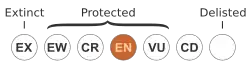
Acacia lanuginophylla is listed as 'Threatened' by the Western Australian Government Department of Biodiversity, Conservation and Attractions,[6] meaning that it is in danger of extinction,[11] 'Vulnerable' under the World Conservation Union (IUCN 2001) Red List and 'Endangered' under the Australian Government Environment Protection and Biodiversity Conservation Act 1999 A national recovery plan has been prepared.[1] There are only nine remaining populations or fifteen subpopulations of the plant remaining with an estimated 5,483 individuals remaining that are found in the Shire of Lake Grace and Shire of Yilgarn where over 75% of the native vegetation has been cleared.[1]
See also
References
- 1 2 3 4 "National recovery plan for the Woolly Wattle (Acacia lanuginophylla)". Department of Agriculture, Water and the Environment. 2008. Retrieved 2 December 2020.
- 1 2 "Acacia lanuginophylla". Australian Plant Census. Retrieved 13 July 2026.
- ↑ Cowan, Richard S.; Maslin, Bruce R. "Acacia lanuginophylla". Australian Biological Resources Study. Retrieved 14 July 2026.
- 1 2 Cowan, Richard S.; Maslin, Bruce R. "Acacia lanuginophylla". Flora of Australia. Australian Biological Resources Study, Department of Climate Change, Energy, the Environment and Water: Canberra. Retrieved 14 July 2026.
- ↑ "Acacia lanuginophylla". World Wide Wattle. Retrieved 14 July 2026.
- 1 2 3 "Acacia lanuginophylla". FloraBase. Western Australian Government Department of Biodiversity, Conservation and Attractions.
- ↑ "Acacia lanuginosa". Australian Plant Name Index. Retrieved 14 July 2026.
- ↑ Cowan, Richard S.; Maslin, Bruce R. (1990). "Acacia Miscellany 1. Some oligoneurous species of Acacia (Leguminosae: Mimosoideae: Section Plurinerves) from Western Australia". Nuytsia. 7 (2). Retrieved 14 July 2026.
- ↑ "Acacia lanuginosa". Australian Plant Name Index. Retrieved 14 July 2026.
- ↑ George, Alex S.; Sharr, Francis A. (2023). Western Australian Plant Names and Their Meanings - A Glossary (fifth ed.). Kardinya: Four Gables Press. p. 241. ISBN 9780645629538.
- ↑ "Conservation codes for Western Australian Flora and Fauna" (PDF). Government of Western Australia Department of Parks and Wildlife. Retrieved 14 July 2026.