Acacia lanei
| Hyden wattle | |
|---|---|
Scientific classification  | |
| Kingdom: | Plantae |
| Clade: | Embryophytes |
| Clade: | Tracheophytes |
| Clade: | Angiosperms |
| Clade: | Eudicots |
| Clade: | Rosids |
| Order: | Fabales |
| Family: | Fabaceae |
| Subfamily: | Caesalpinioideae |
| Clade: | Mimosoid clade |
| Genus: | Acacia |
| Species: | A. lanei |
| Binomial name | |
| Acacia lanei | |
 | |
| Acacia lanei occurrence data from Australasian Virtual Herbarium[2] | |
| Synonyms[1] | |
| |
Acacia lanei, commonly known as Hyden wattle,[3] is a species of flowering plant in the family Fabaceae and is endemic to the south-west of Western Australia. It is a spreading shrub with ascending linear to elliptic phyllodes, spherical heads of yellow flowers, and linear, glabrous, thinly crusty pods raised over the seeds.
Description
Acacia lanei is a spreading shrub that typically grows to a height of 1.5–2.3 m (5–8 ft) and has branchlets covered in silky white hairs often obscured by resin. Its phyllodes are ascending, linear to elliptic, straight or slightly curved, 45–60 mm (1.8–2.4 in) long, 3–5 mm (0.12–0.20 in) wide and glabrous except for silky white hairs at the base and on the pulvinus. The flowers are borne in one or two spherical heads in racemes on peduncles 3–5 mm (0.12–0.20 in) long, each head 4–6 mm (0.16–0.24 in) in diameter with 34 to 38 yellow flowers. Flowering occurs from July to September, and the pods are linear or bent, up to 120 mm (4.7 in) long and 2–3 mm (0.079–0.118 in) wide, thinly crusty, glabrous, sticky and raised over the seeds. The seeds are oblong, 3.5–4.5 mm (0.14–0.18 in) long with an aril on the end.[3][4][5][6]
Taxonomy
Acacia lanei was first formally described in 1990 by Richard Cowan and Bruce Maslin in the journal Nuytsia from specimens collected by Maslin 3.6 mi (5.8 km) east of Hyden on the road to Holt Rock in 1970.[4][7] The specific epithet (lanei) honours Richard J. Lane, a Western Australian farmer who called the attention of botanists to the plant in July 1986 as "an excellent windbreak, because it is vigorous in growth and is not browsed by livestock".[4]
Distribution and habitat
Hyden wattle grows in association with salmon gum or York gum along creek and drainage lines on red or brown clay within 25 km (16 mi) south and east of Hyden in the Avon Wheatbelt and Mallee bioregions of south-western Western Australia.[4][6]
Conservation status
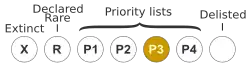
Acacia lanei is listed as 'Priority Three' by the Government of Western Australia Department of Parks and Wildlife,[6] meaning that it is poorly known and known from only a few locations but is not under imminent threat.[8]
See also
References
- 1 2 "Acacia lanei". Australian Plant Census. Retrieved 12 July 2026.
- ↑ "DOI Details". doi.ala.org.au. doi:10.26197/5c0b1388984eb. Retrieved 8 December 2018.
- 1 2 Cowan, Richard S.; Maslin, Bruce R. "Acacia lanei". Flora of Australia. Australian Biological Resources Study, Department of Climate Change, Energy, the Environment and Water: Canberra. Retrieved 13 July 2026.
- 1 2 3 4 Cowan, Richard Sumner; Maslin, Bruce R. (1990). "Acacia Miscellany 1. Some oligoneurous species of Acacia (Leguminosae: Mimosoideae: Section Plurinerves) from Western Australia". Nuytsia. 7 (2): 192–194. Retrieved 13 July 2026.
- ↑ Cowan, Richard S.; Maslin, Bruce R. "Acacia lanei". Australian Biological Resources Study. Retrieved 13 July 2026.
- 1 2 3 "Acacia lanei". FloraBase. Western Australian Government Department of Biodiversity, Conservation and Attractions.
- ↑ "Acacia lanei". Australian Plant Name Index. Retrieved 13 July 2026.
- ↑ "Conservation codes for Western Australian Flora and Fauna" (PDF). Government of Western Australia Department of Parks and Wildlife. Retrieved 13 July 2026.