Acacia lanceolata
| Acacia lanceolata | |
|---|---|
Scientific classification  | |
| Kingdom: | Plantae |
| Clade: | Embryophytes |
| Clade: | Tracheophytes |
| Clade: | Angiosperms |
| Clade: | Eudicots |
| Clade: | Rosids |
| Order: | Fabales |
| Family: | Fabaceae |
| Subfamily: | Caesalpinioideae |
| Clade: | Mimosoid clade |
| Genus: | Acacia |
| Species: | A. lanceolata |
| Binomial name | |
| Acacia lanceolata | |
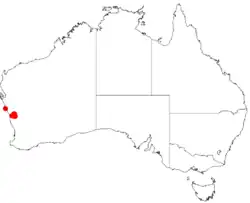 | |
| Acacia lanceolata occurrence data from Australasian Virtual Herbarium[2] | |
| Synonyms[1] | |
|
Racosperma lanceolatum (Maslin) Pedley | |
Acacia lanceolata is a species of flowering plant in the family Fabaceae and is endemic to a small area in the south-west of Western Australia. It is a shrub with many branches, sharply pointed, glabrous lance-shaped to narrowly elliptic phyllodes, spherical heads of golden yellow flowers, and tightly coiled, firmly papery, glabrous pods appearing more or less like a string of beads.
Description
Acacia lanceolata is on open shrub with many branches, that typically grows to a height of 0.3–1.2 m (1 ft 0 in – 3 ft 11 in) and has somewhat spiny, hairy branchlets that are covered with a powdery bloom near the ends. Its phyllodes are lance-shaped, 7–15 mm (0.28–0.59 in) long and 1.5–4 mm (0.059–0.157 in) wide, sometimes narrowly elliptic, sharply pointed with a central midrib and two or three minor veins and a gland 4–7 mm (0.16–0.28 in) above the pulvinus. The flowers are borne in a spherical or oblong head in axils on a peduncle 3–8 mm (0.12–0.31 in) long, the heads with 20 to 23 golden yellow flowers. Flowering has been recorded in August and September, and the pods are rather tightly coiled, up to 17 mm (0.67 in) long, 10 mm (0.39 in) wide and firmly papery and glabrous. The seeds are oblong, about 4 mm (0.16 in) long with an aril about 2/3 the length of the seed.[3][4][5]
Taxonomy
Acacia lanceolata was first formally described in 1999 by Bruce Maslin in the journal Nuytsia from specimens collected near Three Springs by William Edward Blackall in 1940.[3][6] The specific epithet (lanceolata) means 'wikt:lanceolate'.[7]
Distribution and habitat
This species of wattle grows on low rocky or lateritic hills in woodland or tall shrubland in a small area in the Mingenew-Three Springs area in the Avon Wheatbelt and Geraldton Sandplains bioregions of south-western Western Australia.[4][8][9]
Conservation status
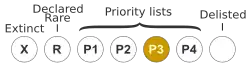
Acacia lanceolata is listed as "Priority Three" by the Government of Western Australia Department of Parks and Wildlife,[9] meaning that it is poorly known and known from only a few locations but is not under imminent threat.[10]
See also
References
- 1 2 "Acacia lanceolata". Australian Plant Census. Retrieved 12 July 2026.
- ↑ "DOI Details". doi.ala.org.au. doi:10.26197/5c0b1388984eb. Retrieved 8 December 2018.
- 1 2 Maslin, Bruce R. (1999). "Acacia miscellany 16. The taxonomy of fifty-five species of Acacia, primarily Western Australian, in section Phyllodineae (Leguminosae: Mimosoideae)". Nuytsia. 12 (3): 363–365. Retrieved 12 July 2026.
- 1 2 Maslin, Bruce R. "Acacia lanceolata". Australian Biological Resources Study. Retrieved 12 July 2026.
- ↑ Maslin, Bruce R. "Acacia lanceolata". Flora of Australia. Australian Biological Resources Study, Department of Climate Change, Energy, the Environment and Water: Canberra. Retrieved 12 July 2026.
- ↑ "Acacia lanceolata". Australian Plant Name Index. Retrieved 12 July 2026.
- ↑ George, Alex S.; Sharr, Francis A. (2023). Western Australian Plant Names and Their Meanings - A Glossary (fifth ed.). Kardinya: Four Gables Press. p. 240. ISBN 9780645629538.
- ↑ "Acacia lanceolata". World Wide Wattle. CSIRO Publishing. Retrieved 29 June 2020.
- 1 2 "Acacia lanceolata". FloraBase. Western Australian Government Department of Biodiversity, Conservation and Attractions.
- ↑ "Conservation codes for Western Australian Flora and Fauna" (PDF). Government of Western Australia Department of Parks and Wildlife. Retrieved 12 July 2026.