Acacia lamprocarpa
| Western salwood | |
|---|---|
 | |
| In Litchfield National Park | |
Scientific classification  | |
| Kingdom: | Plantae |
| Clade: | Embryophytes |
| Clade: | Tracheophytes |
| Clade: | Angiosperms |
| Clade: | Eudicots |
| Clade: | Rosids |
| Order: | Fabales |
| Family: | Fabaceae |
| Subfamily: | Caesalpinioideae |
| Clade: | Mimosoid clade |
| Genus: | Acacia |
| Species: | A. lamprocarpa |
| Binomial name | |
| Acacia lamprocarpa O.Schwarz[1] | |
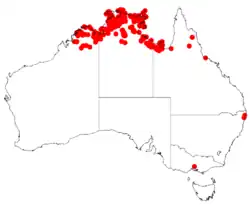 | |
| Occurrence data from AVH | |
| Synonyms[1] | |
|
Racosperma lamprocarpum (O.Schwartz) Pedley | |

Acacia lamprocarpa, commonly known as western salwood,[2] is a species of flowering plant in the family Fabaceae and is endemic to northern Australia. It is a tree with thick, papery, flaky bark, yellow-brown stems, slender, often pendulous branchlets, phyllodes with one edge convex and the other more or less straight, spikes of cream-coloured to pale yellow flowers and oblong to narrowly oblong, flat or twisted, woody, resinous, glabrous pods.
Description
Acacia lamprocarpa is a tree that typically grows to a height of 4–15 m (13–49 ft) and has thick, papery bark, yellow-brown stems, and slender, often pendulous branchlets. Its phyllodes have one convex edge and one more or less straight edge, sometimes sickle-shaped, 55–185 mm (2.2–7.3 in) long and 9–35 mm (0.35–1.38 in) wide on a pulvinus 3–4 mm (0.12–0.16 in) long. The phyllodes are dull green, with six to eight parallel, longitudinal veins slightly more pronounced than the rest. The flowers are cream-coloured to pale yellow and borne in up to four spikes 10–40 mm (0.39–1.57 in) long on peduncles 2–5 mm (0.079–0.197 in) long. Flowering occurs from April to June, and the pods are oblong to narrowly oblong, 20–100 mm (0.79–3.94 in) long, 14–22 mm (0.55–0.87 in) wide, woody, resinous and glabrous, flat or spirally twisted.[2][3][4][5]
Taxonomy
Acacia lamprocarpa was first formally described in 1927 by Otto Schwarz in Repertorium specierum novarum regni vegetabilis from specimens collected by Florenz Bleeser (1871–1942) in Port Darwin.[6][7][8] The specific epithet (lamprocarpa) means 'bright, lustrous or shining fruit', referring to its resinous pods that shine as if polished.[4]
Distribution and habitat
Western salwood is found across northern Australia in Western Australia,[5] the Northern Territory[9] and the Gulf Country of north east Queensland where it grows in a range of habitats, including the margins of watercourses, coastal sand dunes, sandy plain and on sandstone plateau.[3] In Western Australia is native to a small area in the Kimberley region where it grows in sandy soils over sandstone or laterite.[5]
See also
References
- 1 2 "Acacia lamprocarpa". Australian Plant Census. Retrieved 12 July 2026.
- 1 2 "Acacia lamprocarpa". Western Australian Herbarium. Retrieved 23 September 2018.
- 1 2 Maslin, Bruce R. "Acacia lamprocarpa". Australian Biological Resources Study. Retrieved 12 July 2026.
- 1 2 Maslin, Bruce R.; Kodela, Phillip G. "Acacia lamprocarpa". Flora of Australia. Australian Biological Resources Study, Department of Climate Change, Energy, the Environment and Water: Canberra. Retrieved 12 July 2026.
- 1 2 3 "Acacia lamprocarpa". FloraBase. Western Australian Government Department of Biodiversity, Conservation and Attractions.
- ↑ "Acacia lamprocarpa". Australian Plant Name Index. Retrieved 12 July 2026.
- ↑ Schwartz, Otto K.A. (1927). "Plantae novae vel minus cognitae Australiae tropicae". Repertorium Specierum Novarum Regni Vegetabilis. 24 (4–13): 86. Retrieved 12 July 2026.
- ↑ "Bleeser, Florenz August Karl (1871 - 1942)". Council of the Heads of Australasian Herbaria. Retrieved 12 July 2026.
- ↑ "Acacia lamprocarpa". Northern Territory Government. Retrieved 12 July 2026.