Acacia laccata
| Acacia laccata | |
|---|---|
 | |
| In the Mount Annan Botanic Gardens | |
Scientific classification  | |
| Kingdom: | Plantae |
| Clade: | Embryophytes |
| Clade: | Tracheophytes |
| Clade: | Angiosperms |
| Clade: | Eudicots |
| Clade: | Rosids |
| Order: | Fabales |
| Family: | Fabaceae |
| Subfamily: | Caesalpinioideae |
| Clade: | Mimosoid clade |
| Genus: | Acacia |
| Species: | A. laccata |
| Binomial name | |
| Acacia laccata | |
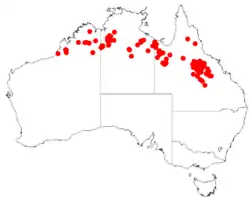 | |
| Occurrence data from AVH | |
| Synonyms[1] | |
|
Racosperma laccatum (Pedley) Pedley | |
Acacia laccata is a species of flowering plant in the family Fabaceae and is endemic to northern Australia. It is an erect, spindly shrub with fissured, dark brown bark, narrowly elliptic to very narrowly elliptic, glabrous phyllodes, spikes of yellow flowers and linear, glabrous pods slightly constricted between the seeds.
Description
Acacia laccata is an erect, spindly, varnished shrub that typically grows to a height of 2–5 m (6 ft 7 in – 16 ft 5 in) with dark brown, flaky and fissured bark and terete, sometimes slightly angular branchelts. Its phyllodes are narrowly to very narrowly elliptic, sometimes lance-shaped with the narrower end towards the base, 90–185 mm (3.5–7.3 in) long, 20–50 mm (0.79–1.97 in) wide, with three or four prominent veins and is glabrous when mature. The flowers are yellow, and borne in spikes 20–50 mm (0.79–1.97 in) long. Flowering occurs from May to September, and the pods are linear, 30–70 mm (1.2–2.8 in) long, 6–8 mm (0.24–0.31 in) wide, thinly leathery, glabrous and slightly consricted between the seeds. The seeds are more or less elliptic, 4–5 mm (0.16–0.20 in) long and dark brown.[2][3][4][5]
Taxonomy
Acacia laccata was first formally described in 1964 in the Proceedings of the Royal Society of Queensland by Leslie Pedley.[6] The specific epithet (laccata) means 'appearing varnished'.[7]
Distribution and habitat
This species of wattle grows in sandy soils over sandstone or granite on plains and flats, often in woodland, in the Central Kimberley, Dampierland, Great Sandy Desert, Northern Kimberley, Ord Victoria Plain and Victoria Bonaparte bioregions of northern Western Australia,[5] the Davenport Murchison Ranges, Gulf Fall and Uplands, Gulf Plains, Ord Victoria Plain and Victoria Bonaparte bioregions of the Northern Territory, and far north-western Queensland, north of 23°S.[3]
See also
References
- 1 2 "Acacia laccata". Australian Plant Census. Retrieved 11 July 2026.
- ↑ Tindale, Mary D. Kodela, Phillip G. (ed.). "Acacia laccata". Flora of Australia. Australian Biological Resources Study, Department of Climate Change, Energy, the Environment and Water: Canberra. Retrieved 11 July 2026.
- 1 2 Tindale, Mary D. Maslin, Bruce R. (ed.). "Acacia laccata". Australian Biological Resources Study. Retrieved 11 July 2026.
- ↑ "Acacia laccata". World Wide Wattle. Western Australian Herbarium. Retrieved 14 August 2019.
- 1 2 "Acacia laccata". FloraBase. Western Australian Government Department of Biodiversity, Conservation and Attractions.
- ↑ "Acacia laccata". Australian Plant Name Index. Retrieved 11 July 2026.
- ↑ George, Alex S.; Sharr, Francis A. (2023). Western Australian Plant Names and Their Meanings - A Glossary (fifth ed.). Kardinya: Four Gables Press. p. 239. ISBN 9780645629538.