Acacia kulinensis
| Kulin wattle | |
|---|---|
Scientific classification  | |
| Kingdom: | Plantae |
| Clade: | Embryophytes |
| Clade: | Tracheophytes |
| Clade: | Angiosperms |
| Clade: | Eudicots |
| Clade: | Rosids |
| Order: | Fabales |
| Family: | Fabaceae |
| Subfamily: | Caesalpinioideae |
| Clade: | Mimosoid clade |
| Genus: | Acacia |
| Species: | A. kulinensis |
| Binomial name | |
| Acacia kulinensis | |
Acacia kulinensis, also known as Kulin wattle,[2] is a species of flowering plant in the family Fabaceae and is endemic to a small area of inland Western Australia. It is an intricately branched, prickly shrub with clusters of oblong to elliptic or lance-shaped phyllodes, spherical heads of bright yellow flowers and thinly leathery, mostly curved or twisted pods, appearing somewhat like a string of beads.
Description
Acacia kulinensis is an intricately branched, prickly shrub that typically grows to a height of 0.5–1.5 m (1 ft 8 in – 4 ft 11 in) and has grey bark. Its phyllodes are in clusters of usually four to ten and are oblong to elliptic or egg-shaped with the narrower end towards the base, 2–3 mm (0.079–0.118 in) long and 0.6–1.0 mm (0.024–0.039 in) wide, straight and glabrous with obscure veins, on a pulvinus 0.3–0.5 mm (0.012–0.020 in) long. There are sharply pointed by brittle stipules 2–3 mm (0.079–0.118 in) long below the phyllodes clusters. The flowers are borne in spherical heads on slender peduncles 4–10 mm (0.16–0.39 in) long, each head about 4 mm (0.16 in) in diameter with 17 to 20 bright yellow flowers. Flowering occurs in September, and the pods are thinly leathery, 20–50 mm (0.79–1.97 in) long, 3.0–3.5 mm (0.12–0.14 in) wide and mostly curved or twisted, clearly raised over the seeds and shallowly constricted between them, appearing somewhat like a string of beads.[3][4][5]
Taxonomy
Acacia kulinensis was first formally described in 2014 in the journal Nuytsia from specimens he collected near Kulin in 2013.[3][6] The specific epithet (kulinensis) means 'native of Kulin'.[7]
Distribution and habitat
Kulin wattle often grows in gravelly sand or sandy loam over clay in low shrubland in a very restricted area near Kulin in the Mallee bioregion of inland Western Australia.[4][2]
Conservation status
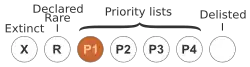
Acacia kulinensis is listed as "Priority One" by the Government of Western Australia Department of Biodiversity, Conservation and Attractions,[2] meaning that it is known from only one or a few locations that are potentially at risk.[8]
See also
References
- ↑ "Acacia kulinensis". Australian Plant Census. Retrieved 9 July 2026.
- 1 2 3 "Acacia kulinensis". FloraBase. Western Australian Government Department of Biodiversity, Conservation and Attractions.
- 1 2 Maslin, Bruce R. (2014). "Four new species of Acacia (Fabaceae: Mimosoideae) with fasciculate phyllodes from south-west Western Australia". Nuytsia. 24: 168–170. Retrieved 9 July 2026.
- 1 2 Maslin, Bruce R. Kodela, Phillip G. (ed.). "Acacia kulinensis". Flora of Australia. Australian Biological Resources Study, Department of Climate Change, Energy, the Environment and Water: Canberra. Retrieved 9 July 2026.
- ↑ Maslin, Bruce R. "Acacia kulinensis". Australian Biological Resources Study. Retrieved 9 July 2026.
- ↑ "Acacia kulinensis". Australian Plant Name Index. Retrieved 9 July 2026.
- ↑ George, Alex S.; Sharr, Francis A. (2023). Western Australian Plant Names and Their Meanings - A Glossary (fifth ed.). Kardinya: Four Gables Press. p. 238. ISBN 9780645629538.
- ↑ "Conservation codes for Western Australian Flora and Fauna" (PDF). Government of Western Australia Department of Parks and Wildlife. Retrieved 9 July 2026.