Acacia kimberleyensis
| Acacia kimberleyensis | |
|---|---|
Scientific classification  | |
| Kingdom: | Plantae |
| Clade: | Embryophytes |
| Clade: | Tracheophytes |
| Clade: | Angiosperms |
| Clade: | Eudicots |
| Clade: | Rosids |
| Order: | Fabales |
| Family: | Fabaceae |
| Subfamily: | Caesalpinioideae |
| Clade: | Mimosoid clade |
| Genus: | Acacia |
| Species: | A. kimberleyensis |
| Binomial name | |
| Acacia kimberleyensis | |
 | |
| Occurrence data from AVH | |
| Synonyms[1] | |
|
Racosperma kimberleyense (W.Fitzg.) Pedley | |
Acacia kimberleyensis is a species of flowering plant in the family Fabaceae and is endemic to the Kimberley region of northern Western Australia. It is a shrub with linear phyllodes, spikes of yellow flowers and thinly crust-like, narrowly linear pods.
Description
Acacia kimberleyensis is an erect, slightly sticky, glabrous shrub that typically grows to a height of up to 1.5 m (4 ft 11 in) and has slender, finely ribbed branchlets that are resinous, at least when young. The phyllodes are narrowly linear, 80–160 mm (3.1–6.3 in) long and 0.8–1.8 mm (0.031–0.071 in) wide, flat or four-sided in cross section, with three to seven veins on each side when flat, the central vein slightly more pronounced. The flowers are yellow and borne in mostly two narrow spikes 20–30 mm (0.79–1.18 in) long in axils on peduncles 5–10 mm (0.20–0.39 in) long. Flowering occurs in June and July and the pods are narrowly linear, thinly crust-like, 70–100 mm (2.8–3.9 in) long and about 2 mm (0.079 in) wide, the edges very narrowly winged with wings about 1 mm (0.039 in) wide. The seeds are narrowly oblong, about 6 mm (0.24 in) long, greenish black with a conical aril.[2][3][4][5]
Taxonomy
Acacia kimberleyensis was first formally described in 1917 by William Vincent Fitzgerald in the Journal and Proceedings of the Royal Society of New South Wales from specimens he collected in the Packhorse Range in the Kimberley district.[6][7] The specific epithet (kimberleyensis) means 'native of the Kimberley district'.[8]
Distribution and habitat
This species of wattle is only known from the Packhorse Range and on Mt. Agnes, about 80 km (50 mi) to the north in the western part of the Kimberley region. The type specimens were collected in an area dominated by Eucalyptus miniata woodland over spinifex on sandstone.[2][4]
Conservation status
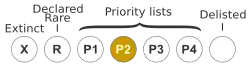
Acacia kimberleyensis is listed as "Priority Two" by the Western Australian Government Department of Biodiversity, Conservation and Attractions,[5] meaning that it is poorly known and from only one or a few locations.[9]
See also
References
- 1 2 "Acacia kimberleyensis". Australian Plant Census. Retrieved 6 July 2026.
- 1 2 Maslin, Bruce R. "Acacia kimberleyensis". Flora of Australia. Australian Biological Resources Study, Department of Climate Change, Energy, the Environment and Water: Canberra. Retrieved 8 July 2026.
- ↑ Maslin, Bruce R. "Acacia kimberleyensis". Australian Biological Resources Study. Retrieved 8 July 2026.
- 1 2 "Acacia kimberleyensis". World Wide Wattle. Western Australian Herbarium. Retrieved 22 May 2019.
- 1 2 "Acacia kimberleyensis". FloraBase. Western Australian Government Department of Biodiversity, Conservation and Attractions.
- ↑ Maiden, Joseph (1917). "Notes on Acacia, No. II. — tropical Western Australia (including descriptions of new species)". Journal and Proceedings of the Royal Society of New South Wales. 51: 112–113. Retrieved 8 July 2026.
- ↑ "Acacia kimberleyensis". Australian Plant Name Index. Retrieved 8 July 2026.
- ↑ George, Alex S.; Sharr, Francis A. (2023). Western Australian Plant Names and Their Meanings - A Glossary (fifth ed.). Kardinya: Four Gables Press. p. 237. ISBN 9780645629538.
- ↑ "Conservation codes for Western Australian Flora and Fauna" (PDF). Government of Western Australia Biodiversity, Conservation and Attractions. Retrieved 8 July 2026.