Acacia kelleri
| Acacia kelleri | |
|---|---|
 | |
| Near Derby | |
Scientific classification  | |
| Kingdom: | Plantae |
| Clade: | Embryophytes |
| Clade: | Tracheophytes |
| Clade: | Angiosperms |
| Clade: | Eudicots |
| Clade: | Rosids |
| Order: | Fabales |
| Family: | Fabaceae |
| Subfamily: | Caesalpinioideae |
| Clade: | Mimosoid clade |
| Genus: | Acacia |
| Species: | A. kelleri |
| Binomial name | |
| Acacia kelleri | |
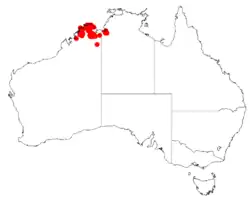 | |
| Occurrence data from AVH | |
| Synonyms[1] | |
|
Racosperma kelleri (F.Muell.) Pedley | |
Acacia kelleri is a species of flowering plant in the family Fabaceae and is endemic to a small area in the north-west of Australia. It is a shrub or tree with linear or very narrowly lance-shaped phyllodes, spikes of dense, deep yellow flowers and leathery, glabrous pods, appearing somewhat like a string of beads.
Description
Acacia kelleri is a shrub or tree that typically grows to a height of up to 7 m (23 ft) with fissured grey bark, weeping branches and terete, light brown branchlets covered with soft hairs. Its phyllodes are crowded, erect, linear or very narrowly lance-shaped, 10–25 mm (0.39–0.98 in) long, 0.7–2.5 mm (0.028–0.098 in) wide and straight or slightly curved. There is a slightly off-centre midvein and a gland 2–4 mm (0.079–0.157 in) above the pulvinus. The flowers are borne in spikes 13–45 mm (0.51–1.77 in) long with dense, deep yellow flowers. Flowering occurs from March to August, and the pods are more or less terete, up to about 110 mm (4.3 in) long, 3–5 mm (0.12–0.20 in) wide, glabrous and leathery, appearing somewhat like a string of beads. The seeds are 4.5–6 mm (0.18–0.24 in) long, shiny dark brown to black with an aril on the end.[2][3][4]
Taxonomy
Acacia kelleri was first formally described in 1892 by the Ferdinand von Mueller in Proceedings of the Linnean Society of New South Wales from specimens collected near the Durack River by Joseph Bradshaw.[5][6] The specific epithet (kelleri) honours Heinrich Keller (1826–1890) of Darmstadt, "one of the leading promoters or rural culture during the latter half of this century through many parts of the world".[6] After its discovery, several specimens of the plant were sent by the director of the botanical garden in Melbourne to its namesake in Darmstadt in 1892.[7]
Distribution and habitat
This wattle is usually associated with sandstone, often on escarpments or ridges in the Central Kimberley, Northern Kimberley and Victoria Bonaparte bioregions of north-western of Western Australia[2][8] and in a small area west of the Victoria River in the far north-west of the Northern Territory.[9]
Conservation status
Acacia kelleri is listed as 'not threatened' by the Government of Western Australia Department of Parks and Wildlife,[8] but as 'near threatened' under the Northern Territory Government Territory Parks and Wildlife Conservation Act.[9]
See also
References
- 1 2 "Acacia kelleri". Australian Plant Census. Retrieved 6 July 2026.
- 1 2 Tindale, Mary D.; Kodela, Phillip G. "Acacia kelleri". Flora of Australia. Australian Biological Resources Study, Department of Climate Change, Energy, the Environment and Water: Canberra. Retrieved 7 July 2026.
- ↑ Tindale, Mary D.; Kodela, Phillip G. "Acacia kelleri". Australian Biological Resources Study. Retrieved 7 July 2026.
- ↑ "Acacia kelleri". World Wide Wattle. CSIRO. Retrieved 20 September 2018.
- ↑ "Acacia kelleri". Australian Plant Name Index. Retrieved 7 July 2026.
- 1 2 Mueller, Ferdinand von (1892). "Observations on plants, collected during Mr Joseph Bradshaw's expedition to the Prince Regent's river". Proceedings of the Linnean Society of New South Wale Series 2s. 6 (3): 468–469. Retrieved 7 July 2026.
- ↑ Berliner Börsen-Zeitung, Morgen-Ausgabe, 04.09.1892, p. 11
- 1 2 "Acacia kelleri". FloraBase. Western Australian Government Department of Biodiversity, Conservation and Attractions.
- 1 2 "Acacia kelleri". Northern Territory Government. Retrieved 7 July 2026.