Acacia juncifolia
| Rush-leaf wattle | |
|---|---|
 | |
| North of Yengarie | |
Scientific classification  | |
| Kingdom: | Plantae |
| Clade: | Embryophytes |
| Clade: | Tracheophytes |
| Clade: | Angiosperms |
| Clade: | Eudicots |
| Clade: | Rosids |
| Order: | Fabales |
| Family: | Fabaceae |
| Subfamily: | Caesalpinioideae |
| Clade: | Mimosoid clade |
| Genus: | Acacia |
| Species: | A. juncifolia |
| Binomial name | |
| Acacia juncifolia | |
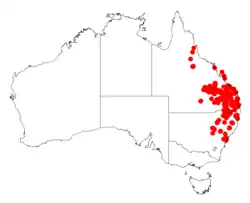 | |
| Occurrence data from AVH | |
| Synonyms[1] | |
| |
Acacia juncifolia, commonly known as rush-leaf wattle,[2] is a species of flowering plant in the family Fabaceae and is endemic to eastern Australia. It is an erect or spreading, somewhat spindly shrub, with rigid, linear, thread-like phyllodes, spherical heads of pale yellow to deep buttercup flowers, and firmly papery to thinly leathery pods raised over the seeds.
Description
Acacia juncifolia is an erect or spreading, somewhat spindly shrub that typically grows to a height of up to 3 m (9.8 ft) and has glabrous, slender, reddish-brown branchlets. Its phyllodes are ascending to erect and thread-like, straight to slightly curved, terete to four-sided in cross section, 70–120 mm (2.8–4.7 in) long and about 1 mm (0.039 in) wide. There is a gland 2–8 mm (0.079–0.315 in) above the pulvinus. The flowers are usually borne in one or two spherical heads in axils on glabrous peduncles 4–12 mm (0.16–0.47 in) long, each head with 20 to 30 pale yellow to deep buttercup yellow flowers. Flowering occurs from June to November, and the pods are up to 100 mm (3.9 in) long and 3–4 mm (0.12–0.16 in) wide, firmaly papery to thinly leathery, prominently raised over the seeds and slightly to moderately constricted between them. The seeds are oblong, 3.5–4.5 mm (0.14–0.18 in) long, mottled dull black and yellow without an aril.[2][3][4][5]
Taxonomy
Acacia juncifolia was first formally described in 1842 by George Bentham in Hooker's London Journal of Botany.[6][7] The specific epithet (juncifolia) is taken from the Latin words juncus meaning 'rush' and folium meaning 'leaf' in reference to the rush-like appearance of the phyllodes. A. juncifolia has a similar appearance to Acacia calamifolia.[2]
Distribution and habitat
Rush-leaf wattle grows in shallow sand derived from sandstone, sometimes granite, in forest or woodland from near Port Clinton in Queensland to near Glenbrook in New South Wales, and inland for a maximum of 550 km (340 mi) inland.[2][3]
Conservation status
Acacia juncifolia is listed as 'least concern' under the Queensland Government Nature Conservation Act 1992.[8]
See also
References
- 1 2 "Acacia juncifolia". Australian Plant Census. Retrieved 5 July 2026.
- 1 2 3 4 "Acacia juncifolia Benth". PlantNet. Royal Botanic Garden, Sydney. Retrieved 26 June 2020.
- 1 2 Maslin, Bruce R.; Kodela, Phillip G. "Acacia juncifolia". Flora of Australia. Australian Biological Resources Study, Department of Climate Change, Energy, the Environment and Water: Canberra. Retrieved 5 July 2026.
- ↑ Maslin, Bruce R. "Acacia juncifolia". Australian Biological Resources Study. Retrieved 5 July 2026.
- ↑ "Acacia juncifolia". World Wide Wattle. Western Australian Herbarium. Retrieved 14 May 2019.
- ↑ "Acacia juncifolia". Australian Plant Name Index. Retrieved 4 July 2026.
- ↑ Bentham, George (1842). Hooker, William Jackson (ed.). "Notes on Mimoseae, with a synopsis of species". London Journal of Botany. 1: 341. Retrieved 5 July 2026.
- ↑ "Taxon - Acacia juncifolia". Queensland Government WildNet. Retrieved 5 July 2026.