Acacia johnsonii
| Gereera wattle | |
|---|---|
Scientific classification  | |
| Kingdom: | Plantae |
| Clade: | Embryophytes |
| Clade: | Tracheophytes |
| Clade: | Angiosperms |
| Clade: | Eudicots |
| Clade: | Rosids |
| Order: | Fabales |
| Family: | Fabaceae |
| Subfamily: | Caesalpinioideae |
| Clade: | Mimosoid clade |
| Genus: | Acacia |
| Species: | A. johnsonii |
| Binomial name | |
| Acacia johnsonii | |
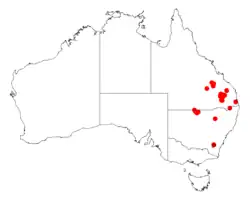 | |
| Occurrence data from AVH | |
| Synonyms[2] | |
| |
Acacia johnsonii, commonly known as gereera wattle, geereva wattle or Johnson's wattle,[2] is a species of flowering plant in the family Fabaceae and is endemic to eastern Australia. It is an erect or spreading shrub with many stems, linear to narrowly linear phyllodes, spherical heads of golden yellow flowers and firmly papery, reddish brown pods.
Description
Acacia johnsonii is an erect or spreading shrub with many stems, that typically grows to a height of 1.5–3 m (4 ft 11 in – 9 ft 10 in) and has slightly resinous, hairy branchlets. Its phyllodes are held horizontally to erect, linear to narrowly linear, 10–30 mm (0.39–1.18 in) long and 1–2 mm (0.039–0.079 in) wide, commonly narrowed at the base with an eccentric to oblique point. The phyllodes are green, more or less glabrous, with a more or less pronounced midrib and one or two minute glands. The flowers are borne in a spherical head in upper axils on a peduncle 4–6 mm (0.16–0.24 in) long, each head with mostly twenty to thirty slightly resinous golden yellow flowers. Flowering occurs from August to October, and the pods are up to 70 mm (2.8 in) long and 3–4 mm (0.12–0.16 in) wide, firmly papery, reddish brown and glabrous. The seeds are oblong, 2.5–4 mm (0.098–0.157 in) long with an oblique aril.[2][3][4][5]
Taxonomy
Acacia johnsonii was first formally described in 1980 by Leslie Pedley in the journal Austrobaileya on the Chinchilla–Auburn road 45 km (28 mi) north of Chinchilla by Robert William Johnson in 1963.[3][6][4] The specific epithet (johnsonii) honours the former Director of the Queensland Herbarium and the collector of the type specimen.[4]
Distribution and habitat
Gereera wattle occurs in south-eastern Queensland in the Chinchilla area and at Jericho, and is uncommon in New South Wales on the north-western plains near Enngonia. It often grows in sand in shrubby open forest or in sandplains in spinifex communities.[2][4]
Conservation status
Acacia johnsonii is listed as 'least concern' under the Queensland Government Nature Conservation Act 1992.[7]
See also
References
- ↑ "Acacia johnsonii". Australian Plant Census. Retrieved 3 July 2026.
- 1 2 3 4 Maslin, Bruce R. Kodela, Phillip G. (ed.). "Acacia johnsonii". Flora of Australia. Australian Biological Resources Study, Department of Climate Change, Energy, the Environment and Water: Canberra. Retrieved 3 July 2026.
- 1 2 Pedley, Leslie (1980). "A revision of Acacia Mill. in Queensland, Part 2". Austrobaileya. 1 (3): 245. Retrieved 3 July 2026.
- 1 2 3 4 Kodela, Phillip G.; Harden, Gwen J. "Acacia johnsonii". Royal Botanic Garden, Sydney. Retrieved 3 July 2026.
- ↑ "Acacia johnsonii Pedley". World Wide Wattle. Royal Botanic Garden, SydneyWestern Australian Herbarium. Retrieved 13 May 2019.
- ↑ "Acacia johnsonii". Australian Plant Name Index. Retrieved 3 July 2026.
- ↑ "Taxon Acacia johnsonii". Queensland Government WildNet. Retrieved 3 July 2026.