Acacia jibberdingensis
| Jibberding wattle | |
|---|---|
 | |
| In the Australian National Botanic Gardens | |
Scientific classification  | |
| Kingdom: | Plantae |
| Clade: | Embryophytes |
| Clade: | Tracheophytes |
| Clade: | Angiosperms |
| Clade: | Eudicots |
| Clade: | Rosids |
| Order: | Fabales |
| Family: | Fabaceae |
| Subfamily: | Caesalpinioideae |
| Clade: | Mimosoid clade |
| Genus: | Acacia |
| Species: | A. jibberdingensis |
| Binomial name | |
| Acacia jibberdingensis | |
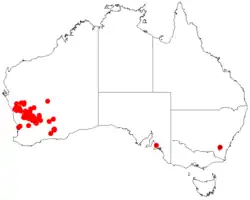 | |
| Occurrence data from AVH | |
| Synonyms | |
|
Racosperma jibberdingense (Maiden & Blakely) Pedley | |

Acacia jibberdingensis, also known as Jibberding wattle[2] or willow-leafed wattle,[3] is a species of flowering plant in the family Fabaceae and is endemic to the south-west of Western Australia. It is a usually a shrub or small tree with linear, straight to slightly curved, flat to terete phyllodes, spikes of golden yellow flowers and glabrous, thinly leathery pods, more or less resembling a string of beads.
Description
Acacia jibberdingensis is usually a shrub or small tree that typically grows to 1.5–7 m (4 ft 11 in – 23 ft 0 in) high, about 5 m (16 ft) wide[3] and has angled branchlets covered with soft hairs pressed against the surface. Its phyllodes are horizontal to ascending. linear, straight to slightly curved, flat to terete, 150–320 mm (5.9–12.6 in) long, 1.0–1.5 mm (0.039–0.059 in) wide and more or less glabrous with up to eight prominent veins. The flowers are golden yellow and usually arranged in a spike 20–35 mm (0.79–1.38 in) long and 6 mm (0.24 in) in diameter in axils, on a peduncle 6–11 mm (0.24–0.43 in) long. Flowering occurs from June to October and the pods are up to 210 mm (8.3 in) long and 5–7 mm (0.20–0.28 in) wide, glabrous and thinly leathery, appearing somewhat like a string of beads. The seeds are broadly elliptic, 4.5–5.5 mm (0.18–0.22 in) long and glossy black.[2][4][5][6][7]
Taxonomy
Acacia jibberdingensis was first formally described in 1927 by Joseph Maiden and William Blakely in the Journal of the Royal Society of Western Australia from specimens collected by Max Koch east of the 120-mile peg near Jibberding, north of Cunderdin, on the East Goldfield Railway in 1906.[4][8] The specific epithet (jibberdingensis) means 'native of Jibberding'.[9]
Distribution and habitat
Jibberding wattle has a scattered distribution from Mullewa and Jingemarra Station to Peak Charles National Park, with a single collection about 350 km (220 mi) east of Jingemarra Station,[2] in the Avon Wheatbelt, Coolgardie, Geraldton Sandplains, Mallee, Murchison, Swan Coastal Plain and Yalgoo bioregions of south-western Western Australia.[6] It mostly grows in loamy sand near granite outcrops in scrub and shrubland.[2]
Conservation status
Acacia jibberdingensis is listed as 'not threatened' by the Government of Western Australia Department of Biodiversity, Conservation and Attractions.[6]
Use in horticulture
It is available for cultivation in seed form but the seeds must be scarified prior to planting. It grows best in well-drained soils in a sunny position and is both frost and drought tolerant.[3]
See also
References
- ↑ "Acacia jibberdingensis". Australian Plant Census. Retrieved 1 July 2026.
- 1 2 3 4 Cowan, Richard S. Kodela, Phillip G. (ed.). "Acacia jibberdingensis". Flora of Australia. Australian Biological Resources Study, Department of Climate Change, Energy, the Environment and Water: Canberra. Retrieved 1 July 2026.
- 1 2 3 "Acacia jibberdingensis Willow-leafed Wattle". Wattle - genus Acacia. Australian National Botanical Gardens. Retrieved 12 August 2019.
- 1 2 Maiden, Joseph; Blakely, William F. (1927). "Descriptions of fifty new species and six varieties of western and northern Australian Acacias, and notes on four other species". Journal of the Royal Society of Western Australia. 13: 29. Retrieved 1 July 2026.
- ↑ Cowan, Richard S. Maslin, Bruce R.; Reid, Jordan (eds.). "Acacia jibberdingensis". Australian Biological Resources Study. Retrieved 1 July 2026.
- 1 2 3 "Acacia jibberdingensis". FloraBase. Western Australian Government Department of Biodiversity, Conservation and Attractions.
- ↑ "Acacia jibberdingensis". World Wide Wattle. Western Australian Herbarium. Retrieved 12 August 2019.
- ↑ "Acacia jibberdingensis". Australian Plant Name Index. Retrieved 27 June 2026.
- ↑ George, Alex S.; Sharr, Francis A. (2023). Western Australian Plant Names and Their Meanings - A Glossary (fifth ed.). Kardinya: Four Gables Press. p. 234. ISBN 9780645629538.