Acacia jensenii
| Acacia jensenii | |
|---|---|
Scientific classification  | |
| Kingdom: | Plantae |
| Clade: | Embryophytes |
| Clade: | Tracheophytes |
| Clade: | Angiosperms |
| Clade: | Eudicots |
| Clade: | Rosids |
| Order: | Fabales |
| Family: | Fabaceae |
| Subfamily: | Caesalpinioideae |
| Clade: | Mimosoid clade |
| Genus: | Acacia |
| Species: | A. jensenii |
| Binomial name | |
| Acacia jensenii | |
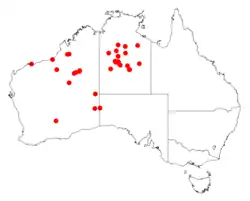 | |
| Occurrence data from AVH | |
| Synonyms | |
| |
Acacia jensenii is a species of flowering plant in the family Fabaceae and is endemic to north western Australia. It is a spindly, open shrub or tree with linear to narrowly elliptic phyllodes and heads of yellow flowers.
Description
Acacia jensenii is a spindly, open shrub or tree that typically grows to a height of 1–6 m (3 ft 3 in – 19 ft 8 in) and has one or two glabrous main stems at the base. Its phyllodes are straight or slightly curved, linear to narrowly lance-shaped, 25–60 mm (0.98–2.36 in) long, 3–6 mm (0.12–0.24 in) wide and end in a small point. The midrib and lateral veins are somewhat prominent and there is a gland at the base of the phyllode. The flowers are yellow and usually borne in axils on a peduncle up to 25 mm (0.98 in) long. Flowering occurs from May to August and the (immature) pods are 7–8 mm (0.28–0.31 in) wide.[2][3][4]
Taxonomy
Acacia jensenii was first formally described in 1917 by Joseph Maiden in the book The Flora of the Northern Territory from specimens collected in 1911.[2][5] The specific epithet (jensenii) honours Harold Ingomar Jensen, who, when government geologist of the Northern Territory, "collected the local flora, particularly Eucalyptus".[2]
Distribution and habitat
This species of wattle has a scattered distribution in the Coolgardie, Dampierland, Great Sandy Desert, Great Victoria Desert and Tanami bioregions of Western Australia[6] and in the Burt Plain, Davenport Murchison Ranges, Great Sandy Desert, Gulf Fall and Uplands, Sturt Plateau and Tanami bioregions of the Northern Territory.[7] In the Edgar Range in Western Australia it grows in sandstone gullies and at Lake Surprise in the Northern Territory, it grows on the upper slopes and crests of sand dunes.[3]
Conservation status
Acacia jensenii is listed as 'not threatened' by the Government of Western Australia Department of Parks and Wildlife,[6] and as 'least concern under the Northern Territory Government Territory Parks and Wildlife Conservation Act.[7]
See also
References
- ↑ "Acacia jensenii". Australian Plant Census. Retrieved 1 July 2026.
- 1 2 3 Maiden, Joseph; Ewart, Alfred James; Davies, Olive Blanche (1917). The flora of the Northern Territory. Melbourne: McCarron, Bird & Co. pp. 332–333. Retrieved 1 July 2026.
- 1 2 Maslin, Bruce R. "Acacia jensenii". Flora of Australia. Australian Biological Resources Study, Department of Climate Change, Energy, the Environment and Water: Canberra. Retrieved 1 July 2026.
- ↑ "Acacia jensenii". World Wide Wattle. Western Australian Herbarium. Retrieved 12 May 2019.
- ↑ "Acacia jensenii". Australian Plant Name Index. Retrieved 1 July 2026.
- 1 2 "Acacia jensenii". FloraBase. Western Australian Government Department of Biodiversity, Conservation and Attractions.
- 1 2 "Acacia jensenii". Northern Territory Government. Retrieved 1 July 2026.