Acacia jacksonioides
| Acacia jacksonioides | |
|---|---|
 | |
Scientific classification  | |
| Kingdom: | Plantae |
| Clade: | Embryophytes |
| Clade: | Tracheophytes |
| Clade: | Angiosperms |
| Clade: | Eudicots |
| Clade: | Rosids |
| Order: | Fabales |
| Family: | Fabaceae |
| Subfamily: | Caesalpinioideae |
| Clade: | Mimosoid clade |
| Genus: | Acacia |
| Subgenus: | Acacia subg. Phyllodineae |
| Species: | A. jacksonioides |
| Binomial name | |
| Acacia jacksonioides | |
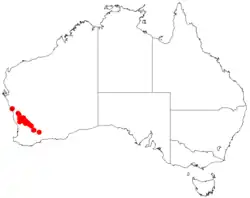 | |
| Occurrence data from AVH | |
| Synonyms[1] | |
|
Racosperma jacksonioides (Maslin) Pedley | |
Acacia jacksonioides is a species of flowering plant in the family Fabaceae and is endemic to the south-west of Western Australia. It is an intricate, glabrous shrub with many short, spiny, leafless branchlets, egg-shaped, elliptic or oblong phyllodes, spherical heads of light golden yellow flowers and thinly leathery, bow-shaped or coiled pods raised over the seeds.
Description
Acacia jacksonioides is an intricate, glabrous shrub typically grows to a height of 20–70 cm (7.9–27.6 in) and has many short, spiny, leafless, ridged branchlets that are usually covered with a white, powdery bloom. Its phyllodes are egg-shaped to narrowly egg-shaped, elliptic or almost oblong, 3.5–10 mm (0.14–0.39 in) long, 2.5–5 mm (0.098–0.197 in) wide, often wavy and more or less glaucous with a more or less prominent mid-rib. The flowers are borne in a spherical head in axils on a peduncle 3–6 mm (0.12–0.24 in) long, each head 3.5–4.5 mm (0.14–0.18 in) in diameter with 10 to 14 light golden yellow flowers. The pods are up to 40 mm (1.6 in) long and 3.0–3.5 mm (0.12–0.14 in) wide, strongly bow-shaped to openly coiled, thinly leathery and raised over the seeds alternately on each side. The seeds are oblong, 2.0–2.5 mm (0.079–0.098 in) long, shiny mottled brown with an aril on the end.[2][3][4][5]
Taxonomy
Acacia jacksonioides was first formally described in 1976 by Bruce Maslin from specimens he found near the Nalyaring Well, 20 km (12 mi) north of Kellerberrin towards Yelbeni in 1970.[2][6] The specific epithet (jacksonioides) means 'like Jacksonia", referring to the species' branching habit.[7]
Distribution
This species of wattle grows in gravelly sand or loam, often on hilltops in scrub, shrubland or woodland from near Three Springs to south-east of Hyden, with a disjunct occurrence east of Geraldton, in the Avon Wheatbelt, Geraldton Sandplains, Mallee and Swan Coastal Plain bioregions of south-western Western Australia.[8]
Conservation status
Acacia jacksonioides is listed as 'not threatened' by the Government of Western Australia Department of Parks and Wildlife.[8]
See also
References
- 1 2 "Acacia jacksonioides". Australian Plant Census. Retrieved 29 June 2026.
- 1 2 Maslin, Bruce R. (1976). "Studies in the genus Acacia (Mimosaceae) - 5 - Miscellaneous new phyllodinous species". Nuytsia. 2 (2): 99–100. Retrieved 30 June 2026.
- ↑ Maslin, Bruce R. "Acacia jacksonioides". Australian Biological Resoures Study. Retrieved 30 June 2026.
- ↑ Maslin, Bruce R. "Acacia jacksonioides". Flora of Australia. Australian Biological Resources Study, Department of Climate Change, Energy, the Environment and Water: Canberra. Retrieved 30 June 2026.
- ↑ "Acacia jacksonioides". World Wide Wattle. Western Australian Herbarium. Retrieved 12 August 2019.
- ↑ "Acacia jacksonioides". Australian Plant Name Index. Retrieved 30 June 2026.
- ↑ Sharr, Francis Aubi; George, Alex (2021). Western Australian Plant Names and Their Meanings (4th ed.). Kardinya, WA: Four Gables Press. p. 233. ISBN 9780958034180.
- 1 2 "Acacia jacksonioides". FloraBase. Western Australian Government Department of Biodiversity, Conservation and Attractions.