Acacia ixodes
| Motherumbung | |
|---|---|
 | |
| In the Australian National Botanic Gardens | |
Scientific classification  | |
| Kingdom: | Plantae |
| Clade: | Embryophytes |
| Clade: | Tracheophytes |
| Clade: | Angiosperms |
| Clade: | Eudicots |
| Clade: | Rosids |
| Order: | Fabales |
| Family: | Fabaceae |
| Subfamily: | Caesalpinioideae |
| Clade: | Mimosoid clade |
| Genus: | Acacia |
| Species: | A. ixodes |
| Binomial name | |
| Acacia ixodes | |
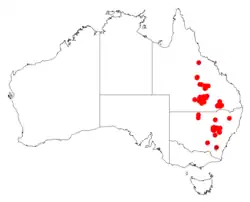 | |
| Occurrence data from AVH | |
| Synonyms | |
Acacia ixodes, commonly known as motherumbung,[2] is a species of flowering plant in the family Fabaceae and is endemic to eastern Australia. It is a glabrous, bushy shrub or small tree with narrowly oblong to lance-shaped phyllodes with the narrower end towards the base, spherical heads of bright golden yellow flowers and firmly leathery, narrowly oblong to linear pods rounded over the seeds.
Description
Acacia ixodes is a glabrous, slightly resinous, bushy shrub or small tree that typically grows to a height of 5–8 m (16–26 ft) and has slender branchlets. Its phyllodes are usually narrowly oblong to lance-shaped or narrowly lance-shaped with the narrower end towards the base, mostly straight, 20–50 mm (0.79–1.97 in) long and usually 3–6 mm (0.12–0.24 in) wide with a thickened point on the tip. The midrib is not prominent and there is a minute gland 1–3 mm (0.039–0.118 in) above the pulvinus and another at the tip. The flowers are arranged in a spherical head in axils on a peduncle 5–12 mm (0.20–0.47 in) long, each head with 20 to 30 showy, bright golden yellow flowers. Flowering occurs from August to November, and the pods are narrowly oblong to linear, up to 60 mm (2.4 in) long and usually 5–8 mm (0.20–0.31 in) wide, firmly leathery and rounded over the seeds. The seeds are oblong to elliptic or egg-shaped, 3–4 mm (0.12–0.16 in) long with an oblique aril.[2][3][4][5]
Taxonomy
This species was first formally described in 1905 by Joseph Maiden and Ernst Betche, who gave it the name Acacia gnidium var. latifolia in Proceedings of the Linnean Society of New South Wales from specimens collected near Gilgandra by Richard Hind Cambage.[6][7] In 1980, Leslie Pedley raised the variety to species status as A. ixodes in the journal Austrobaileya.[8] The specific epithet (ixodes) is a reference to the sticky nature of new shoots and young phyllodes.[5]
Distribution and habitat
This species of wattle grows on sandy soils, often with Eucalyptus melanophloia and Callitris columellaris, from west of Charleville to north of Bungunya in southern inland Queensland[3] and from Dubbo to Gilgandra and near Mendooran in central New South Wales, with older records from near Bourke.[5]
Conservation status
Acacia ixodes is listed as 'least concern' under the Queensland Government Nature Conservation Act 1992.[9]
See also
References
- ↑ "Acacia ixodes". Australian Plant Census. Retrieved 28 June 2026.
- 1 2 Maslin, Bruce R. Kodela, Phillip G. (ed.). "Acacia ixodes". Flora of Australia. Australian Biological Resources Study, Department of Climate Change, Energy, the Environment and Water: Canberra. Retrieved 28 June 2026.
- 1 2 Pedley, Leslie (1980). "A revision of Acacia Mill. in Queensland, Part 2". Austrobaileya. 1 (3): 256. Retrieved 28 June 2026.
- ↑ Maslin, Bruce R. "Acacia ixodes". Australian Biological Resources Study. Retrieved 28 June 2026.
- 1 2 3 Kodela, Phillip G. "Acacia ixodes". Royal Botanic Garden, Sydney. Retrieved 28 June 2026.
- ↑ "Acacia gnidium var. latifolia". Australian Plant Name Index. Retrieved 28 June 2026.
- ↑ Maiden, Joseph; Betche, Ernst (1905). "Notes from the Botanic Gardens, Sydney No. 11". Proceedings of the Linnean Society of New South Wales. 30 (3): 362–363. Retrieved 28 June 2026.
- ↑ "Acacia ixodes". Australian Plant Name Index. Retrieved 30 June 2026.
- ↑ "Acacia ixodes". Queensland Government WildNet. Retrieved 28 June 2026.