Acacia inops
| Acacia inops | |
|---|---|
Scientific classification  | |
| Kingdom: | Plantae |
| Clade: | Embryophytes |
| Clade: | Tracheophytes |
| Clade: | Angiosperms |
| Clade: | Eudicots |
| Clade: | Rosids |
| Order: | Fabales |
| Family: | Fabaceae |
| Subfamily: | Caesalpinioideae |
| Clade: | Mimosoid clade |
| Genus: | Acacia |
| Species: | A. inops |
| Binomial name | |
| Acacia inops | |
| Synonyms[1] | |
|
Racosperma inops (Maiden & Blakely) Pedley | |
Acacia inops is a species of flowering plant in the family Fabaceae and is endemic to a restricted part of the south-west of Western Australia. It is a scrambling shrub with weak, thread-like branches, more or less sessile narrowly triangular, sharply pointed phyllodes, and spherical heads of cream-coloured to white flowers.
Description
Acacia inops is a weak, scrambling shrub that typically grows to a height of 0.4–1.1 m (1 ft 4 in – 3 ft 7 in) and has thread-like branches, its branchlets usually glabrous and green. The phyllodes are more or less sessile, narrowly triangular and turned downwards, 5–7 mm (0.20–0.28 in) long and 0.5–1 mm (0.020–0.039 in) wide, sharply pointed and glabrous. There are stipules 1–2 mm (0.039–0.079 in) long and a gland on a short, blunt spur at the base of the phyllode, and a central midvein. The flowers are borne in a spherical head in axils on a slender peduncle 3–5 mm (0.12–0.20 in) long, each head with five to nine cream-coloured to white flowers.[2][3][4]
Taxonomy
Acacia inops was first formally described in 1928 by the botanists Joseph Maiden and William Blakely in the Journal of the Royal Society of Western Australia.[5][6] The specific epithet (inops) means 'poor' or 'weak'.[7]
Distribution and habitat
This species of wattle grows in and around swamps and creek-lines in black peaty sand or clay and is restricted to areas around Margaret River in the Jarrah Forest and Warren bioregions of south-western Western Australia.[8]
Conservation status
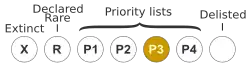
Acacia inops is listed as "Priority Three" by the Government of Western Australia Department of Parks and Wildlife,[9] meaning that it is poorly known and known from only a few locations but is not under imminent threat.[10]
See also
References
- 1 2 "Acacia inops". Australian Plant Census. Retrieved 27 June 2026.
- ↑ Maslin, Bruce R. Kodela, Phillip G. (ed.). "Acacia inops". Flora of Australia. Australian Biological Resources Study, Department of Climate Change, Energy, the Environment and Water: Canberra. Retrieved 27 June 2026.
- ↑ Maslin, Bruce R. Rogers, J. (ed.). "Acacia inops". Australian Biological Resources Study. Retrieved 27 June 2026.
- ↑ "Acacia inops". World Wide Wattle. Western Australian Herbarium. Retrieved 13 May 2019.
- ↑ "Acacia inops". Australian Plant Name Index. Retrieved 27 June 2026.
- ↑ Blakely, William F. (1927). "Descriptions of fifty new species and six varieties of western and northern Australian Acacias, and notes on four other species". Journal of the Royal Society of Western Australia. 13: 4–5. Retrieved 27 June 2026.
- ↑ George, Alex S.; Sharr, Francis A. (2023). Western Australian Plant Names and Their Meanings - A Glossary (fifth ed.). Kardinya: Four Gables Press. p. 230. ISBN 9780645629538.
- ↑ "Acacia inops". FloraBase. Western Australian Government Department of Biodiversity, Conservation and Attractions.
- ↑ Cite error: The named reference
FBwas invoked but never defined (see the help page). - ↑ "Conservation codes for Western Australian Flora and Fauna" (PDF). Government of Western Australia Department of Parks and Wildlife. Retrieved 27 June 2026.