Acacia inophloia
| Fibre-barked wattle | |
|---|---|
 | |
| In Kings Park | |
Scientific classification  | |
| Kingdom: | Plantae |
| Clade: | Embryophytes |
| Clade: | Tracheophytes |
| Clade: | Angiosperms |
| Clade: | Eudicots |
| Clade: | Rosids |
| Order: | Fabales |
| Family: | Fabaceae |
| Subfamily: | Caesalpinioideae |
| Clade: | Mimosoid clade |
| Genus: | Acacia |
| Species: | A. inophloia |
| Binomial name | |
| Acacia inophloia | |
 | |
| Occurrence data from AVH | |
| Synonyms[1] | |
|
Racosperma inophloia (Maiden & Blakely) Pedley | |
Acacia inophloia, commonly known as fibre-barked wattle,[2] is a species of flowering plant in the family Fabaceae and is endemic to the south-west of Western Australia. It is a shrub or tree with Minni ritchi bark, thread-like phyllodes, oblong to cylindrical heads of golden yellow flowers and thinly leathery, linear pods slightly raised over the seeds.
Description
Acacia inophloia is a shrub or tree that typically grows to a height of 1–3.5 m (3 ft 3 in – 11 ft 6 in) and has stringy, shaggy bark, more or less Minni Ritchi bark on the upper branches. The new shoots are bright yellow-green and more or less sticky. The branchlets are resinous and covered with silky hairs. Its phyllodes are thread-like, gently curved and terete, 60–155 mm (2.4–6.1 in) long, 0.6–0.8 mm (0.024–0.031 in) wide and greyish green with eight fine, closely parallel veins, obscured by silky hairs. The flowers are borne in an oblong to cylindrical head 8–20 mm (0.31–0.79 in) long and 4–6 mm (0.16–0.24 in) wide in axils, on a peduncle 0.7–2 mm (0.028–0.079 in) long and covered with golden hairs pressed against the surface. Each head has 50 to 76 golden yellow flowers. Flowering occurs from August to October, and the pods are linear, slightly curved, up to 80 mm (3.1 in) long and 2.5–4.0 mm (0.098–0.157 in) wide, thinly leathery and densely covered with woolly hairs. The seeds are broadly elliptic or oblong, 3.0–3.5 mm (0.12–0.14 in) long, glossy mottled brown with an aril, a thin flap of tissue.[2][3][4]
Taxonomy
Acacia inophloia was first formally described in 1928 by Joseph Maiden and William Blakely in the Journal of the Royal Society of Western Australia from specimens collected near Bendering by Charles Gardner.[5][6] The specific epithet (inophloia) refers to the fibrous-stringy bark.[7]
Distribution
Fibre-barked wattle grows in gravelly, sandy and loamy granitic soils and is restricted to areas north and east of Kondinin, with a single collection near Moora in the Avon Wheatbelt, Coolgardie, Mallee and Swan Coastal Plain bioregions in the inland of south-western Western Australia.[8]
Conservation status
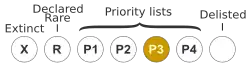
Acacia inophloia is listed as "Priority Three" by the Government of Western Australia Department of Parks and Wildlife,[8] meaning that it is poorly known and known from only a few locations but is not under imminent threat.[9]
See also
References
- 1 2 "Acacia inophloia". Australian Plant Census. Retrieved 27 June 2026.
- 1 2 "Acacia inophloia". World Wide Wattle. CSIRO. Retrieved 19 September 2018.
- ↑ Cowan, Richard S.; Maslin, Bruce R. Kodela, Phillip G. (ed.). "Acacia inophloia". Flora of Australia. Australian Biological Resources Study, Department of Climate Change, Energy, the Environment and Water: Canberra. Retrieved 27 June 2026.
- ↑ Cowan, Richard S.; Maslin, Bruce R. Reid, Jordan (ed.). "Acacia inophloia". Australian Biological Resources Study. Retrieved 27 June 2026.
- ↑ "Acacia inophloia". Australian Plant Name Index. Retrieved 27 June 2026.
- ↑ Blakely, William F. (1927). "Descriptions of fifty new species and six varieties of western and northern Australian Acacias, and notes on four other species". Journal of the Royal Society of Western Australia. 13: 25. Retrieved 27 June 2026.
- ↑ George, Alex S.; Sharr, Francis A. (2023). Western Australian Plant Names and Their Meanings - A Glossary (fifth ed.). Kardinya: Four Gables Press. p. 229. ISBN 9780645629538.
- 1 2 "Acacia inophloia". FloraBase. Western Australian Government Department of Biodiversity, Conservation and Attractions.
- ↑ "Conservation codes for Western Australian Flora and Fauna" (PDF). Government of Western Australia Department of Parks and Wildlife. Retrieved 27 May 2026.