Acacia inaequilatera
| Kanji bush | |
|---|---|
 | |
| Habit | |
Scientific classification  | |
| Kingdom: | Plantae |
| Clade: | Embryophytes |
| Clade: | Tracheophytes |
| Clade: | Angiosperms |
| Clade: | Eudicots |
| Clade: | Rosids |
| Order: | Fabales |
| Family: | Fabaceae |
| Subfamily: | Caesalpinioideae |
| Clade: | Mimosoid clade |
| Genus: | Acacia |
| Species: | A. inaequilatera |
| Binomial name | |
| Acacia inaequilatera | |
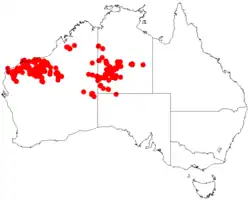 | |
| Occurrence data from AVH | |
| Synonyms[1] | |
|
Racosperma inaequilaterum (Domin) Pedley | |


Acacia inaequilatera, commonly known as kanji bush, baderi,[2] camel bush, fire wattle, kanyji bush or ranji bush[3] is a tree in the family Mimosaceae. Endemic to Australia, it is widely distributed in the semi-arid Triodia country eastwards from Karratha, Western Australia into the Northern Territory.
Description
Kanji bush is a gnarled tree or shrub with a single trunk,[3] corky bark, spiny foliage and stems. It grows to a height of between 2 and 5 m (6 ft 7 in and 16 ft 5 in) but can reach as high as 8 m (26 ft).[2] It has thick, rough, corky, dark grey to black coloured bark on the main trunk that is often scarred by fire.[3] Its phyllodes are a blue-grey and leathery with a curved midrib and a short spine at the tip. The phyllodes are asymmetrically egg-shaped to elliptic, 15–70 mm (0.59–2.76 in) long and 6–45 mm (0.24–1.77 in) wide and there is a spiny stipule at the base of the phyllodes.[3][4]
Unusually for Acacia species, the flowers are not pure yellow, but rather yellow with a reddish purple centre. The flowers occur between May and October[2] are borne in spherical clusters about 5 mm (0.20 in) in diameter. The pods are flat and curved, up to 10 cm (3.9 in) long and 1 cm (0.39 in) wide. They can be strongly curved to coiled and are raised high over the seeds and slightly constricted between. The pods have a pale maroon colour when young but deepen to a mid-brown or pinkish-purplish brown as they age. The dull dark brown seeds within are arranged longitudinally oblique within the pod. Each seed has a length of 4 to 6 m (13 to 20 ft) and has an obloid to globose shape.[3][4]
Kanji bush is very fire tolerant and colonises rapidly after a bushfire. It is able to regenerate from or and resprout from the base or epicormically It is short-lived, lasting less than ten years.[3]
Taxonomy
Acacia inaequilatera was first formally described by the botanist Karel Domin in 1926 in Bibliotheca Botanica from specimens collected near the Ashburton and Yule Rivers.[5] The specific epithet is derived from the Latin word inaequilatera meaning with unequal sides, referring to the very asymmetric phyllodes.[4] A. inaequilerata is closely related to Acacia trudgeniana and has inflorescences and phyllodes resembling those of Acacia marramamba, it is also often confused with Acacia pyrifolia.[6]
Distribution
It has a scattered distribution throughout arid areas of the north western tip of South Australia,[6] the south western parts of the Northern Territory[7]and the Pilbara and southern parts of the Kimberley regions of Western Australia where it is found on rocky hillsides, stony hills and plains growing in sandy to loamy stony soils.[2] It is often part of tall shrubland communities with a spinifex understorey.[6]
Uses
Indigenous Australians used the seeds of the plant as raw bush tucker or after roasting over a fire or grinding the seeds into a flour and preparing as damper. After grinding the seeds can also be used to make a beverage resembling coffee. The seeds, as for most Acacia are quite nutritious and contain around 26% protein, 2% carbohydrate and 9% fat Acacia seeds are highly nutritious and contain around 26% protein, 26% available carbohydrate, 32% fibre and 9% fat. An edible gum also exudes from the trunk and branches. The bark was also used for medicinal purposes to treat skin complains and sores by boiling in water or using the ash from burning it in fire. The tannins leached out of the bark in water make an astringent solution which were taken to treat diarrhoea and dysentery.[8]
See also
References
- 1 2 "Acacia inaequilatera". Australian Plant Census. Retrieved 5 June 2026.
- 1 2 3 4
- "Acacia inaequilatera". FloraBase. Western Australian Government Department of Biodiversity, Conservation and Attractions.
- 1 2 3 4 5 6 "Acacia inaequilatera". Australian Biological Resources Study. Retrieved 5 June 2026.
- 1 2 3 Maslin, Bruce R. "Acacia inaequilatera". Flora of Australia. Australian Biological Resources Study, Department of Climate Change, Energy, the Environment and Water: Canberra. Retrieved 5 June 2026.
- ↑ "Acacia inaequilatera". Australian Plant Name Index. Retrieved 5 June 2026.
- 1 2 3 Bruce Maslin. "Acacia inaequilatera Domin". Wattles: Acacias of Australia. Department of Environment and Energy. Retrieved 22 January 2019.
- ↑ "Acacia inaequilatera". Northern Territory Government. Retrieved 5 June 2026.
- ↑ Ken Fern. "Acacia inaequilatera". Useful Tropical Plants. Tropical Plants Database. Retrieved 22 January 2019.
External links

- Mitchell, A. A.; Wilcox, D. G. (1994). Arid Shrubland Plants of Western Australia, Second and Enlarged Edition. University of Western Australia Press, Nedlands, Western Australia. ISBN 978-1-875560-22-6.