Acacia improcera
| Acacia improcera | |
|---|---|
Scientific classification  | |
| Kingdom: | Plantae |
| Clade: | Embryophytes |
| Clade: | Tracheophytes |
| Clade: | Angiosperms |
| Clade: | Eudicots |
| Clade: | Rosids |
| Order: | Fabales |
| Family: | Fabaceae |
| Subfamily: | Caesalpinioideae |
| Clade: | Mimosoid clade |
| Genus: | Acacia |
| Species: | A. improcera |
| Binomial name | |
| Acacia improcera | |
| Synonyms[1] | |
|
Racosperma improcerum (Maslin) Pedley | |
Acacia improcera is a species of flowering plant in the family Fabaceae and is endemic to the south-west of Western Australia. It is a spreading, spiny shrub with ribbed branches, obliquely egg-shaped to elliptic phyllodes, spherical heads of light golden yellow flowers, and rounded, firmly papery to thinly leathery pods.
Description
Acacia improcera is a spreading, spiny shrub that typically grows to a height of 15–40 cm (5.9–15.7 in) high and has striated and finely ribbed branches, waxy white between the ribs and covered with minute, rigid, soft hairs. Its phyllodes are obliquely egg-shaped, 3–6 mm (0.12–0.24 in) long and 1.5–3.5 mm (0.059–0.138 in) wide with a scarcely prominent midrib and few or no lateral veins. The flowers are borne in a spherical head in axils on a glabrous peduncle 2.5–4 mm (0.098–0.157 in) long, with nine to eleven light golden yellow flowers. Flowering occurs in August and the pods are rounded over the seeds and variably constricted between them, curved, up to 30 mm (1.2 in) long and 4 mm (0.16 in) wide and firmly papery to thinly leathery. The seeds are widely egg-shaped, 3 mm (0.12 in) long and mostly shiny dark brown with an aril about 3/4 the length of the seed.[2][3][4]
Taxonomy
Acacia improcera was first formally described in 1999 by Bruce Maslin in the journal Nuytsia from specimens he collected 50 km (31 mi) east-north-east of Grass Patch in 1985.[2][3][5] The specific epithet (improcera) is derived from Latin word meaning 'very tall' with the prefix 'contrary', referring to the plant's small stature.[2]
Distribution and habitat
This species of wattle grows in clay, rocky loam or sand in the zone between heath and scrub mallee, from Lake King to the Bremer Range (about 105 km (65 mi) west-south-west of Norseman), through Frank Hann National Park, and near Ravensthorpe and Sheoak Hill (about 80 km (50 mi) north-east of Esperance) in the Coolgardie, Esperance Plains and Mallee bioregions in the south-west of Western Australia.[2][3][6]
Conservation status
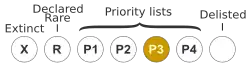
Acacia improcera is listed as "Priority Three" by the Government of Western Australia Department of Biodiversity, Conservation and Attractions,[6] meaning that it is poorly known and known from only a few locations but is not under imminent threat.[7]
See also
References
- 1 2 "Acacia improcera". Australian Plant Census. Retrieved 3 June 2026.
- 1 2 3 4 Maslin, Bruce R. (1999). "Acacia miscellany 16. The taxonomy of fifty-five species of Acacia, primarily Western Australian, in section Phyllodineae (Leguminosae: Mimosoideae)". Nuytsia. 12 (3): 359–361. Retrieved 3 June 2026.
- 1 2 3 Maslin, Bruce R. "Acacia improcera". Flora of Australia. Australian Biological Resources Study, Department of Climate Change, Energy, the Environment and Water: Canberra. Retrieved 3 June 2026.
- ↑ "Acacia improcera Maslin". Wattle - Acacias of Australia. CSIRO publishing. Retrieved 17 June 2020.
- ↑ "Acacia improcera". Australian Plant Name Index. Retrieved 3 June 2026.
- 1 2 "Acacia improcera". FloraBase. Western Australian Government Department of Biodiversity, Conservation and Attractions.
- ↑ "Conservation codes for Western Australian Flora and Fauna" (PDF). Government of Western Australia Department of Parks and Wildlife. Retrieved 3 Jun 2026.