Abidi alkyne synthesis
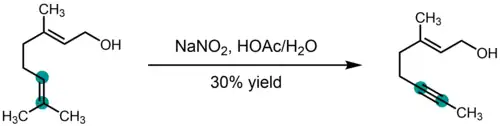
In organic chemistry, the Abidi alkyne synthesis or the Abidi transformation is an organic reaction whereby an 1,1-dimethyl-2-alkyl substituted alkene (i.e., an isopropylidene olefin) is converted by sodium nitrite in acetic acid/water solvent to give a methyl alkyl alkyne through the net loss of a hydrogen atom and a methyl group, the elements of methane. It is therefore described as a demethanation. The reaction was first reported in 1985 as a serendipitous finding by S. L. Abidi, an analytical chemist at the National Fishery Research Laboratory (then part of the US Fish and Wildlife Service) in La Crosse, Wisconsin.[1][2]
The highly unusual transformation provoked considerable interest in its mechanism, which was subsequently studied by the groups of E. J. Corey and Samir Zard. The key intermediate is believed to be an allylic nitro compound, which undergoes further nitrosylation and cyclization steps. The methyl group is believed to be ultimately lost as CO2.[3] However, only a broad outline of the latter steps of the mechanism is currently known.[4][5]
It has been applied towards a number of total syntheses.[6][7][8][9]
References
- ↑ Abidi, S. L. (1985-01-01). "Nitrosative elimination of terpenyl alkanolamines leading to alkynyl N-nitroso-analogues". Journal of the Chemical Society, Chemical Communications (18): 1222–1223. doi:10.1039/C39850001222. ISSN 0022-4936.
- ↑ Abidi, S.L. (1986). "Ethylidyne alkynes from isopropylidene olefins". Tetrahedron Letters. 27 (3): 267–270. doi:10.1016/S0040-4039(00)83993-3. ISSN 0040-4039. Archived from the original on 2024-06-12.
- ↑ Corey, E. J.; Seibel, William L.; Kappos, John C. (1987-01-01). "Mechanism of the nitrous acid-induced dealkylation of trisubstituted (terminal isopropylidene) olefins to form acetylenes". Tetrahedron Letters. 28 (42): 4921–4924. doi:10.1016/S0040-4039(00)96659-0. ISSN 0040-4039.
- ↑ Boivin, Jean; Pillot, Eric; Williams, Alvin; Roger, Walter; Zard, Samir Z. (1995-05-08). "On the mechanism of the nitrous acid induced conversion of an isopropylidene group into an alkyne". Tetrahedron Letters. 36 (19): 3333–3336. doi:10.1016/0040-4039(95)00522-E. ISSN 0040-4039.
- ↑ Zard, Samir Z. (2012). "Some Aspects of the Chemistry of Nitro Compounds". Helvetica Chimica Acta. 95 (10): 1730–1757. doi:10.1002/hlca.201200324. ISSN 1522-2675.
- ↑ Gao, Peng; Xu, Peng-Fei; Zhai, Hongbin (2009-03-20). "Expeditious Construction of (+)-Mintlactone via Intramolecular Hetero-Pauson−Khand Reaction". The Journal of Organic Chemistry. 74 (6): 2592–2593. doi:10.1021/jo900045k. ISSN 0022-3263.
- ↑ Tan, Chuanzhen; Lin, Hongpeng; Wang, Yuan; Jia, Yanxing (2026-06-25). "Total Synthesis of (+)-Niduenes A and B". Journal of the American Chemical Society. doi:10.1021/jacs.6c08709. ISSN 0002-7863.
- ↑ Wang, Yuzhou; Darweesh, Ahmed F.; Zimdars, Patrick; Metz, Peter (2019-04-09). "An efficient synthesis of the guaiane sesquiterpene (−)-isoguaiene by domino metathesis". Beilstein Journal of Organic Chemistry. 15 (1): 858–862. doi:10.3762/bjoc.15.83. ISSN 1860-5397. PMC 6466796.
- ↑ Kraft, Philip; Berthold, Carola (February 2008). "(4 E ,8 Z )-12-Methyloxacyclotetradeca-4,8-dien-2-one and Its 7a-Homologue: Conformationally Constrained Double-Unsaturated Macrocyclic Musks by Ring-Closing Alkyne Metathesis". Synthesis. 2008 (4): 543–550. doi:10.1055/s-2008-1032135. ISSN 0039-7881.