Aaron's Rod (novel)
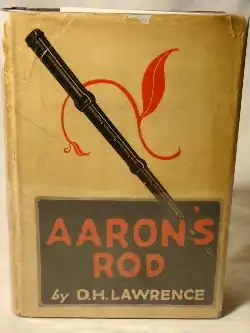 First edition (US, publ, Thomas Seltzer) | |
| Author | D. H. Lawrence |
|---|---|
| Language | English |
| Genre | Picaresque novel |
| Publisher | Thomas Seltzer |
| Publication date | 1922 |
| Publication place | United States |
| Media type | |
| OCLC | 1935128 |
Aaron's Rod is a picaresque novel by D. H. Lawrence, started in 1918 and published in 1922.
Background
The title refers to the rod of Aaron in the Old Testament, Moses' brother who built the Golden Calf in the desert for the worship of the Israelites. The rod, his divine symbol of authority and independence, finds its echo in the flute of Aaron Sisson.
Synopsis
Aaron Sisson, a union official in the coal mines of the English Midlands, is trapped in a stale marriage. He is also an amateur, but talented, flautist. At the start of the story he walks out on his wife and two children and decides on impulse to visit Italy. His dream is to become recognised as a professional musician. During his travels he encounters and befriends Rawdon Lilly, a Lawrence-like writer who nurses Aaron back to health when he is taken ill in post-war London. Having recovered his health, Aaron arrives in Florence. Here he moves in intellectual and artistic circles, argues about politics, leadership and submission, and has an affair with an aristocratic lady. The novel ends with an anarchist or fascist explosion that destroys Aaron’s instrument.
Publication history
Reception
People portrayed
According to Richard Aldington's Life for Life's Sake (1941), p. 375 (and also Aldington's Pinorman (1954), pp. 165, 185), the character James Argyle in Aaron's Rod is based on Norman Douglas. Aldington saw the character Lilly as Lawrence himself, and Aaron as John Middleton Murry; the relationship between Lilly and Aaron in the novel mirrors that of Lawrence and Murry.[1] According to Lawrence biographer Frances Wilson, Aldington himself is portrayed in Aaron's Rod: "Aldington is Robert Cunningham, 'a fresh, stoutish young Englishman in khaki.'"[2] Wilson adds that Aldington's wife, the poet H.D., is also portrayed in Aaron's Rod; she is Cunningham's wife Julia, "a tall stag of a thing ... hunched up like a witch".[3] Wilson also writes that Maurice Magnus is "recognizable ... as the mischievously named Little Mee in Aaron's Rod".[4] Another British writer, Reginald Turner, was the model for the character "little Algy Constable" in Aaron's Rod.[5]
References
- ↑ Aldington, Richard (1976). Aaron's Rod. Penguin. p. 8. ISBN 0140007555.
- ↑ Wilson, Frances, Burning Man: The Trials of D.H. Lawrence, New York: Farrar, Straus and Giroux, 2021, p. 138. ISBN 9780374282257.
- ↑ Burning Man, p. 138.
- ↑ Paul Dean, "D. H. Lawrence the adventurer: A review of Burning Man by Frances Wilson," The New Criterion, vol. 30, no. 1 (September 2021)
- ↑ Morchard, Bishop, "Gentlemanly Game", The Times Literary Supplement, 16 June 1966, p. 536.
External links

- Digital facsimile at the Internet Archive
 Aaron's Rod public domain audiobook at LibriVox