3-methyl-2-oxobutanoate dehydrogenase
| 3-methyl-2-oxobutanoate dehydrogenase (2-methylpropanoyl-transferring) | |||||||||
|---|---|---|---|---|---|---|---|---|---|
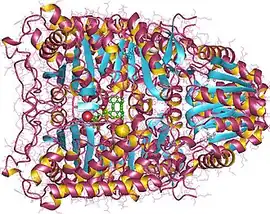 2-oxoisovalerate dehydrogenase heterotetramer, Human | |||||||||
| Identifiers | |||||||||
| EC no. | 1.2.4.4 | ||||||||
| CAS no. | 9082-72-8 | ||||||||
| Databases | |||||||||
| BRENDA | enzyme data | ||||||||
| ExPASy | NiceZyme view | ||||||||
| KEGG | enzyme entry | ||||||||
| MetaCyc | metabolic pathway | ||||||||
| Rhea | reactions | ||||||||
| PDB structures | RCSB PDB PDBe PDBsum | ||||||||
| Gene Ontology | AmiGO / QuickGO | ||||||||
| |||||||||
In enzymology, a 3-methyl-2-oxobutanoate dehydrogenase (EC 1.2.4.4) is an enzyme that catalyzes the chemical reaction
- 3-methyl-2-oxobutanoate + [dihydrolipoyllysine-residue (2-methylpropanoyl)transferase] lipoyllysine [dihydrolipoyllysine-residue (2-methylpropanoyl)transferase] S-(2-methylpropanoyl)dihydrolipoyllysine + CO2

The 3 substrates of this enzyme are 3-methyl-2-oxobutanoate, dihydrolipoyllysine-residue (2-methylpropanoyl)transferase, and lipoyllysine, whereas its 3 products are dihydrolipoyllysine-residue (2-methylpropanoyl)transferase, S-(2-methylpropanoyl)dihydrolipoyllysine, and CO2.
This enzyme belongs to the family of oxidoreductases, specifically those acting on the aldehyde or oxo group of donor with a disulfide as acceptor.
This enzyme participates in valine, leucine and isoleucine degradation. It employs one cofactor, thiamin diphosphate. It is the E1 subunit of a catalytic complex.
Structural studies
As of late 2007, twenty-nine structures have been solved for this class of enzymes, with PDB accession codes PDB: 1DTW, PDB: 1OLS, PDB: 1OLU, PDB: 1OLX, PDB: 1U5B, PDB: 1UM9, PDB: 1UMB, PDB: 1UMC, PDB: 1UMD, PDB: 1V11, PDB: 1V16, PDB: 1V1M, PDB: 1V1R, PDB: 1WCI, PDB: 1X7W, PDB: 1X7X, PDB: 1X7Y, PDB: 1X7Z, PDB: 1X80, PDB: 2BEU, PDB: 2BEV, PDB: 2BEW, PDB: 2BFB, PDB: 2BFC, PDB: 2BFD, PDB: 2BFE, PDB: 2BFF, PDB: 2BP7, and PDB: 2J9F.
References
- Bowden JA, Connelly JL (1968). "Branched chain alpha-keto acid metabolism. II. Evidence for the common identity of alpha-ketoisocaproic acid and alpha-keto-beta-methyl-valeric acid dehydrogenases". J. Biol. Chem. 243 (12): 3526–31. doi:10.1016/S0021-9258(18)93339-9. PMID 5656388.
- Connelly JL, Danner DJ, Bowden JA (1968). "Branched chain alpha-keto acid metabolism. I. Isolation, purification, and partial characterization of bovine liver alpha-ketoisocaproic:alpha-keto-beta-methylvaleric acid dehydrogenase". J. Biol. Chem. 243 (6): 1198–203. doi:10.1016/S0021-9258(19)56972-1. PMID 5689906.
- Danner DJ, Lemmon SK, Besharse JC, Elsas LJ II (1979). "Purification and characterization of branched chain alpha-ketoacid dehydrogenase from bovine liver mitochondria". J. Biol. Chem. 254 (12): 5522–6. doi:10.1016/S0021-9258(18)50626-8. PMID 447664.
- Pettit FH, Yeaman SJ, Reed LJ (1978). "Purification and characterization of branched chain alpha-keto acid dehydrogenase complex of bovine kidney". Proc. Natl. Acad. Sci. U.S.A. 75 (10): 4881–5. Bibcode:1978PNAS...75.4881P. doi:10.1073/pnas.75.10.4881. PMC 336225. PMID 283398.
- Perham RN (2000). "Swinging arms and swinging domains in multifunctional enzymes: catalytic machines for multistep reactions". Annu. Rev. Biochem. 69 (1): 961–1004. doi:10.1146/annurev.biochem.69.1.961. PMID 10966480.