3,5-Dinitrosalicylic acid
| |||
| Names | |||
|---|---|---|---|
| Preferred IUPAC name
2-Hydroxy-3,5-dinitrobenzoic acid | |||
| Other names
3,5-Dinitrosalicylic acid | |||
| Identifiers | |||
3D model (JSmol) |
|||
| 2220661 | |||
| ChEBI | |||
| ChEMBL | |||
| ChemSpider | |||
| ECHA InfoCard | 100.009.278 | ||
| EC Number |
| ||
| 5309 | |||
| KEGG | |||
PubChem CID |
|||
| UNII | |||
CompTox Dashboard (EPA) |
|||
| |||
| |||
| Properties[1] | |||
| C7H4N2O7 | |||
| Molar mass | 228.116 g·mol−1 | ||
| Appearance | Yellow needles or plates | ||
| Density | 1.70 g/cm3 | ||
| Melting point | 182 °C (360 °F; 455 K)[1] (decomposes at 275 °C (527 °F; 548 K))[2] | ||
| 2 g/100mL (20 °C (68 °F; 293 K)) | |||
| Solubility in organic solvents | Soluble in ethanol, diethyl ether, benzene | ||
| log P | 1.71[2] | ||
| Hazards | |||
| GHS labelling:[3] | |||
  | |||
| Danger | |||
| H302, H318 | |||
| P264, P270, P280, P301+P312+P330, P305+P351+P338+P310, P501 | |||
| NFPA 704 (fire diamond) | |||
| Lethal dose or concentration (LD, LC): | |||
LD50 (median dose) |
860 mg/kg (Oral, rat)[3] | ||
Except where otherwise noted, data are given for materials in their standard state (at 25 °C [77 °F], 100 kPa).
Infobox references | |||


3,5-Dinitrosalicylic acid (DNS or DNSA, IUPAC name 2-hydroxy-3,5-dinitrobenzoic acid) is an aromatic compound that reacts with reducing sugars and other reducing molecules to form 3-amino-5-nitrosalicylic acid, which strongly absorbs light at 540 nm.
Synthesis
3,5-Dinitrosalicylic acid can be prepared by the nitration of salicylic acid:[4]

Uses
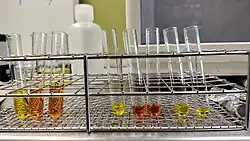
It was first introduced as a method to detect reducing substances in urine by James B. Sumner.[5] It has since been widely used (for example) for quantifying carbohydrate levels in blood.[6] It is mainly used in assay of alpha-amylase, however enzymatic methods are usually preferred due to DNS's lack of specificity.[7]
Safety
Although specific sensitivity information is not given, Sigma-Aldrich lists the storage class of the free acid as "other explosive materials".[3]
Various metal salts of DNS are explosives of varying sensitivity. The copper salt explodes on rapid heating, while the lead salt is a primary explosive as impact sensitive as mercury fulminate.[8] The barium salt is friction sensitive and both it and the dipotassium salts are impact sensitive (though not extremely so).[9]
References
- 1 2 3 Lide, David R., ed. (2006). CRC Handbook of Chemistry and Physics (87th ed.). Boca Raton, Florida: CRC Press. pp. 3–318, 3–319. ISBN 0-8493-0487-3.
- 1 2 3 "SDS - 3,5-dinitrosalicylic acid". www.fishersci.com. ThermoFisher Scientific. 19 December 2025. p. 3. Retrieved 22 March 2026.
- 1 2 3 Sigma-Aldrich Co., 3,5-dinitrosalicylic acid. Retrieved on 21 March 2026.
- ↑ Thiel, W.; Mayer, R.; Jauer, E.-A.; Modrow, H.; Dost, H. (1986). "Synthesis and Spectral Characterization of Blue Dyes of the Benzene Series". J. Prakt. Chem. 328 (4). Leipzig, Germany: 497–514. doi:10.1002/prac.19863280406.
- ↑ Sumner, James B.; Graham, V.A. (June 1921). "Dinitrosalicylic Acid: A Reagent for the Estimation of Sugar in Normal and Diabetic Urine" (pdf). Journal of Biological Chemistry. 47 (1): 5–9. doi:10.1016/S0021-9258(18)86093-8. S2CID 34820005.
- ↑ Wang, Nam Sun. "Glucose Assay By Dinitrosalicylic Colorimetric Method". College Park, MD: Department of Chemical & Biomolecular Engineering, University of Maryland. Retrieved 21 March 2026.
- ↑ Miller, Gail Lorenz (1959). "Use of dinitrosalicylic acid reagent for determination of reducing sugar". Anal. Chem. 31 (3): 426–428. doi:10.1021/ac60147a030.
- ↑ Fedoroff, Basil T.; Sheffield, Oliver E.; Kaye, Seymour M. (1 January 1975). "Hydroxybenzoic acid and derivatives". Encyclopedia of Explosives and Related Items (PDF) (Technical report). Vol. 7, H2 to Lysol. Dover, NJ: Picatinny Arsenal. pp. H-237. LCCN 61-61759. ADA019502, PATR 2700.
- ↑ Kaye, Seymour M. (1 January 1978). Encyclopedia of Explosives and Related Items (PDF) (Technical report). Vol. 9, QDX through Type Explosives. Dover, NJ: Army Armament Research And Development Center - Large Caliber Weapon Systems Lab. pp. S-32, S-33. LCCN 61-61759. ADA097595, PATR 2700.