2026 Tuapse oil terminal attack
| Part of Deep strike campaign, Russo-Ukrainian War | |
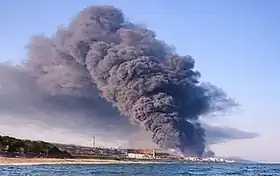 A fire in Tuapse, caused by Ukrainian drones | |
  2026 Tuapse oil terminal attack Location within Krasnodar Krai  2026 Tuapse oil terminal attack Location within European Russia  2026 Tuapse oil terminal attack Location within Black Sea | |
| Date | 16 April 2026 – present |
|---|---|
| Location | |
| Also known as | 2026 Tuapse oil refinery fire |
| Type | Industrial fire, environmental disaster, wartime infrastructure strike |
| Theme | Air pollution, toxic emissions (benzene, xylene, soot), acid rain in surrounding areas |
| Cause | Ukrainian drone attacks during the Russo-Ukrainian War |
| Target | Tuapse oil terminal, Tuapse Refinery |
| Outcome | Major fire, shutdown of Tuapse oil refinery and terminal operations, environmental contamination |
| Deaths | 2 (first wave)[1] + 1 (second wave)[2] |
| Injuries | 7 (first wave)[1] + 3 (second wave)[3] |
Property damage | Severe damage to refinery, storage tanks, pipelines, and port infrastructure |
Between 16 April and 27 May 2026, Ukrainian drone strikes hit the Tuapse Refinery and Tuapse oil terminal amid a series of Ukrainian attacks in Russia. The attacks aimed at reducing Russian oil revenue following the 2022 Russian invasion of Ukraine. They damaged the refinery and terminal, a major oil export hub, starting large fires and forcing them to suspend operations. At least three people were killed, and there is significant environmental pollution in the area, including black rain and an oil spill.[4][5]
Background
The multi-day attacks took place at the Tuapse Refinery, a major oil-processing and export facility operated by Rosneft, with an annual capacity of around 12 million tonnes of crude oil. The refinery and associated marine terminal form a key part of Russia's petroleum export infrastructure on the Black Sea.[4]
Tuapse had previously been targeted multiple times during the war due to its strategic importance for exporting refined petroleum products and generating revenue for the Russian economy.[5]
Events
On 16 April 2026, Ukrainian UAVs struck the Tuapse oil refinery and adjacent terminal facilities, igniting a large fire that spread across fuel storage areas and port infrastructure. The blaze burned for three days and forced a complete halt of refinery operations due to the inability to ship products.[4] Emergency services deployed hundreds of personnel and dozens of vehicles to contain the fire, which produced a massive plume of smoke visible over long distances.[6]
On 20 April, a second wave of strikes further damaged infrastructure, reignited fires, and intensified the scale of destruction at the site.[4]
On 28 April, а third wave of strikes took place before flames from previous strikes were extinguished.[7] Due to an air attack, residents of surrounding buildings were evacuated.[8][9] More than 160 firefighters were deployed to extinguish the blaze.[10]
On 2 May, The Guardian reported a fourth wave of strikes, and the Ukrainian SBU said that drones had again struck the seaport and the refinery. Local Russian officials said a major operation was under way to put out a fire, but reported no casualties.[11]
Another attack was on the night of 26–27 May.[12]
Impact
The attack caused at least one confirmed death and multiple injuries.[13] Significant damage was reported to port infrastructure, oil storage facilities, and nearby civilian buildings.[13] The refinery suspended operations indefinitely, disrupting oil exports and logistics in the region.[4]
The fires released hazardous substances into the atmosphere, including benzene and xylene, leading to severe air pollution around Tuapse. Authorities advised residents to remain indoors due to toxic conditions.[14] Rainfall mixed with combustion byproducts created a phenomenon described as "black rain," depositing oily residue and soot across the city and surrounding areas.[5] Satellite and environmental monitoring indicated the formation of an oil slick in the Black Sea near Tuapse, raising concerns about marine pollution and ecological damage.[5]
The attack significantly disrupted operations at one of Russia's key export-oriented refineries, reducing throughput and forcing the diversion of tanker traffic to alternative ports such as Novorossiysk.[4] Given the refinery's role in exporting petroleum products, the incident affected regional logistics and contributed to broader disruptions in Russia's energy export network.[4]
A correspondent from the "Bereg" reported that a strong smell of oil is present in the city, making it difficult to breathe.[15]
The resultant fires and smoke plume were so intense that the aftermath was commonly referred to as resembling a volcano.[16][17][18]
By late April 2026, the environmental impact had intensified significantly. Large-scale oil spills and toxic smoke from repeated strikes led to severe contamination of air, soil, and coastal waters. Russian authorities reported that more than 13,000 cubic meters of fuel oil and contaminated soil had been removed from affected areas, while beaches along the Black Sea coastline were heavily polluted and in some cases rendered unusable. Residents were advised to remain indoors, keep windows closed, and rely on bottled water due to concerns over air and water safety.[19]
Environmental experts, including Yevgeny Vitishko and Dmitry Lisitsyn, raised concerns about the broader ecological impact of the strikes. They noted risks related to air pollution, soil contamination, and the spread of oil products into marine ecosystems, warning that the full extent of the environmental damage may take time to assess.[20]
Emergency response

Local authorities declared a state of emergency following the initial strike on 20 April, closing schools and mobilizing firefighting units to contain the blaze.[21]
Firefighting operations continued for days after the initial strike, with open flames eventually brought under control in three days.[6]
According to the Krasnodar operational headquarters on 26 April, city services were working around the clock to clean oil contamination from the beaches. Authorities reported that as of April 26, over 2,500 cubic meters of contaminated soil have been removed, with 132 people and 26 pieces of equipment involved in the disaster response.[15] Local residents were also assisting city services in cleaning the beaches.[15] On 29 April, the Krasnodar-based outlet Anapa Region published an article that contained statements by Krasnodar Krai governor Veniamin Kondratyev, including him saying that the Tuapse situation was "under full control" and that footage of large scale fires was a "psychological attack", accusing Ukraine of using "insidious innovative" tactics involving fuel tanks attached to drones for dramatic effect. The article was deleted shortly after it was published, and the outlet said its website had been hacked to plant the interview.[22][23][24]
On 29 April, Russia's minister of emergency situations, Aleksandr Kurenkov, said the spill of burning oil had been contained, and called the situation "difficult but under control." Russian president Vladimir Putin commented on the situation only after the third strike, referring to Kurenkov's report and highlighting potential environmental damage.[25]
See also
References
- 1 2 The number of victims of drone attacks in Tuapse increased to seven
- ↑ "Беспилотники атаковали морской порт Туапсе, есть погибший".
- ↑ The number of victims of drone attacks in Tuapse increased to three
- 1 2 3 4 5 6 7 "Russia's Tuapse oil refinery halted operations after April drone attack". Reuters. 21 April 2026.
- 1 2 3 4 Hodunova, Kateryna; Moroziuk, Polina (April 23, 2026). "A nightmare: Russians in Tuapse in disbelief after Ukrainian drones bring the war home". The Kyiv Independent.
- 1 2 "Fire brought under control at Russia's Tuapse oil terminal". Reuters. 23 April 2026.
- ↑ "Ukrainian drones reportedly strike Russian oil storage tanks before flames from previous attacks extinguished". Kyiv Independent. 28 April 2026.
- ↑ Hlushchenko, Olha; Balachuk, Iryna. "Drones again attack oil refinery in Russia's Tuapse, sparking huge fire; residents evacuated – photos". Ukrainska Pravda. Retrieved 2026-04-28.
- ↑ "Attack on the Tuapse refinery - residents of surrounding buildings evacuated". Ukrainian National News (UNN). 2026-04-28. Retrieved 2026-04-28.
- ↑ "Third Ukraine strike on Tuapse hits Russian oil refinery and prompts evacuations". www.bbc.com. 2026-04-28. Retrieved 2026-04-28.
- ↑ "Ukraine war briefing: Russian oil hub of Tuapse hit for fourth time as environmental disaster mounts". The Guardian. 2 May 2026. Retrieved 2 May 2026.
- ↑ "Ukraine confirms strike on Tuapse oil refinery and Storm Shadow missile hits on Russian facilities". Ukrainska Pravda. Retrieved 2026-05-28.
- 1 2 "Ukrainian drone attack on Russia's Tuapse port kills one". Reuters. 20 April 2026.
- ↑ "Fire after Ukrainian attack hits air quality in Tuapse". Reuters. 22 April 2026.
- 1 2 3 "На юге России опять экологическая катастрофа, на этот раз — из-за войны. Нефтяной дождь покрыл сажей весь Туапсе. В городе трудно дышать. Вот что там происходит". Meduza (in Russian). Retrieved 2026-04-27.
- ↑ Fenbert, Abbey; Post, Kollen (April 16, 2026). "Ukrainian drone strikes turn major Russian oil refinery into 'volcano' along the Black Sea". The Kyiv Independent. Retrieved May 1, 2026.
- ↑ Fenbert, Abbey (April 16, 2026). "Ukraine hits major Russian oil refinery in Krasnodar Krai, media, officials report". Yahoo! News. The Kyiv Independent. Retrieved May 1, 2026.
- ↑ "Ukrainian strikes on Russian oil refinery send smoke across Black Sea coast as state of emergency is declared". Meduza. April 28, 2026. Retrieved May 1, 2026.
- ↑ Trevelyan, Mark; Dysa, Yuliia (2026-04-30). "Ukraine strikes Russian port of Tuapse again as environment crisis deepens". Reuters.
- ↑ Anna Chernova; Clare Sebastian (2026-04-30). "'Oil is literally falling from the sky': Russian town fears environmental disaster after Ukrainian drone strikes on refinery". CNN. Retrieved 2026-05-03.
- ↑ "Black rain, toxic air and bird deaths in Tuapse". The Moscow Times. 24 April 2026.
- ↑ "The Governor of the Krasnodar region called the fire in Tuapse a psychological attack involving fuel oil tanks suspended from drones". Ukrainian National News (UNN). 1 May 2026. Retrieved 5 May 2026.
- ↑ "Russian regional outlet says website was hacked to plant fake 'exclusive interview' with governor downplaying drone strikes". Meduza. 1 May 2026. Retrieved 10 May 2026.
- ↑ Malinovsky, Eric (2 May 2026). "Russia says Ukrainian drones carry oil tanks to produce extra smoke". NV. Retrieved 10 May 2026.
- ↑ "Russia says burning oil spill at refinery struck by Ukrainian drones has been contained". Meduza. 29 April 2026. Retrieved 29 April 2026.

- Tuapse
- 2026 disasters in Russia
- April 2026 in Russia
- Impacts of the Russian invasion of Ukraine
- 2020s in Krasnodar Krai
- 2026 fires in Europe
- Industrial fires and explosions in Russia
- Environmental disasters in Russia
- Environmental impact of the Russian invasion of Ukraine
- 2026 building bombings
- 2026 industrial disasters
- Attacks in Russia during the Russo-Ukrainian war (2022–present)
- Petroleum infrastructure in Russia
- Oil spills in Russia
- Pollution events in 2026
- May 2026 in Russia
- Environmental disasters in 2026
- Drone strikes in Russia
- Drone strikes conducted by Ukraine
- Military operations of the Russian invasion of Ukraine in 2026
- Building bombings in Russia
- Attacks on energy sector
- Ukrainian airstrikes during the Russian invasion of Ukraine
- 2026 airstrikes
- Attacks in Russia in 2026