2018–2019 student protests in Albania
| 2018–2019 student protests in Albania | |||
|---|---|---|---|
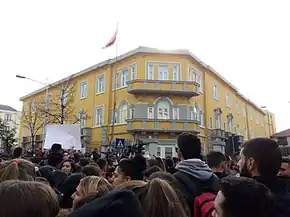 Students protesting outside the Ministry of Education in Tirana | |||
| Date | 4 December 2018 – February 2019 | ||
| Location | |||
| Caused by |
| ||
| Goals |
| ||
| Methods | |||
| Result |
| ||
| Parties | |||
| |||
| Lead figures | |||
Kurtish Rexhmati, Enrik Shehu, Marlin Muça, Xhuljan Guçe | |||
| Number | |||
| |||
The 2018–2019 student protests in Albania were a series of demonstrations, class boycotts, faculty occupations and online activism events held by students of public universities in Albania from December 2018 until early 2019. The protests began after a government decision required students to pay an additional fee for resit or grade-improvement exams, but quickly expanded into broader demands over tuition fees, dormitory conditions, university governance, budget transparency, academic integrity and the Higher Education Law.[1][2]
The protests won several short-term concessions, including the repeal of the additional exam fee, tuition reductions for some categories of students and the announcement of a government programme known as the "Pact for the University".[3][4] However, the movement failed to achieve most of its structural goals. The Higher Education Law was not repealed, education spending did not rise to the demanded level of 5% of GDP, and several commitments on student representation, budget transparency, student cards and plagiarism review remained incomplete or unresolved years later.[5]
Background
The immediate trigger of the protests was a government decision requiring students to pay an additional fee of about 5 euros per credit for resit or grade-improvement exams. Since many exams were worth several credits, the measure could add roughly 30 to 45 euros for one exam.[1] Students argued that the new fee came on top of already high tuition costs and poor conditions in public universities and dormitories.[6]
The protests also reflected wider dissatisfaction with the state of higher education in Albania. Students criticised deteriorated university infrastructure, poor dormitory conditions, insufficient libraries and study spaces, lack of transparency in university budgets and limited student participation in decision-making.[2] Many protesters also linked these problems to the 2015 Higher Education Law, which they argued had increased the financial burden on students and weakened public universities.[7]
Academic-integrity concerns also contributed to the protests. In October 2018, Deputy Minister of Education Ervin Demo resigned after being accused of plagiarism by researcher Taulant Muka.[8] By December 2018, Albanian media were reporting wider plagiarism allegations against public officials and academics, which strengthened student demands for the verification of academic titles and publications.[9]
The protest

The protests started on 4 December 2018 with students from the Faculty of Architecture and Urbanism of the Polytechnic University of Tirana. By 6 and 7 December, students from other faculties and universities had joined the demonstrations, marching toward the Ministry of Education in Tirana and demanding the repeal of the additional exam fee.[10][3]
Thousands of students across Tirana boycotted lectures and marched from their faculties toward the Ministry of Education, Sports and Youth. They demanded the cancellation of the additional fee for resit exams, lower tuition fees, better living conditions in dormitories and a larger role for students in university decision-making. Balkan Insight described the demonstrations as among the largest protests the country had seen in years.[10]
Students from public universities in other cities, including Durrës, Shkodër, Elbasan, Korçë and Vlorë, also joined the movement by boycotting lectures and organising rallies.[6][11]
On the second day of the protest, Education Minister Lindita Nikolla declared that the government's decision on higher fees would be repealed, but students continued the protests for their other demands.[3] The students, organised largely through social media, sent an official letter to the government with eight non-negotiable demands. The protest was also supported by some professors, public figures and citizens.[1]
The students demanded the repeal or major revision of the Higher Education Law, considering it one of the main sources of the problems they faced. At first, Prime Minister Edi Rama offered concessions, including fee reductions for excellent students and students from low-income families, as well as employment opportunities in public administration. These offers were rejected by many protesters, who argued that partial concessions did not address the root causes of the crisis in higher education.[7]
The movement was widely described as leaderless and non-partisan. Students rejected attempts by the government and political parties to select representatives for negotiation, arguing that the protest should not be captured by party politics.[12]
Government changes
Prime Minister Edi Rama began a tour of public universities to discuss students' concerns. He started the tour at the Agricultural University of Tirana, but many students rejected the meetings and some left the room while he was speaking. His request for dialogue was also rejected by many protesters in the streets and in television discussions.[1]
On 28 December 2018, Rama reshuffled his cabinet, replacing seven ministers, including Education Minister Lindita Nikolla. The changes came after the student protests had exposed wider public discontent with the government. Rama insisted that the changes were not the result of ministerial failures, and blamed the opposition, the media and problems inside his own party for the political climate.[13]
Besa Shahini was appointed to replace Nikolla as Minister of Education, Sports and Youth. The reshuffle was one of the most visible political consequences of the protests, although it did not satisfy students who continued to demand structural changes in the university system.[13]
Plagiarism scandal
One of the reasons why students continued to protest was the plagiarism scandal involving public officials, politicians and university professors. The public denunciation of plagiarism cases began in October 2018, when Taulant Muka, an Albanian researcher educated in the Netherlands, started publishing allegations about plagiarised academic work by officials and academics.[9]
The scandal first led to the resignation of Ervin Demo, Deputy Minister of Education, after plagiarism allegations were made against him.[8] Further allegations were later reported in Albanian media against politicians, public officials and university academics. Students argued that such cases showed the need for the verification of academic titles, the review of doctoral theses and stronger academic-integrity standards in public universities.[9]
Officials and public figures accused in media reports included:
- Ervin Demo – Deputy Minister of Education, who resigned after plagiarism allegations surfaced[8]
- Blerina Gjylameti – Socialist Party of Albania MP
- Ogerta Manastirliu – Minister of Health and Social Protection
- Mimi Kodheli – former Minister of Defence and MP
- Monika Kryemadhi – chairwoman of the Socialist Movement for Integration
- Taulant Balla – Socialist Party MP
- Miranda Karçanaj – director of the National Information Society Agency
- Ditjona Kule – professor at the University of Tirana
- Kseanela Sotirofski – rector of the Aleksandër Moisiu University of Durrës
Public universities occupation
After resuming their protests in January 2019, students continued boycotting classes and began occupying faculties. They organised debate forums, reading groups and assemblies inside university buildings while demanding the fulfilment of their demands.[12]
On 9 January 2019, students at the Faculty of Law and the Faculty of Economics spent the night inside auditoriums. The occupations later spread to other faculties, with students arguing that they would not return to normal teaching until the government accepted their demands. Professors in some faculties expressed support for the students' requests, while university administrators and government officials called for a return to lectures.[12]
The boycott continued during January in several faculties. The movement gradually lost momentum in early 2019. Its leaderless structure helped prevent easy political capture, but it also made sustained negotiation and long-term coordination more difficult.[12]
Outcomes
The protests achieved several immediate concessions. The government repealed the additional fee for resit and grade-improvement exams, reduced or subsidised tuition fees for some categories of students, promised scholarships for high-performing and low-income students, announced dormitory investments and presented the "Pact for the University".[3][4] The protests also contributed to the December 2018 cabinet reshuffle, including the replacement of the education minister.[13]
However, the protests did not achieve most of their central structural goals. The Higher Education Law was not repealed, the student vote in university elections was not increased to 50%, and education spending did not reach the demanded level of 5% of GDP. A 2023 review by the Albanian Center for Quality Journalism found that, almost five years after the protests, education spending was about 3.3% of GDP, far below the level demanded by the students.[5]
The same review reported that several commitments of the "Pact for the University" had not been fully implemented. The budget-transparency platform had not fulfilled its function, a national student card had still not been implemented outside Tirana, and the verification of academic titles and plagiarism remained unresolved or inconsistently handled by universities.[5] The Ministry of Education was quoted as stating that there was "no real balance" of the University Pact after more than four years.[5]
For this reason, the protests are generally considered to have produced partial and symbolic victories while failing to deliver the deeper higher-education reforms demanded by students.
Legacy
The protests were significant as a rare large-scale, non-party student movement in post-communist Albania. Commentators described them as an example of leaderless and digitally coordinated activism, and as a sign of wider dissatisfaction with corruption, clientelism and the quality of public institutions.[12][14]
In September 2019, Balkan Insight reported that students were still debating the political meaning of the protests and whether the movement could be transformed into broader civic or political change.[15] Later assessments argued that the protests revived civic engagement among young Albanians, but that their failure to secure systemic reform showed the limits of spontaneous, leaderless mobilization when confronting entrenched political and institutional structures.[12][5]
References
- 1 2 3 4 Madhi, Gentiola (11 December 2018). "Students' protests shake apathy in Albania". Osservatorio Balcani e Caucaso Transeuropa. Retrieved 23 June 2026.
- 1 2 Sinoruka, Fjori (14 December 2018). "Albanian students demand change". Kosovo 2.0. Retrieved 23 June 2026.
- 1 2 3 4 "Albanian students protest against tuition fee hikes". Xinhua. 7 December 2018. Retrieved 23 June 2026.
- 1 2 "On the working document on the Pact for the University". Prime Minister's Office of Albania. Retrieved 23 June 2026.
- 1 2 3 4 5 Zela, Marina (20 June 2023). "The pact for the university and where we are after 5 years". Albanian Center for Quality Journalism. Retrieved 23 June 2026.
- 1 2 "Thousands of Albanian students oppose additional tuition fees in higher education". Prishtina Insight. 7 December 2018. Retrieved 23 June 2026.
- 1 2 "Escalation of students' protests in Albania". Osservatorio Balcani e Caucaso Transeuropa. 20 December 2018. Retrieved 23 June 2026.
- 1 2 3 "Deputy minister of education resigns after plagiarism charges surface". Tirana Times. 20 October 2018. Retrieved 23 June 2026.
- 1 2 3 "Massive Plagiarism Scandal Hits Albanian Officials without Consequences". Exit. 25 December 2018. Retrieved 23 June 2026.
- 1 2 Likmeta, Besar (6 December 2018). "Student Anger Over Higher Tuition Fees Rocks Albania". Balkan Insight. Retrieved 23 June 2026.
- ↑ "Studentët vazhdojnë protestat deri në plotësimin e të gjitha kërkesave". Reporter.al (in Albanian). 7 December 2018. Retrieved 23 June 2026.
- 1 2 3 4 5 6 Hasa, Rei (4 March 2019). "Student Protests in Albania: When Digital Activism Is Not Enough". Center for Media, Data and Society, Central European University. Retrieved 23 June 2026.
- 1 2 3 Likmeta, Besar (28 December 2018). "Albania PM Axes Seven Ministers After Protests". Balkan Insight. Retrieved 23 June 2026.
- ↑ "Confronting Corruption Through Voice and Protest: The Albanian Student Example". Tirana Times. Retrieved 23 June 2026.
- ↑ Sinoruka, Fjori (24 September 2019). "Emboldened Albanian Students Eye Wider Change". Balkan Insight. Retrieved 23 June 2026.