2012–13 Euroleague
| Euroleague | |||||||||||||
|---|---|---|---|---|---|---|---|---|---|---|---|---|---|
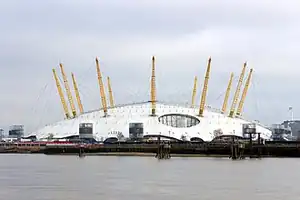 The O2 Arena in London hosted the Final Four | |||||||||||||
| Season | 2012–13 | ||||||||||||
| Duration | 11 October 2012 – 12 May 2013 | ||||||||||||
| Teams | 24 | ||||||||||||
| Regular season | |||||||||||||
| Season MVP |  Vassilis Spanoulis | ||||||||||||
| Finals | |||||||||||||
| Champions | Olympiacos 3rd title | ||||||||||||
| Runners-up |  Real Madrid | ||||||||||||
| Third place |  CSKA Moscow | ||||||||||||
| Fourth place | FC Barcelona Regal | ||||||||||||
| Final Four MVP | Vassilis Spanoulis | ||||||||||||
| Awards | |||||||||||||
| Best Defender |  Stéphane Lasme | ||||||||||||
| Rising Star | Kostas Papanikolaou | ||||||||||||
| Coach of the Year | Georgios Bartzokas | ||||||||||||
| Statistical leaders | |||||||||||||
| |||||||||||||
← 2011–12 2013–14 → | |||||||||||||
The 2012–13 Euroleague was the 13th season of the modern era of Euroleague Basketball and the third under the title sponsorship of the Turkish Airlines. Including the competition's previous incarnation as the FIBA Europe Champions Cup, this was the 56th season of the premier competition for European men's clubs. The season started on 11 October 2012 and finished on 12 May 2013.
The Final Four was held at The O2 Arena in London. The championship game was won by Olympiacos, who defeated Real Madrid 100–88. Olympiacos became the third team since the introduction of the Final Four format to win two Euroleague championships in a row and the second team in Euroleague Basketball Company era (2000–01 Euroleague season to present) to become back-to-back Euroleague champions.
Allocation
A total of 31 teams participated in the 2012–13 Euroleague. There were three routes to participation in the Euroleague:
- The top 13 teams with an A-Licence from the 2011–12 Euroleague based on their Euroleague Club Ranking.[1]
- An additional team promoted to an A-Licence.
- The 2011–12 Eurocup winner was given a C-Licence.
- 14 places were allocated from a list of 28 teams given a B-Licence ranked according to their European national basketball league rankings over the last year. 14 teams were given both an A-Licence or C-Licence and a B-Licence. When a country ranking spot had already been assigned to an A-Licence team, the assignation jumped to the next country appearing in the ranking, and their league was not granted an additional place in the competition. The first 8 of the remaining 16 teams were given places in the regular-season, and the next 6 were given places in the qualifying competition. The last 2 places from the Netherlands and Latvia were not taken up.
- As the list of teams with a B-Licence was exhausted, two wild cards were granted to fill the remaining spaces in the qualifying competition.
Euroleague allocation criteria
On 31 May 2012, the Euroleague published the official License Allocation criteria.[2]
A licenses
|
|
- The A license of Acea Roma was cancelled and it was awarded to Italian team EA7 Milano.
B licenses
| A licensed teams | |
| B licensed teams | |
| Teams qualified for the Qualifying Round |


C licenses and wildcards
- C license converted in wildcard for the Regular Season (since 2011–12 Eurocup champion BC Khimki qualified via B license):
- Wildcards for the qualification rounds:
Teams
On 31 May 2012 the new Euroleague license allocation criteria were announced.[3] Twenty-three teams directly joined the regular season, while one more team joined it from the qualifying rounds. Eight teams fought for the last berth, and Mapooro Cantù got the final spot.[4]
The labels in the parentheses show how each team qualified for the place of its starting round (TH: EuroLeague title holders)
- A - licensed clubs: teams with 3-year licence
- Associated clubs: teams with B and C temporary licenses
- 1st, 2nd, etc.: League position after Playoffs
- EC: Champion of the 2011–12 Eurocup
- WC: Wild card
- Bold: Qualification round winner
| Regular season | |||
|---|---|---|---|
| A-license | |||
| FC Barcelona Regal (1st) |
Olympiacos (1st)TH |
 Anadolu Efes (2nd) |
 Asseco Prokom Gdynia (1st) |
| Real Madrid (2nd) |
Panathinaikos (2nd) |
Fenerbahçe Ülker (5th) |
CSKA Moscow (1st) |
| Caja Laboral (3rd) |
 Montepaschi Siena (1st) |
 Maccabi Electra (1st) |
|
| Unicaja (9th) |
EA7 Milano (2nd) |
 Žalgiris (1st) | |
| Associated clubs | |||
 Brose Baskets (1st) |
 Élan Chalon (1st) |
Beşiktaş (1st) |
Khimki (2nd)(EC) |
| Alba Berlin (5th)(WC) |
 Partizan (1st)^ |
Lietuvos rytas (2nd) |
 Union Olimpija (2nd)^ |
 Cedevita (2nd)^ |
|||
| Qualifying rounds | |||
| ratiopharm Ulm (2nd) |
Mapooro Cantù (5th)(WC) |
 Lukoil Academic (1st) |
UNICS (5th)(WC) |
 Telenet Oostende (1st) |
Le Mans (2nd) |
 ČEZ Nymburk (1st) |
 Donetsk (1st) |
*^ The Adriatic League teams (1 from Serbia, 1 from Slovenia and 1 from Croatia) were the ones with the best Adriatic League + National League + European competitions ranking.
- EA7 Milano had a two-year A license, awarded in June 2012.[5]
Qualifying rounds
The qualifying rounds were played in a knock-out tournament consisting of eight teams in a single-venue tournament format. The winner advanced to the Euroleague Regular Season. The qualifying rounds were played between 25 and 28 September at the PalaDesio in Desio, Italy.[6]
| First qualifying round 25–26 September | Second qualifying round 27 September | Third qualifying round 28 September | ||||||||||||
| UNICS
| 91 | |||||||||||||
| ratiopharm Ulm
| 73 | |||||||||||||
| UNICS
| 78 | |||||||||||||
| Le Mans
| 86 | |||||||||||||
| Le Mans
| 61 | |||||||||||||
| Donetsk
| 55 | |||||||||||||
| Le Mans
| 66 | |||||||||||||
| Mapooro Cantù
| 80 | |||||||||||||
| ČEZ Nymburk
| 83 | |||||||||||||
| Telenet Oostende
| 65 | |||||||||||||
| ČEZ Nymburk
| 83 | |||||||||||||
| Mapooro Cantù
| 89 | |||||||||||||
| Mapooro Cantù
| 87 | |||||||||||||
| Lukoil Academic
| 79 | |||||||||||||
Draw
The draws for the 2012–13 Turkish Airlines Euroleague were held on Friday, 6 July. The draws determined the qualifying-round matchups and regular-season groups for the Euroleague, as well as the qualifying rounds for the Eurocup and the regular-season for the EuroChallenge.
Teams were seeded into six pots of four teams in accordance with the Club Ranking, based on their performance in European competitions during a three-year period.[7]
Two teams from the same country could not be drawn together in the same Regular Season group.
| Pot 1 | Pot 2 | Pot 3 | Pot 4 | Pot 5 | Pot 6 |
|---|---|---|---|---|---|
Regular season
The regular season began on 11 October 2012.
If teams were level on record at the end of the Regular Season, tiebreakers were applied in the following order:
- Head-to-head record.
- Head-to-head point differential.
- Point differential during the Regular Season.
- Points scored during the regular season.
- Sum of quotients of points scored and points allowed in each Regular Season match.
Group A
| Pos | Team | Pld | W | L | PF | PA | PD | Qualification |
|---|---|---|---|---|---|---|---|---|
| 1 | Real Madrid |
10 | 7 | 3 | 832 | 738 | +94 | Advance to Top 16 |
| 2 | Khimki |
10 | 6 | 4 | 753 | 754 | −1 | |
| 3 | Panathinaikos |
10 | 6 | 4 | 748 | 722 | +26 | |
| 4 | Fenerbahçe Ülker |
10 | 5 | 5 | 727 | 738 | −11 | |
| 5 | Union Olimpija |
10 | 3 | 7 | 722 | 808 | −86 | |
| 6 | Mapooro Cantù |
10 | 3 | 7 | 708 | 730 | −22 |
Group B
| Pos | Team | Pld | W | L | PF | PA | PD | Qualification |
|---|---|---|---|---|---|---|---|---|
| 1 | Maccabi Tel Aviv |
10 | 8 | 2 | 810 | 708 | +102 | Advance to Top 16 |
| 2 | Unicaja |
10 | 8 | 2 | 762 | 715 | +47 | |
| 3 | Montepaschi Siena |
10 | 5 | 5 | 879 | 844 | +35 | |
| 4 | Alba Berlin |
10 | 4 | 6 | 722 | 748 | −26 | |
| 5 | Élan Chalon |
10 | 3 | 7 | 782 | 843 | −61 | |
| 6 | Asseco Prokom Gdynia |
10 | 2 | 8 | 704 | 801 | −97 |
Group C
| Pos | Team | Pld | W | L | PF | PA | PD | Qualification |
|---|---|---|---|---|---|---|---|---|
| 1 | Žalgiris |
10 | 8 | 2 | 804 | 693 | +111 | Advance to Top 16 |
| 2 | Olympiacos |
10 | 8 | 2 | 788 | 737 | +51 | |
| 3 | Anadolu Efes |
10 | 5 | 5 | 738 | 740 | −2 | |
| 4 | Caja Laboral |
10 | 4 | 6 | 749 | 778 | −29 | |
| 5 | EA7 Milano |
10 | 3 | 7 | 760 | 767 | −7 | |
| 6 | Cedevita |
10 | 2 | 8 | 725 | 849 | −124 |
Group D
| Pos | Team | Pld | W | L | PF | PA | PD | Qualification |
|---|---|---|---|---|---|---|---|---|
| 1 | FC Barcelona Regal |
10 | 9[a] | 1 | 774 | 636 | +138 | Advance to Top 16 |
| 2 | CSKA Moscow |
10 | 9[b] | 1 | 783 | 709 | +74 | |
| 3 | Beşiktaş |
10 | 5 | 5 | 699 | 749 | −50 | |
| 4 | Brose Baskets |
10 | 3 | 7 | 740 | 807 | −67 | |
| 5 | Lietuvos rytas |
10 | 2[c] | 8 | 670 | 724 | −54 | |
| 6 | Partizan |
10 | 2[d] | 8 | 731 | 772 | −41 |
Notes:
Top 16
The Top 16 began on 27 December 2012.
If teams were level on record at the end of the Top 16, tiebreakers were applied in the following order:
- Head-to-head record.
- Head-to-head point differential.
- Point differential during the Top 16.
- Points scored during the Top 16.
- Sum of quotients of points scored and points allowed in each Top 16 match.
Group E
| Pos | Team | Pld | W | L | PF | PA | PD | Qualification |
|---|---|---|---|---|---|---|---|---|
| 1 | CSKA Moscow |
14 | 11 | 3 | 1095 | 981 | +114 | Advance to quarterfinals |
| 2 | Real Madrid |
14 | 10 | 4 | 1085 | 1021 | +64 | |
| 3 | Anadolu Efes |
14 | 9[a] | 5 | 1028 | 1031 | −3 | |
| 4 | Panathinaikos |
14 | 9[b] | 5 | 1001 | 968 | +33 | |
| 5 | Unicaja |
14 | 7 | 7 | 988 | 1015 | −27 | |
| 6 | Žalgiris |
14 | 6 | 8 | 1065 | 1040 | +25 | |
| 7 | Alba Berlin |
14 | 4 | 10 | 959 | 1036 | −77 | |
| 8 | Brose Baskets |
14 | 0 | 14 | 1026 | 1155 | −129 |
Notes:
Group F
| Pos | Team | Pld | W | L | PF | PA | PD | Qualification |
|---|---|---|---|---|---|---|---|---|
| 1 | FC Barcelona Regal |
14 | 13 | 1 | 1151 | 986 | +165 | Advance to quarterfinals |
| 2 | Olympiacos |
14 | 9 | 5 | 1068 | 1033 | +35 | |
| 3 | Maccabi Tel Aviv |
14 | 8 | 6 | 1105 | 1012 | +93 | |
| 4 | Laboral Kutxa |
14 | 8 | 6 | 1093 | 1045 | +48 | |
| 5 | Khimki |
14 | 7 | 7 | 1133 | 1051 | +82 | |
| 6 | Montepaschi Siena |
14 | 7 | 7 | 1036 | 1057 | −21 | |
| 7 | Beşiktaş |
14 | 2 | 12 | 893 | 1104 | −211 | |
| 8 | Fenerbahçe Ülker |
14 | 2 | 12 | 1055 | 1246 | −191 |
Quarterfinals
| Team 1 | Agg. | Team 2 | 1st leg | 2nd leg | 3rd leg | 4th leg | 5th leg |
|---|---|---|---|---|---|---|---|
| CSKA Moscow | 3–1 | Laboral Kutxa | 89–78 | 90–68 | 72–93 | 94–85 | |
| Olympiacos | 3–2 | Anadolu Efes | 67–62 | 71–53 | 72–83 | 73–74 | 82–72 |
| FC Barcelona Regal | 3–2 | Panathinaikos | 72–70 | 65–66 | 63–65 | 70–60 | 64–53 |
| Real Madrid | 3–0 | Maccabi Electra | 79–53 | 75–63 | 69–57 |
Final Four
On 12 May 2012 it was announced the Final Four would be hosted at The O2 Arena in London, United Kingdom.[8]
| Semifinals 10 May | Final 12 May | |||||
| CSKA Moscow | 52 | |||||
| Olympiacos | 69 | |||||
| Olympiacos | 100 | |||||
| Real Madrid | 88 | |||||
| FC Barcelona Regal | 67 | |||||
| Real Madrid | 74 | |||||
| Third place | ||||||
| CSKA Moscow | 74 | |||||
| FC Barcelona Regal | 73 | |||||
Top 10 attendances
Single game
| Round | Game | Home team | Visitor | Attendance | Sources | |
|---|---|---|---|---|---|---|
| 1 | Quarter-finals | 4 | Panathinaikos |
FC Barcelona |
20,300 | |
| 2 | Quarter-finals | 3 | Panathinaikos |
FC Barcelona |
17,800 | |
| Top 16 | 14 | Panathinaikos |
CSKA Moscow |
17,800 | [9] | |
| 4 | Regular Season | 8 | Žalgiris |
Olympiacos |
15,420 | |
| 5 | Top 16 | 4 | Žalgiris |
CSKA Moscow |
15,199 | |
| 6 | Regular Season | 7 | Žalgiris |
Caja Laboral |
15,110 | |
| 7 | Top 16 | 5 | Caja Laboral |
FC Barcelona |
15,068 | |
| 8 | Top 16 | 10 | Žalgiris |
Real Madrid |
15,010 | |
| 9 | Regular Season | 9 | Panathinaikos |
Fenerbahçe Ülker |
15,000 | [10] |
| 10 | Top 16 | 5 | Panathinaikos |
Real Madrid |
14,909 | [11] |
Average
| Rank | Team | Matches | Average |
|---|---|---|---|
| 1 | Žalgiris |
12 | 13,425 |
| 2 | Caja Laboral |
14 | 12,036 |
| 3 | Maccabi Electra |
13 | 10,935 |
| 4 | Panathinaikos |
14 | 10,564 |
| 5 | Real Madrid |
14 | 9,148 |
| 6 | Alba Berlin |
12 | 9,033 |
| 7 | Olympiacos |
15 | 8,265 |
| 8 | Anadolu Efes |
14 | 8,191 |
| 9 | Fenerbahçe Ülker |
12 | 7,109 |
| 10 | Partizan |
5 | 7,100 |
Individual statistics
Rating
| Rank | Name | Team | Games | Rating | PIR |
|---|---|---|---|---|---|
| 1. |  Bobby Brown | Montepaschi Siena | 24 | 417 | 17.38 |
| 2. | Victor Khryapa | CSKA Moscow | 26 | 443 | 17.04 |
| 3. | Nenad Krstić | CSKA Moscow | 29 | 488 | 16.83 |
Points
| Rank | Name | Team | Games | Points | PPG |
|---|---|---|---|---|---|
| 1. | Bobby Brown | Montepaschi Siena | 24 | 452 | 18.83 |
| 2. | Boštjan Nachbar | Brose Bamberg | 23 | 370 | 16.09 |
| 3. | Bojan Bogdanović | Fenerbahçe Ülker | 21 | 334 | 15.90 |
Rebounds
| Rank | Name | Team | Games | Rebounds | RPG |
|---|---|---|---|---|---|
| 1. | Victor Khryapa | CSKA Moscow | 26 | 190 | 7.31 |
| 2. | Ante Tomić | FC Barcelona | 30 | 195 | 6.50 |
| 3. | Shawn James | Maccabi Electra | 27 | 175 | 6.48 |
Assists
| Rank | Name | Team | Games | Assists | APG |
|---|---|---|---|---|---|
| 1. | Zoran Planinić | Khimki | 22 | 139 | 6.32 |
| 2. | Dimitris Diamantidis | Panathinaikos | 27 | 156 | 5.78 |
| 3. | Vassilis Spanoulis | Olympiacos | 31 | 170 | 5.48 |
Other Stats
| Category | Name | Team | Games | Stat |
| Steals per game |  Bo McCalebb | Fenerbahçe Ülker | 23 | 1.91 |
| Blocks per game | Shawn James | Maccabi Electra | 27 | 1.93 |
| Turnovers per game | Vassilis Spanoulis | Olympiacos | 31 | 3.42 |
| Fouls drawn per game | Vassilis Spanoulis | Olympiacos | 31 | 5.45 |
| Minutes per game | Bobby Brown | Montepaschi Siena | 24 | 32:37 |
| 2FG% | Sasha Kaun | CSKA Moscow | 30 | 0.716 |
| 3FG% | Kostas Papanikolaou | Olympiacos | 31 | 0.520 |
| FT% |  Marcelinho Huertas | FC Barcelona | 31 | 0.972 |
Game highs
| Category | Name | Team | Stat |
| Rating | Bobby Brown | Montepaschi Siena | 50 |
| Points | Bobby Brown | Montepaschi Siena | 41 |
| Rebounds |  Rašid Mahalbašić | Asseco Prokom | 16 |
| Assists | Zoran Planinić | Khimki | 13 |
| Steals | 7 occasions | 5 | |
| Blocks | 6 occasions | 5 | |
| Turnovers | Nenad Krstić | CSKA Moscow | 8 |
| Fouls Drawn | Bobby Brown | Montepaschi Siena | 15 |
Awards
2012–13 Euroleague MVP
2012–13 Euroleague Final Four MVP
All-Euroleague Team 2012–13
| Pos. | All-Euroleague First Team | Club Team | All-Euroleague Second Team | Club Team |
|---|---|---|---|---|
| G | Dimitris Diamantidis |
Panathinaikos |
Miloš Teodosić |
CSKA Moscow |
| G | Vassilis Spanoulis |
Olympiacos |
Juan Carlos Navarro |
FC Barcelona |
| F | Rudy Fernández |
Real Madrid |
Victor Khryapa |
CSKA Moscow |
| F | Nenad Krstić |
CSKA Moscow |
Nikola Mirotić |
Real Madrid |
| C | Ante Tomić |
FC Barcelona |
Shawn James |
Maccabi Electra |

Top Scorer (Alphonso Ford Trophy)
Best Defender
Rising Star
Coach of the Year (Alexander Gomelsky Award)
MVP Weekly
Regular season
| Game | Player | Team | PIR |
|---|---|---|---|
| 1 | Emir Preldžić | Fenerbahçe Ülker | 31 |
| 2 | Sonny Weems | CSKA Moscow | 38 |
| 3 | Rudy Fernández | Real Madrid | 30 |
| Fernando San Emeterio | Caja Laboral | 30 | |
| 4 | Bobby Brown | Montepaschi Siena | 43 |
| 5 | Bobby Brown (2) | Montepaschi Siena | 31 |
| 6 | Sasha Vujačić | Anadolu Efes | 31 |
| 7 | Rudy Fernández (2) | Real Madrid | 28 |
| Ante Tomić | FC Barcelona Regal | 28 | |
| 8 | Miloš Teodosić | CSKA Moscow | 25 |
| 9 | Blake Schilb | Élan Chalon | 38 |
| 10 | Shawn James | Maccabi Electra | 27 |
| Nemanja Bjelica | Caja Laboral | 27 | |
Top 16
| Game | Player | Team | PIR |
|---|---|---|---|
| 1 | Ante Tomić (2) | FC Barcelona | 27 |
| 2 | Bobby Brown (3) | Montepaschi Siena | 50 |
| 3 |  Ricky Hickman | Maccabi Electra | 34 |
| 4 | Paul Davis | Khimki | 29 |
| 5 | Bojan Bogdanović | Fenerbahçe Ülker | 27 |
| Marcus Williams | Unicaja | 27 | |
| 6 | Rudy Fernández (3) | Real Madrid | 34 |
| 7 | Sasha Kaun | CSKA Moscow | 30 |
| 8 | Devin Smith | Maccabi Electra | 28 |
| Luka Žorić | Unicaja | 28 | |
| Roko Ukić | Panathinaikos | 28 | |
| 9 | Nenad Krstić | CSKA Moscow | 26 |
| 10 | Nikola Mirotić | Real Madrid | 37 |
| 11 | Luka Žorić (2) | Unicaja | 33 |
| 12 |  Petteri Koponen | Khimki | 35 |
| 13 |  Nathan Jawai | FC Barcelona | 34 |
| 14 | Kostas Papanikolaou | Olympiacos | 37 |
Quarter-finals
| Game | Player | Team | PIR |
|---|---|---|---|
| 1 | Rudy Fernández (4) | Real Madrid | 22 |
| 2 | Victor Khryapa | CSKA Moscow | 25 |
| 3 | Jamon Gordon | Anadolu Efes | 24 |
| 4 | Victor Khryapa (2) | CSKA Moscow | 29 |
| 5 | Nathan Jawai (2) | FC Barcelona | 21 |
MVP of the Month
| Month | Player | Team |
|---|---|---|
| October 2012 | Sonny Weems | CSKA Moscow |
| November 2012 | Vassilis Spanoulis | Olympiacos |
| December 2012 | Maciej Lampe | Caja Laboral |
| January 2013 | Bobby Brown | Montepaschi Siena |
| February 2013 | Ante Tomić | FC Barcelona |
| March 2013 | Devin Smith | Maccabi Electra |
| April 2013 | Sergio Llull | Real Madrid |
See also
References
- ↑ "In-The-Game.org Euroleague three-year-ranking". Archived from the original on 1 October 2012. Retrieved 16 August 2012.
- ↑ 2012–13 Turkish Airlines Euroleague license allocation criteria Euroleague
- ↑ 2012–13 Turkish Airlines Euroleague license allocation criteria Euroleague.net 31 May 2012
- ↑ ECA Board meets in preparation for the 2012–13 season Euroleague.net 20 June 2012
- ↑ "Euroleague.net". 20 June 2012.
- ↑ "Turkish Airlines Euroleague Draw 2012–13". Euroleague.net. Retrieved 6 July 2012.
- ↑ Turkish Airlines Euroleague Draw seeds Euroleague.net – 29 June 2012
- ↑ "The O2 in London to host the 2013 Turkish Airlines Euroleague Final Four". Euroleague.net. 12 May 2012.
- ↑ Euroleague.net Panathinaikos Athens 63 – 69 CSKA Moscow.
- ↑ Euroleague.net Panathinaikos Athens 69 – 55 Fenerbahce Ulker Istanbul.
- ↑ Euroleague.net Panathinaikos Athens 54 – 58 Real Madrid.
- ↑ Euroleague.net Vassilis Spanoulis, named bwin MVP of the 2012–13 Turkish Airlines Euroleague.
- ↑ Euroleague.net Spanoulis named bwin MVP of 2013 Final Four.
- ↑ 2012–13 All-Euroleague First and Second teams announced. Euroleague.net. Retrieved 2013-05-06.
- ↑ Euroleague.net Montepaschi Siena's Bobby Brown wins Alphonso Ford Top Scorer Trophy.
- ↑ Best Defender Trophy winner: Stephane Lasme, Panathinaikos Athens.
- ↑ Rising Star Trophy winner: Kostas Papanikolaou, Olympiacos Piraeus.
- ↑ "Latest News | Euroleague". 3 October 2024.
External links

| Champions | |
|---|---|
| Runners-up | |
| Third place | |
| Fourth place | |
| Eliminated in the quarterfinals | |
| Eliminated in the Top 16 | |
| Eliminated in the regular season | |
| Eliminated in the third qualifying round | |
| Eliminated in the second qualifying round | |
| Eliminated in the first qualifying round | |
| |||||||||
| |||||||||
| |||||||||
| |||||||||
