2004 United States Senate election in Illinois
 | |||||||||||||||||
November 2, 2004
| |||||||||||||||||
| Turnout | 68.56% 18.31 pp | ||||||||||||||||
|---|---|---|---|---|---|---|---|---|---|---|---|---|---|---|---|---|---|
| |||||||||||||||||
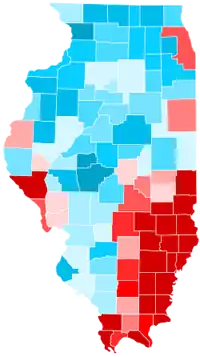
 County results Obama: 40–50% 50–60% 60–70% 70–80% 80–90% Keyes: 50–60% | |||||||||||||||||
| |||||||||||||||||


| Elections in Illinois |
|---|
 |
| ||
|---|---|---|
|
Personal
Illinois State Senator and U.S. Senator from Illinois 44th President of the United States Tenure
  |
||

The 2004 United States Senate election in Illinois was held on November 2, 2004. Republican incumbent Peter Fitzgerald decided to retire after one term in office. Democratic state senator and future president Barack Obama won the open seat over Alan Keyes, who was a late replacement for the original Republican nominee, investment banker Jack Ryan, who withdrew following a sex scandal. Obama's landslide victory, along with his well-received keynote address at the 2004 Democratic National Convention during the race, launched him into national prominence and set up his 2008 election to the presidency.
Primary elections were held on March 16. The open race, which was a first for this seat since 1980, drew a large and wealthy field of candidates. In total, at least 15 candidates, including seven millionaires,[1][2] ran in the primary elections and spent a record sum of over $60 million, triggering the first application of the millionaires' amendment to the Bipartisan Campaign Reform Act of 2002.[3] In the Democratic primary, Obama came from behind in the polls to defeat a large field of opponents, including state comptroller Daniel Hynes and financier Blair Hull, with a surprisingly large majority of the vote. Ryan won the Republican nomination over a large field of Republicans, including dairy farmer Jim Oberweis, state senator Steve Rauschenberger, and businessman Andrew McKenna.
Obama was the early favorite over Ryan in general election polling, but the race was overshadowed by Chicago Tribune reporting on Ryan's child custody lawsuit against his ex-wife Jeri Ryan, which included allegations that Ryan had pressured his then-wife to perform sexual acts in public. Ryan withdrew from the race on July 29, leaving Obama without a Republican opponent. Having apparently won the seat by midsummer, Obama instead focused on his keynote address in support of Democratic presidential nominee John Kerry and supporting other Democratic candidates in Illinois and throughout the country, further enhancing his rising political profile. Six weeks after Ryan's withdrawal, the Illinois Republican Party chose Keyes, a resident of Maryland with a history of landslide losses, as their replacement nominee. Keyes ran an advocacy campaign focused on social issues, and Obama maintained a strong lead in polling through Election Day. Overall, Obama outspent Keyes by over $12 million, among the largest margins in United States Senate history in both absolute and relative terms.
Obama won the election with 70 percent of the vote, the largest margin of victory for any U.S. Senate candidate in Illinois history and significantly larger than Kerry's 55 percent in the concurrent presidential election. Obama carried 92 of the state's 102 counties, including several rural and suburban counties where the Democratic Party had traditionally not performed.[4] This was the first United States Senate election in history in which both major party candidates were African American. According to Obama's 2020 memoir A Promised Land, he promised his wife Michelle that if he lost the race, he would retire from politics.[5]
Background
The primaries and general elections coincided with those for federal offices (president and House), as well as those for state offices.
For the primary elections, turnout was 26.69%, with 1,904,800 votes cast.[6][7] For the general election, turnout was 68.56%, with 5,141,520 votes cast.[8][7]
Republican primary
Candidates
- John L. Borling, retired U.S. Air Force major general
- Norm Hill, Army veteran
- Chirinjeev Kathuria, healthcare and technology businessman
- Andrew McKenna, businessman and son of Andrew J. McKenna
- Jim Oberweis, owner of Oberweis Dairy and investment manager
- Steve Rauschenberger, state senator from Elgin
- Jack Ryan, investment banker
- Jonathan C. Wright, former state representative from Lincoln
Declined
- Jim Edgar, former governor of Illinois[9]
- Peter G. Fitzgerald, incumbent senator since 1999 (announced retirement April 15, 2003)[10][11][12]
In this campaign, Chirinjeev Kathuria became the first Indian American and the first Sikh to run for United States Senate.[13]
Campaign
The Republican primary began in earnest on April 15, 2003, when one-term incumbent Peter G. Fitzgerald announced his retirement.[10] Fitzgerald had developed a reputation as a maverick and a political moderate over his time in office, frequently clashing with fellow Republicans such as Governor George Ryan and United States House speaker Dennis Hastert.[14] Despite commissioning polling that showed him handily defeating all potential primary challengers and all potential Democratic opponents, Fitzgerald believed his poor relationship with Republican leadership would have forced him to self-finance his re-election, something he did not want to do.[10][14] His retirement was a blow to Republican senate leadership, which had backed Fitzgerald's re-election out of a belief that he was best placed to hold the seat.[10] At the time of his announcement, Fitzgerald had at least six Democratic opponents and at least three Republicans were threatening to challenge him in the primary.[11][12]
After Fitzgerald's retirement and Edgar's decision, investment banker Jack Ryan was an early favorite for the party's nomination. Ryan was a proponent of broad tax reductions and tort reform, an effort to limit payout in medical malpractice lawsuits. He was also a proponent of school choice and supported vouchers for private school students. However, he was dogged throughout the campaign by his high-profile divorce from actress Jeri Ryan; the Chicago Tribune and local American Broadcasting Company affiliate WLS-TV sought repeatedly to unseal his divorce records during the primary. On March 3, shortly before the primary, Ryan's opponents urged him to release the records; both Ryan and his wife agreed to unseal their divorce records but preserve the court seal on their child custody dispute, claiming that the records could be harmful to their son if released.[15][16]
Ryan's leading opponent in the polls was dairy farmer Jim Oberweis, who had run for Senate in 2002 and finished second in the Republican primary. Oberweis's 2004 campaign was notable for a television commercial where he flew in a helicopter over Soldier Field and claimed enough illegal immigrants entered the United States per week to fill the stadium's 61,500 seats.[17][18] Oberweis was also fined $21,000 by the Federal Election Commission for a commercial for his dairy that ran during the campaign. The FEC ruled that the commercial wrongly benefited his campaign and constituted a corporate contribution on behalf of the dairy, thus violating campaign law.[19]
Polling
| Poll source | Date(s) administered |
Sample size[a] |
Margin of error |
Jack Ryan |
Jim Oberweis |
Steve Rauschenberger |
Andrew McKenna |
Jonathan Wright |
John Borling |
Norm Hill |
Chirinjeev Kathuria |
Other | Undecided |
|---|---|---|---|---|---|---|---|---|---|---|---|---|---|
| Chicago Tribune[20][A] | March 3–6, 2004 | 580 (LV) | ± 4.0% | 32% | 11% | 8% | 10% | 1% | 2% | <1% | <1% | – | 35% |
| Rasmussen Reports[21][B] | March 3, 2004 | – (LV) | – | 44% | 18% | 4% | 10% | – | – | – | – | 6% | 18% |
| Chicago Tribune[20][22][A] | February 11–17, 2004 | – (LV) | – | 30% | 12% | 4% | 8% | – | – | – | – | – | 43% |
| Chicago Tribune[23][A] | January 6–11, 2004 | 503 (LV) | ± 4.5% | 12% | 16% | 5% | 5% | – | – | – | – | – | 57% |
| Chicago Tribune[24][A] | October 15–20, 2003 | 450 (LV) | ± 5.0% | 20% | 11% | 4% | 3% | – | – | 1% | – | 4% | 58% |
Debate
| No. | Date | Host | Moderator | Link | Republican | Republican | Republican | Republican | Republican | Republican |
|---|---|---|---|---|---|---|---|---|---|---|
| Key: P Participant A Absent N Not invited I Invited W Withdrawn |
||||||||||
| John L. Borling | Chirinjeev Kathuria | Andrew McKenna | Jim Oberweis | Steve Rauschenberger | Jack Ryan | |||||
| 1 | Jan. 29, 2004 | City Club of Chicago | Paul Green | YouTube | P | P | P | P | P | P |
Endorsements
- Federal officials
- John McCain, U.S. Senator from Arizona[25]
- Executive officials
- Samuel K. Skinner, former White House Chief of Staff and former United States Secretary of Transportation[25]
- Federal officials
- Ray LaHood, U.S. Representative from IL-18[25]
- State officials
- Greg Baise, businessman and former Illinois Secretary of Transportation[25]
- Tyrone C. Fahner, former Attorney General of Illinois[25]
- Individuals
- Organizations
- Federal officials
- Henry Hyde, U.S. Representative from IL-06[25]
- Individuals
- Tom Roeser, newspaper columnist and radio broadcaster[25]
- Newspapers & publications
- Executive officials
- William Bennett, former United States Secretary of Education[25]
- Jack Kemp, former United States Secretary of Housing and Urban Development[25]
- Newspapers & publications
- State officials
- Bill Mitchell, Illinois state representative from the 87th district[25]
- Art Tenhouse, Illinois state representative from the 96th district[25]
Results

- Ryan—50–60%
- Ryan—40–50%
- Ryan—30–40%
- Oberweis—30–40%
- Rauschenberger—30–40%
- Rauschenberger—40–50%
- Rauschenberger—50–60%
- McKenna—30–40%
- Wright—30–40%
- Wright—40–50%
| Party | Candidate | Votes | % | |
|---|---|---|---|---|
| Republican | Jack Ryan | 234,791 | 35.5% | |
| Republican | Jim Oberweis | 155,794 | 23.5% | |
| Republican | Steve Rauschenberger | 132,655 | 20.0% | |
| Republican | Andrew McKenna | 97,238 | 14.7% | |
| Republican | Jonathan C. Wright | 17,189 | 2.6% | |
| Republican | John L. Borling | 13,390 | 2.0% | |
| Republican | Norm Hill | 5,637 | 0.9% | |
| Republican | Chirinjeev Kathuria | 5,110 | 0.8% | |
| Total votes | 661,804 | 100.0% | ||
Democratic primary
Candidates
Declared
- Gery Chico, former president of the Chicago Board of Education
- Blair Hull, financial technology executive
- Daniel Hynes, state comptroller
- Barack Obama, state senator from Hyde Park, Chicago and candidate for Illinois's 1st congressional district in 2000
- Maria Pappas, Cook County treasurer
- Nancy Skinner, radio personality
- Joyce Washington, health care executive
- Estella Johnson Hunt (write-in)
Withdrew
Declined
- Carol Moseley Braun, former U.S. senator (1993–99)
Campaign

Early speculation on the Democratic side, prior to Fitzgerald's withdrawal, centered on Fitzgerald's predecessor, Carol Moseley Braun.[29] However, she declined to seek the nomination on January 17, 2003.Barack Obama, a member of the Illinois Senate since 1997 who had unsuccessfully challenged U.S. representative Bobby Rush in the 2000 Democratic primary, had already launched a campaign fundraising committee in July 2002,[30] and two months later had David Axelrod lined up to do his campaign media.[31] Obama formally announced his candidacy on January 21, 2003, four days after Moseley Braun's announcement.[32][33]
As the Democratic primary field firmed up by November 2003, Roll Call cited Obama, Illinois comptroller Daniel Hynes and multimillionaire securities trader Blair Hull as frontrunners. Obama was considered charismatic, and his status as the only prominent black candidate in the race and strength with "lakefront liberals" were expected to give him a solid political base. Hynes was expected to have strong backing from labor unions and the party establishment broadly, as well as name recognition from being elected statewide. Hull was considered a contender given his promise to spend $20 million on his bid. Of the other candidates, Roll Call cited Gery Chico for his strong fundraising and Maria Pappas for her name recognition, but neither were considered likely victors.[34]
Obama touted his legislative experience and early public opposition to the Iraq War to distinguish himself from his Democratic primary rivals. Although Hynes won the endorsement of the AFL-CIO, Obama won the support of three of the state's largest and most active member unions: the AFSCME, the SEIU, and the Illinois Federation of Teachers. Obama had the endorsements of four sitting members of the United States House of Representatives (Jesse Jackson Jr., Danny Davis, Lane Evans, and Jan Schakowsky); Blair Hull (Bobby Rush and Luis Gutiérrez) and Dan Hynes (Jerry Costello and Bill Lipinski) each had two. Rahm Emanuel remained neutral.
In the final three weeks of the campaign, Obama surged into the lead after he finally began advertising on Chicago television, which was expanded to downstate Illinois during the last six days of the campaign. The ads included strong endorsements by the state's five largest newspapers—the Chicago Tribune, Chicago Sun-Times, Daily Herald, Rockford Register Star, and Journal Star—and a testimonial by Sheila Simon, daughter of the late U.S. senator Paul Simon, who had planned to endorse and campaign for Obama before his unexpected death in December 2003.[35]
Polling
| Poll source | Date(s) administered |
Sample size[a] |
Margin of error |
Barack Obama |
Daniel Hynes |
Blair Hull |
Maria Pappas |
Gery Chico |
Nancy Skinner |
Joyce Washington |
Undecided |
|---|---|---|---|---|---|---|---|---|---|---|---|
| Chicago Tribune[20][A] | March 3–6, 2004 | 602 (LV) | ± 4.0% | 33% | 19% | 16% | 8% | 6% | 1% | 1% | 16% |
| Rasmussen Reports[21][B] | March 3, 2004 | – (LV) | – | 28% | 22% | 23% | 10% | 3% | 1% | 3% | 11% |
| Rasmussen Reports[21][B] | February 19, 2004 | – (LV) | – | 17% | 17% | 27% | 14% | 5% | 2% | 1% | 16% |
| Chicago Tribune[20][22][A] | February 11–17, 2004 | – (LV) | – | 15% | 11% | 24% | 9% | 5% | – | 1% | 34% |
| Chicago Tribune[23][A] | January 6–11, 2004 | 528 (LV) | ± 4.5% | 14% | 14% | 10% | 14% | 6% | – | – | 38% |
| Chicago Tribune[24][A] | October 15–20, 2003 | 450 (LV) | ± 5.0% | 9% | 12% | 6% | 16% | 6% | 3% | 2% | 45% |
| 10% | 15% | 6% | – | 8% | 4% | 3% | 54% |
Debate
| No. | Date | Host | Moderator | Link | Democratic | Democratic | Democratic | Democratic | Democratic | Democratic |
|---|---|---|---|---|---|---|---|---|---|---|
| Key: P Participant A Absent N Not invited I Invited W Withdrawn |
||||||||||
| Gery Chico | Daniel Hynes | Barack Obama | Maria Pappas | Nancy Skinner | Joyce Washington | |||||
| 1 | Jan. 28, 2004 | City Club of Chicago | Paul Green | YouTube | P | P | P | P | P | P |
Endorsements
- State officials
- Susana Mendoza, Illinois state representative from the 1st district[25]
- Local officials
- Edward M. Burke, Chicago City Alderman from the 14th Ward[25]
- Ricardo Muñoz, Chicago City Alderman from the 22nd Ward[25]
- Bernard Stone, Vice Mayor of Chicago and Chicago City Alderman from the 50th Ward[25]
- Paul Vallas, former CEO of Chicago Public Schools[25]
- Individuals
- Neil Bluhm, businessman[36]
- Federal officials
- Cardiss Collins, former U.S. Representative from IL-07[25]
- Luis Gutiérrez, U.S. Representative from IL-04[25]
- Bobby Rush, U.S. Representative from IL-01[37]
- Local officials
- Richard Mell, former Vice Mayor of Chicago and Chicago City Alderman from the 33rd Ward[25]
- State officials
- Tom Hynes, former President of the Illinois Senate (candidate's father)[38]
- Mike Madigan, Speaker of the Illinois House of Representatives[38]
- Local officials
- John P. Daley, Cook County Commissioner[25]
- John Stroger, Cook County Board President[38]
- Labor unions
- Executive officials
- Abner Mikva, former White House Counsel and former U.S. Representative from IL-10[26]
- Newton N. Minow, former Chairman of the Federal Communications Commission[36]
- Federal officials
- Danny Davis, U.S. Representative from IL-07[25]
- Lane Evans, U.S. Representative from IL-17[25]
- Jesse Jackson Jr., U.S. Senator from IL-02[25]
- Jan Schakowsky, U.S. Representative from IL-09[26]
- Paul Simon, former U.S. Senator from Illinois (deceased)[35]
- State officials
- Emil Jones, President of the Illinois Senate[37]
- Miguel del Valle, Illinois state senator from the 2nd district[25]
- Local officials
- Sheila Simon, Carbondale City Councillor and daughter of Paul Simon[35]
- Individuals
- David Axelrod, political consultant[36]
- Michael Jordan, basketball player[21]
- Michelle Obama, attorney (candidate's wife)[26]
- R. Eugene Pincham, former Judge of the Appellate Court of Illinois[39]
- Penny Pritzker, businesswoman[37]
- Alan Solow, consultant and lawyer[36]
- Studs Terkel, writer, historian and radio broadcaster[40]
- Jeremiah Wright, pastor[37]
- Labor unions
- American Federation of State, County and Municipal Employees
- Illinois Federation of Teachers
- Service Employees International Union
- Organizations
- Independent Voters of Illinois-Independent Precinct Organization[25]
- Planned Parenthood Illinois[25]
- Newspapers & publications
- State officials
Results
On March 16, 2004, Obama won the Democratic primary by an unexpected landslide—receiving 53% of the vote, 29% ahead of his nearest Democratic rival, with a vote total that nearly equaled that of all eight Republican candidates combined—which overnight made him a rising star in the national Democratic Party, started speculation about a presidential future, and led to the reissue of his memoir, Dreams from My Father.[42][43] The Democratic primary election, including seven candidates who combined to spend over $46 million, was the most expensive U.S. Senate primary election in history.

- Obama—60–70%
- Obama—50–60%
- Obama—40–50%
- Obama—30–40%
- Hynes—30–40%
- Hynes—40–50%
- Hynes—50–60%
- Hynes—60–70%
- Hynes—70–80%
- Hull—30–40%
- Hull—40–50%
- Hull—50–60%
| Party | Candidate | Votes | % | |
|---|---|---|---|---|
| Democratic | Barack Obama | 655,923 | 52.8% | |
| Democratic | Daniel W. Hynes | 294,717 | 23.7% | |
| Democratic | M. Blair Hull | 134,453 | 10.8% | |
| Democratic | Maria Pappas | 74,987 | 6.0% | |
| Democratic | Gery Chico | 53,433 | 4.3% | |
| Democratic | Nancy Skinner | 16,098 | 1.3% | |
| Democratic | Joyce Washington | 13,375 | 1.1% | |
| Democratic | Estella Johnson-Hunt (write-in) | 10 | 0.0% | |
| Total votes | 1,242,996 | 100.0% | ||
General election
Candidates
- Alan Keyes, conservative activist, former U.S. assistant secretary of state for international organization affairs, and candidate for president of the United States in 1996 and 2000 (Republican)
- Jerry Kohn, Oak Lawn high school economics and government teacher[45] (Libertarian)
- Al Franzen, retired union leader from Hinckley[46][47] (Independent)
- Barack Obama, state senator from Hyde Park, Chicago and candidate for Illinois's 1st congressional district in 2000 (Democratic)
Withdrew
- Jack Ryan, investment banker (Republican) (suspended campaign June 25; withdrew July 29)
Campaign
Obama vs. Ryan
Ryan trailed Obama in early polls and suffered an early setback after the Tribune reported that a Ryan campaign staffer tracked Obama's appearances.[48] Although Obama acknowledged that campaign tracking is standard practice in politics, the aggressive use of the tactic by the Ryan campaign was criticized in the Tribune. Ryan's spokesman apologized and promised that the tracker would give Obama more space. Obama said he was satisfied with Ryan's decision.[48]
As the campaign progressed, the Tribune lawsuit seeking to unseal the Ryans' child custody files continued. The Obama campaign emailed reporters about the story while refraining from on-the-record commentary.[49] On March 29, Los Angeles County Superior Court judge Robert Schnider ruled that a court-appointed referee would decide which custody files should remain sealed to protect the interests of the couple's young child.[50] A few days later, Obama changed his position, calling on Democrats not to make the Ryans' divorce a campaign issue.[49] On June 22, after receiving the referee's report, Schnider publicly released those files that were deemed consistent with the interests of the Ryans' son. The released files included allegations by Jeri Ryan that Jack Ryan had taken her to sex clubs in several cities, intending for them to have sex in public.[51][52] Schnider's decision was immediately controversial, because the release went against both parties' direct request and reverse the earlier decision to seal all files in the best interest of the child. Oberweis, Ryan's primary opponent, questioned whether the allegations had any public merit, remarking, "These are allegations made in a divorce hearing, and we all know people tend to say things that aren't necessarily true in divorce proceedings when there is money involved and custody of children involved."[51]
Although some initial reaction sympathized with the couple, the sensational and sexual nature of the allegations made the revelations fodder for tabloid newspapers and television programs. The files also raised questions about whether Ryan had accurately described the documents to Republican leadership. Prior to release of the documents, Ryan had reportedly told leading Republicans that "five percent" of the divorce file could cause problems for his campaign.[53] After the documents were released, Republican officials including state party chair Judy Baar Topinka said they felt Ryan had misleadingly indicated the divorce records would not be embarrassing.[54] Some Republicans called for Ryan to withdraw from the race, and his campaign effectively ended less than a week after the records were unsealed, on June 25. Topinka, who was considering running herself, claimed that his decision was "a personal one" and that the state party had not pressured him to withdraw.[55]
Ryan officially filed documentation to withdraw his name from the ballot on July 29, leaving the Republican Party without a candidate and Obama effectively unopposed. As the Ryan campaign collapsed, Obama delivered the keynote address at the 2004 Democratic National Convention on July 27. The speech was widely praised and pushed Obama into national political stardom.
Obama vs. Keyes
Over the next month, Edgar, Topinka, and former Chicago Bears head coach Mike Ditka all declined to run.[56] Orion Samuelson was prepared to accept the nomination but abandoned those plans under a doctor's orders.[57] Eventually, the Republican state committee settled on Alan Keyes, a former State Department official who had lost two earlier bids for U.S. Senate in his home state of Maryland and two bids for the Republican nomination for president in 1996 and 2000. Although Keyes was nationally known, he had few ties to Illinois, an unsuccessful electoral track record, and no momentum in the race.[58][59] The local and national media lambasted Keyes for his parachute candidacy. The Chicago Tribune published a scathing editorial, calling Keyes a "rent-a-senator" and sarcastically spelling out local geography for a candidate they suspected had no familiarity with the area: "Keyes may have noticed a large body of water as he flew into O'Hare. That is called Lake Michigan. It's large. It's wide. It's deep. And we'll spoil the surprise: You can't even see across it."[60] The New York Times published an editorial decrying Keyes's "rank hypocrisy", recalling that four years earlier, he had attacked Hillary Clinton for establishing residency in New York only two months before announcing her own U.S. Senate campaign in that state.[61]
Obama and Keyes differed on many issues including school vouchers and tax cuts, both of which Keyes supported and Obama opposed.[62] Keyes attacked Obama for voting against a bill that would have outlawed a form of late-term abortion.[63] Race became an issue in the contest when Keyes claimed that he was the true "African-American" in the race. (Ultimately, 92 percent of Black voters in Illinois would vote for Obama.)[64][65]
Obama largely ignored Keyes, leveraging his huge lead in polls to campaign outside of Illinois in support of other Democratic candidates, transfer large sums of campaign funds to other candidates and the Democratic Senatorial Campaign Committee, and sending many of his volunteers to work on other races, including that of Melissa Bean, who ultimately defeated longtime incumbent Phil Crane in the Chicago suburbs.[62]
Campaign spending
The gap in spending by the two campaigns–$14,244,768 by Obama, and $2,545,325 by Keyes–was among the largest in United States Senate history in both absolute and relative terms.[66]
Predictions
| Source | Ranking | As of |
|---|---|---|
| Sabato's Crystal Ball[67] | Safe D (flip) | November 1, 2004 |
Polling
| Poll source | Date(s) administered |
Sample size[a] |
Margin of error |
Alan Keyes (R) |
Barack Obama (D) |
Other | Undecided |
|---|---|---|---|---|---|---|---|
| SurveyUSA[68][C] | October 27–29, 2004 | 655 (LV) | ± 3.9% | 27% | 66% | 5% | 1% |
| Research 2000[69] | October 27–28, 2004 | 600 (LV) | ± 4.0% | 25% | 67% | – | 8% |
| Research 2000[70][D] | October 21–23, 2004 | 800 (LV) | ± 3.5% | 25% | 67% | – | 8% |
| Chicago Tribune[71][A] | October 16–19, 2004 | 700 (LV) | ± 4.0% | 19% | 66% | 6% | 9% |
| SurveyUSA[72][C] | October 4–6, 2004 | 636 (LV) | ± 4.0% | 23% | 68% | 7% | 2% |
| Rasmussen Reports[73][B] | October 5, 2004 | 500 (LV) | ± 4.5% | 20% | 64% | 7%[b] | 9% |
| Research 2000[74] | October 3–4, 2004 | 600 (LV) | ± 4.0% | 24% | 69% | – | 7% |
| Chicago Tribune[75][A] | September 17–20, 2004 | 700 (LV) | ± 4.0% | 17% | 68% | 3% | 12% |
| Research 2000[76][D] | September 14–16, 2004 | 800 (LV) | ± 3.5% | 23% | 68% | – | 9% |
| Chicago Tribune[77][A] | August 13–16, 2004 | 700 (LV) | ± 4.0% | 24% | 65% | – | 11% |
| SurveyUSA[78] | August 8–6, 2004 | 612 (RV) | ± 4.0% | 28% | 67% | – | 5% |
Jack Ryan vs. Barack Obama
| Poll source | Date(s) administered |
Sample size[a] |
Margin of error |
Jack Ryan (R) |
Barack Obama (D) |
Other | Undecided |
|---|---|---|---|---|---|---|---|
| Chicago Tribune[79][A] | May 21–24, 2004 | 600 (RV) | ± 4.0% | 30% | 52% | – | 8% |
| Rasmussen Reports[80][B] | May 12, 2004 | 500 (LV) | ± 4.5% | 40% | 48% | – | 12% |
Results
The race was one of the first to be called on Election Day.[81]


| Party | Candidate | Votes | % | ±% | |
|---|---|---|---|---|---|
| Democratic | Barack Obama | 3,597,456 | 69.97% | +22.6% | |
| Republican | Alan Keyes | 1,390,690 | 27.05% | −23.3% | |
| Independent | Al Franzen | 81,164 | 1.6% | N/A | |
| Libertarian | Jerry Kohn | 69,253 | 1.3% | N/A | |
| Write-in | 2,957 | 0.1% | N/A | ||
| Total votes | 5,141,520 | 100.0% | N/A | ||
| Democratic gain from Republican | |||||
By county
By county | |||||||||||||||||||||||||||||||||||||||||||||||||||||||||||||||||||||||||||||||||||||||||||||||||||||||||||||||||||||||||||||||||||||||||||||||||||||||||||||||||||||||||||||||||||||||||||||||||||||||||||||||||||||||||||||||||||||||||||||||||||||||||||||||||||||||||||||||||||||||||||||||||||||||||||||||||||||||||||||||||||||||||||||||||||||||||||||||||||||||||||||||||||||||||||||||||||||||||||||||||||||||||||||||||||||||||||||||||||||||||||||||||||||||||||||||||||||||||||||||||||||||||||||||||||||||||||||||||||||||||||||||||||||||||||||||||||||||||||||||||||||||||||||||||||||||||||||||||||||||||||||||||||||||||||||||||||||||||||||||||||||||||||||||||||||||||||||||||||||||||||||||||||||||||||||||||||||||||||||||||||||||||||||||||||||||||||||||||||||||||||||||||||||||||||||||||||||||||||||||||||||||||||||||||||||||||||||||||||||||||||||||||||||||||||||||||||||||||||||||||||||||||||||||||||||||||||||||||||||||||||||||||||||||||||||||||||||||||||||||||||||||||||||||||||||||||||||||||||||||
|---|---|---|---|---|---|---|---|---|---|---|---|---|---|---|---|---|---|---|---|---|---|---|---|---|---|---|---|---|---|---|---|---|---|---|---|---|---|---|---|---|---|---|---|---|---|---|---|---|---|---|---|---|---|---|---|---|---|---|---|---|---|---|---|---|---|---|---|---|---|---|---|---|---|---|---|---|---|---|---|---|---|---|---|---|---|---|---|---|---|---|---|---|---|---|---|---|---|---|---|---|---|---|---|---|---|---|---|---|---|---|---|---|---|---|---|---|---|---|---|---|---|---|---|---|---|---|---|---|---|---|---|---|---|---|---|---|---|---|---|---|---|---|---|---|---|---|---|---|---|---|---|---|---|---|---|---|---|---|---|---|---|---|---|---|---|---|---|---|---|---|---|---|---|---|---|---|---|---|---|---|---|---|---|---|---|---|---|---|---|---|---|---|---|---|---|---|---|---|---|---|---|---|---|---|---|---|---|---|---|---|---|---|---|---|---|---|---|---|---|---|---|---|---|---|---|---|---|---|---|---|---|---|---|---|---|---|---|---|---|---|---|---|---|---|---|---|---|---|---|---|---|---|---|---|---|---|---|---|---|---|---|---|---|---|---|---|---|---|---|---|---|---|---|---|---|---|---|---|---|---|---|---|---|---|---|---|---|---|---|---|---|---|---|---|---|---|---|---|---|---|---|---|---|---|---|---|---|---|---|---|---|---|---|---|---|---|---|---|---|---|---|---|---|---|---|---|---|---|---|---|---|---|---|---|---|---|---|---|---|---|---|---|---|---|---|---|---|---|---|---|---|---|---|---|---|---|---|---|---|---|---|---|---|---|---|---|---|---|---|---|---|---|---|---|---|---|---|---|---|---|---|---|---|---|---|---|---|---|---|---|---|---|---|---|---|---|---|---|---|---|---|---|---|---|---|---|---|---|---|---|---|---|---|---|---|---|---|---|---|---|---|---|---|---|---|---|---|---|---|---|---|---|---|---|---|---|---|---|---|---|---|---|---|---|---|---|---|---|---|---|---|---|---|---|---|---|---|---|---|---|---|---|---|---|---|---|---|---|---|---|---|---|---|---|---|---|---|---|---|---|---|---|---|---|---|---|---|---|---|---|---|---|---|---|---|---|---|---|---|---|---|---|---|---|---|---|---|---|---|---|---|---|---|---|---|---|---|---|---|---|---|---|---|---|---|---|---|---|---|---|---|---|---|---|---|---|---|---|---|---|---|---|---|---|---|---|---|---|---|---|---|---|---|---|---|---|---|---|---|---|---|---|---|---|---|---|---|---|---|---|---|---|---|---|---|---|---|---|---|---|---|---|---|---|---|---|---|---|---|---|---|---|---|---|---|---|---|---|---|---|---|---|---|---|---|---|---|---|---|---|---|---|---|---|---|---|---|---|---|---|---|---|---|---|---|---|---|---|---|---|---|---|---|---|---|---|---|---|---|---|---|---|---|---|---|---|---|---|---|---|---|---|---|---|---|---|---|---|---|---|---|---|---|---|---|---|---|---|---|---|---|---|---|---|---|---|---|---|---|---|---|---|---|---|---|---|---|---|---|---|---|---|---|---|---|---|---|---|---|---|---|---|---|---|---|---|---|---|---|---|---|---|---|---|---|---|---|---|---|---|---|---|---|---|---|---|---|---|---|---|---|---|---|---|---|---|---|---|---|---|---|---|---|---|---|---|---|---|---|---|---|---|---|---|---|---|---|---|---|---|---|---|---|---|---|---|---|---|---|---|---|---|---|---|---|---|---|---|---|---|---|---|---|---|---|---|---|---|---|---|---|---|---|---|---|---|---|---|---|---|---|---|---|---|---|---|---|---|---|---|---|---|---|---|---|---|---|---|---|---|---|---|---|---|---|---|---|---|---|---|---|---|---|---|---|---|---|---|---|---|---|---|---|---|---|---|---|---|---|---|---|---|---|---|---|---|---|---|---|---|---|---|---|---|---|---|---|---|---|---|---|---|---|---|---|---|---|---|---|---|---|---|---|---|---|---|---|---|---|---|---|---|---|---|---|---|---|---|---|---|---|---|---|---|---|---|---|---|---|---|---|---|---|---|---|---|---|---|---|---|---|---|---|---|---|---|---|---|---|---|---|---|---|---|---|---|---|---|---|---|---|---|---|---|---|---|---|---|---|---|---|---|---|---|---|---|---|---|---|---|---|---|---|---|---|---|---|---|---|---|---|---|---|---|---|---|---|---|---|---|---|---|---|---|---|---|---|---|---|---|---|---|---|---|---|---|---|---|---|
Counties that flipped from Republican to Democratic
| |||||||||||||||||||||||||||||||||||||||||||||||||||||||||||||||||||||||||||||||||||||||||||||||||||||||||||||||||||||||||||||||||||||||||||||||||||||||||||||||||||||||||||||||||||||||||||||||||||||||||||||||||||||||||||||||||||||||||||||||||||||||||||||||||||||||||||||||||||||||||||||||||||||||||||||||||||||||||||||||||||||||||||||||||||||||||||||||||||||||||||||||||||||||||||||||||||||||||||||||||||||||||||||||||||||||||||||||||||||||||||||||||||||||||||||||||||||||||||||||||||||||||||||||||||||||||||||||||||||||||||||||||||||||||||||||||||||||||||||||||||||||||||||||||||||||||||||||||||||||||||||||||||||||||||||||||||||||||||||||||||||||||||||||||||||||||||||||||||||||||||||||||||||||||||||||||||||||||||||||||||||||||||||||||||||||||||||||||||||||||||||||||||||||||||||||||||||||||||||||||||||||||||||||||||||||||||||||||||||||||||||||||||||||||||||||||||||||||||||||||||||||||||||||||||||||||||||||||||||||||||||||||||||||||||||||||||||||||||||||||||||||||||||||||||||||||||||||||||||||
Analysis
Voter demographics
Voter demographic data for 2004 was collected by CNN. The voter survey is based on exit polls completed by 1,373 voters in person as well as by phone.[83]
| Demographic subgroup | Keyes | Obama | % of total vote |
|---|---|---|---|
| Ideology | |||
| Liberals | 8 | 91 | 23 |
| Moderates | 18 | 80 | 50 |
| Conservatives | 61 | 33 | 27 |
| Party | |||
| Democrats | 5 | 94 | 40 |
| Republicans | 56 | 40 | 33 |
| Independents | 24 | 74 | 27 |
| Gender | |||
| Men | 30 | 67 | 45 |
| Women | 25 | 73 | 55 |
| Race/ethnicity | |||
| White | 31 | 66 | 78 |
| Black | 8 | 92 | 10 |
| Latino | 17 | 82 | 9 |
| Asian | N/A | N/A | 2 |
| Other | N/A | N/A | 1 |
| Gender by race/ethnicity | |||
| White men | 33 | 64 | 36 |
| White women | 28 | 69 | 42 |
| Non-White men | 19 | 81 | 10 |
| Non-White women | 11 | 88 | 13 |
| Age | |||
| 18–29 years old | 25 | 73 | 21 |
| 30–44 years old | 27 | 70 | 30 |
| 45–59 years old | 26 | 72 | 29 |
| 60 and older | 32 | 65 | 20 |
| Income | |||
| Under $15,000 | 28 | 72 | 7 |
| $15–30,000 | 27 | 71 | 12 |
| $30–50,000 | 29 | 70 | 24 |
| $50–75,000 | 27 | 71 | 24 |
| $75–100,000 | 24 | 72 | 14 |
| $100–150,000 | 24 | 70 | 11 |
| $150–200,000 | N/A | N/A | 4 |
| $200,000 or More | 25 | 75 | 4 |
| Religion | |||
| Protestant | 37 | 60 | 47 |
| Catholic | 23 | 75 | 36 |
| Jewish | N/A | N/A | 3 |
| Other | 8 | 92 | 5 |
| None | 15 | 84 | 9 |
| Issue regarded as most important | |||
| War in Iraq | 12 | 88 | 21 |
| Economy/Jobs | 4 | 93 | 20 |
| Moral Issues | 61 | 38 | 19 |
| Terrorism | 40 | 51 | 18 |
| Healthcare | 12 | 88 | 5 |
| Taxes | 41 | 59 | 5 |
| Education | 25 | 75 | 5 |
| Decision to go to war in Iraq | |||
| Strongly Approve | 65 | 29 | 22 |
| Somewhat Approve | 38 | 59 | 25 |
| Somewhat Disapprove | 11 | 87 | 18 |
| Strongly Disapprove | 4 | 94 | 34 |
| Bush job approval | |||
| Strongly Approve | 61 | 34 | 28 |
| Somewhat Approve | 38 | 56 | 19 |
| Somewhat Disapprove | 13 | 87 | 15 |
| Strongly Disapprove | 4 | 96 | 38 |
| Region | |||
| Chicago | 11 | 88 | 20 |
| Cook County Suburbs | 23 | 75 | 20 |
| Collar counties | 32 | 65 | 23 |
| Northern Illinois | 35 | 62 | 24 |
| Southern Illinois | 36 | 61 | 13 |
| Area type | |||
| Urban | 19 | 80 | 31 |
| Suburban | 27 | 70 | 47 |
| Rural | 40 | 58 | 22 |
Aftermath
Following the election, Keyes refused to call Obama to congratulate him. Media reports claimed that Keyes also failed to concede the race to Obama.[84] Two days after the election, a radio interviewer asked Keyes whether he had conceded the race. Keyes replied, "Of course I've conceded the race. I mean, I gave my speech to that effect."[85]
On the radio program, Keyes explained that his refusal to congratulate Obama was "not anything personal," but was meant to make a statement against "extend[ing] false congratulations to the triumph of what we have declared to be across the line." He said that Obama's position on moral issues regarding abortion and the family had crossed that line. "I'm supposed to make a call that represents the congratulations toward the triumph of that which I believe ultimately stands for... a culture evil enough to destroy the very soul and heart of my country? I can't do this. And I will not make a false gesture," Keyes said.[85]
Obama would go on to be elected President of the United States in 2008.
See also
Notes
Partisan clients
References
- ↑ Davey, Monica (March 7, 2004). "Closely watched Illinois Senate race attracts 7 candidates in millionaire range". The New York Times. p. 1.19. Archived from the original on February 14, 2015. Retrieved May 9, 2026.
- ↑ "Candidate wealth; net worth of the richest Illinois candidates for the U.S. Senate". The New York Times. March 7, 2004. p. 1.19. Retrieved May 9, 2026.
- ↑ Justice, Glen (October 17, 2003). "In races with one deep pocket, the law tries to tailor a second". The New York Times. p. A.1. Archived from the original on November 11, 2012. Retrieved May 9, 2026.
- ↑ "Obama Resigns Senate Seat, Honors Illinois - CBS News". www.cbsnews.com. November 16, 2008. Retrieved January 6, 2024.
- ↑ Obama, Barack (2024) [1st pub. 2020]. A Promised Land (2nd ed.). United States: Crown. p. 44. ISBN 978-1-5247-6318-3 – via Google Books.
With Michelle, I didn't sugarcoat the amount of time I'd be away. But this was it, I promised, up or out; if I lost this one, we were done with politics for good.
- ↑ "Voter Turnout". www.elections.il.gov. Illinois State Board of Elections. Archived from the original on August 26, 2025. Retrieved March 22, 2020.
- 1 2 3 "Election Results". www.elections.il.gov. Illinois State Board of Elections. Archived from the original on February 22, 2020. Retrieved March 23, 2020.
- 1 2 "Voter Turnout". www.elections.il.gov. Illinois State Board of Elections. Archived from the original on May 2, 2025. Retrieved March 22, 2020.
- ↑ Pearson, Rick; Chase, John (May 10, 2003). "GOP Senate floodgates open as Edgar says no". Chicago Tribune. p. 1. Archived from the original (paid archive) on November 3, 2012. Retrieved November 4, 2008.
- 1 2 3 4 Mercurio, John (April 15, 2003). "Fitzgerald announces he won't seek second term in Senate". CNN. Retrieved August 7, 2026.
- 1 2 Krol, Eric (December 9, 2002). "Why senator ending up more isolated; Fitzgerald's style has both Democrats and Republicans planning to challenge him" (paid archive). Daily Herald (Arlington Heights). p. 1. Retrieved November 4, 2008.
Neal, Steve (April 16, 2003). "Writing was on the wall after latest Fitzgerald polls" (paid archive). Chicago Sun-Times. p. 55. Retrieved November 4, 2008. - 1 2 Wilgoren, Jodi (April 16, 2003). "Illinois Senator announces he won't seek re-election". The New York Times. p. A.10. Retrieved November 4, 2008.
- ↑ Clarke, Rachel (August 25, 2003). "Sikh bids for US history". BBC. Retrieved August 8, 2026.
- 1 2 Chambers, Aaron (June 1, 2003). "State of the State: Story of Fitzgerald depends on the narrator's perspective". NPR Illinois. Retrieved August 7, 2026.
- ↑ Fornek, Scott; Herrmann, Andrew. “Senate rivals urge Ryan to unseal divorce records”, Chicago Sun-Times (March 4, 2004).
- ↑ Davey, Monica (March 17, 2004). "From Crowded Field, Democrats Choose State Legislator to Seek Senate Seat". The New York Times.
- ↑ Ford, Liam; Avila, Oscar (February 25, 2004). "Oberweis ads rile immigrant groups". Chicago Tribune. Archived from the original on September 6, 2008.
- ↑ Andres Salles (November 16, 2007). "Oberweis: hard line on immigration". The Beacon News.
- ↑ cbs2chicago.com - Oberweis Fined For Funding Campaign With Dairy Ad Archived December 14, 2007, at the Wayback Machine
- 1 2 3 4 "Obama, Ryan out front". Chicago Tribune. March 9, 2004. Archived from the original on June 26, 2025. Retrieved May 8, 2026.
- 1 2 3 4 Jackson, John S. (August 2006). "The Making of a Senator: Barack Obama and the 2004 Illinois Senate Race". Southern Illinois University Carbondale. Retrieved May 15, 2025.
- 1 2 Murray, Mark (March 4, 2004). "Lots of choices in Illinois Senate race". NBC News. Archived from the original on January 26, 2022. Retrieved May 13, 2025.
- 1 2 "Senate chase remains murky". Chicago Tribune. January 15, 2004. Archived from the original on August 28, 2025. Retrieved May 8, 2026.
- 1 2 "Illinois undecided on Bush challenger". Chicago Tribune. October 27, 2003. Archived from the original on June 26, 2025. Retrieved May 8, 2026.
- 1 2 3 4 5 6 7 8 9 10 11 12 13 14 15 16 17 18 19 20 21 22 23 24 25 26 27 28 29 30 31 Henderson, Harold; et al. (March 12, 2004). "15 Candidates! We Can Help—The Reader's Guide to the Big Showdown". Chicago Reader. p. 1. Retrieved January 24, 2009.
- 1 2 3 4 5 6 7 Finnegan, William (May 31, 2004). "The Candidate. How far can Barack Obama go?". The New Yorker. pp. 32–38. Retrieved December 14, 2009.
- ↑ Quigley, Kelly (December 1, 2003). "O'Shea backs out of Senate race". Crain's Chicago Business. Chicago, Illinois. Retrieved August 4, 2017.
- ↑ "Will Mr. Obama go to Washington? Illinois state legislator seeks to become only black U.S. senator.(Washington Report)". Black Enterprise. February 1, 2004.
- ↑ Mihalopoulos, Dan (February 14, 2003). "Chance for 2nd act on national stage". Chicago Tribune. Retrieved May 15, 2021 – via Newspapers.com.
- ↑ Neal, Steve (July 3, 2002). "Obama could add drama to Senate race" (paid archive). Chicago Sun-Times. p. 41. Retrieved November 4, 2008.
- ↑ "No shortage of candidates for U.S. Senate run in '04" (paid archive). The State Journal-Register. September 1, 2002. p. 15. Retrieved November 4, 2008.
- ↑ Pearson, Rick; Chase, John (January 22, 2003). "Legislator in race to unseat Fitzgerald; Democrat seeks 2004 nomination for U.S. Senate". Chicago Tribune. p. 4 (Metro). Archived from the original (paid archive) on October 24, 2012. Retrieved November 4, 2008.
- ↑ Krol, Eric (January 18, 2003). "Ex-senator doesn't want rematch with Fitzgerald" (paid archive). Daily Herald (Arlington Heights). p. 11. Retrieved November 4, 2008.
Zorn, Eric (January 18, 2003). "Moseley-Braun gives Democrats reason for hope". Chicago Tribune. p. 15 (Metro). Archived from the original (paid archive) on November 3, 2012. Retrieved November 4, 2008. - ↑ "Midwest". Roll Call. November 7, 2003. Retrieved August 10, 2026.
- 1 2 3 Rosenbaum, David E. (December 10, 2003). "Paul Simon, former Senator from Illinois, is dead at 75". The New York Times. p. A29. Retrieved November 4, 2008.
Long, Ray (December 10, 2003). "A legacy of honesty and dignity; Straight-talking manner appealed even to conservatives". Chicago Tribune. p. 1. Archived from the original (paid archive) on October 20, 2012. Retrieved November 4, 2008.
Neal, Steve (December 31, 2003). "Obama's endorsements stacking up; Before he died, former Sen. Paul Simon had decided to endorse Obama" (paid archive). Chicago Sun-Times. p. 33. Retrieved November 4, 2008.
Schoenburg, Bernard (February 26, 2004). "Obama gets endorsement from Simon's daughter" (paid archive). The State Journal-Register. p. 12. Retrieved November 4, 2008.
Wallace-Wells, Ben (April 1, 2007). "Obama's narrator". The New York Times Magazine. Retrieved April 13, 2008.
Mendell (2007), pp. 227–232 - 1 2 3 4 Kessler, E.J. (May 9, 2003). "Illinois Senate Candidates Eyeing State's Jewish Voters". The Forward. Retrieved July 23, 2026.
- 1 2 3 4 5 6 Weisskopf, Michael (May 8, 2008). "Obama: How He Learned to Win". Time. Retrieved July 23, 2026.
- 1 2 3 "Hynes takes low-key road in Senate bid". Chicago Tribune. January 11, 2004. Retrieved July 23, 2026.
- ↑ Tilove, Jonathan (March 17, 2004). "Meet Barack Obama". Newhouse News Service. Retrieved July 24, 2026.
- ↑ "Money and brains: Would Obama do better as O'Bama?". The Economist. March 11, 2014. Retrieved July 23, 2026.
- ↑ Weber, Tom (March 15, 2004). "IL Candidates for U.S. Senate Making Final Pitch". St. Louis Public Radio. Retrieved July 23, 2026.
- ↑ Mendell, David (March 17, 2004). "Obama routs Democratic foes; Ryan tops crowded GOP field; Hynes, Hull fall far short across state". Chicago Tribune. p. 1. Retrieved November 4, 2008.
Fornek, Scott; Herguth, Robert C. (March 17, 2004). "Obama defeats Hull's millions, Hynes' name; Consistent effort results in landslide for Hyde Parker" (paid archive). Chicago Sun-Times. p. 2. Retrieved November 4, 2008.
Brown, Mark (March 17, 2004). "Voters warmed to Obama, the next hot politician" (paid archive). Chicago Sun-Times. p. 2. Retrieved December 14, 2009.
Wills, Christopher (Associated Press) (March 18, 2004). "Republican Ryan trying to battle new Democratic star despite questions" (paid archive). Times-Courier. Retrieved December 14, 2009.
Mendell, David (March 18, 2004). "Ryan, Obama enter new ring; Democrat carries high hopes of blacks with him to center stage". Chicago Tribune. p. 1. Archived from the original (paid archive) on October 24, 2012. Retrieved December 14, 2009.
Sweet, Lynn (March 18, 2004). "Senate Democrats race to raise cash for Obama. The Obama campaign energized voters. The Ryan election did not get people to the polls" (paid archive). Chicago Sun-Times. p. 43. Retrieved December 14, 2009.
Krol, Eric (March 18, 2004). "Campaign starts early for Ryan, Obama; Senate hopefuls already trying to define each other" (paid archive). Daily Herald (Arlington Heights). p. 1. Retrieved December 14, 2009.
"Illinois primary victor is Party's Senate hope; Democratic leaders see the state as a key battleground in their effort to regain control". Los Angeles Times. March 18, 2004. p. A25. Archived from the original (paid archive) on October 24, 2012. Retrieved December 14, 2009.
Tilove, Jonathan (Newhouse News Service) (March 18, 2004). "Barack Obama: Black Senate candidate a rising star" (paid archive). Mobile Register. p. A06. Retrieved December 14, 2009.
Davey, Monica (March 18, 2004). "As quickly as overnight, a Democratic star is born". The New York Times. p. A20. Retrieved November 4, 2008.
Howlett, Debbie (March 19, 2004). "Dems see a rising star in Illinois Senate candidate". USA Today. p. A04. Retrieved November 4, 2008.
Harwood, John (March 31, 2004). "Presidential politics overshadows rise of state-level stars". The Wall Street Journal (paid archive). p. A4.
Romano, Lois (April 10, 2004). "Kerry sprinkles jobs message with attacks on Iraq policy". The Washington Post. p. A4. Archived from the original (paid archive) on October 24, 2012. Retrieved December 14, 2009.
Fornek, Scott (April 12, 2004). "Obama's poll puts him far ahead of Ryan" (paid archive). Chicago Sun-Times. p. 7. Retrieved December 14, 2009.
Kuhnhenn, James (May 24, 2004). "With seven retirements, control of Senate is at stake in election" (paid archive). The Philadelphia Inquirer. p. A02. Retrieved December 14, 2009.
Scheiber, Noam (May 31, 2004). "Race against history. Barack Obama's miraculous campaign". The New Republic. pp. 21–22, 24–26 (cover story). Retrieved December 14, 2009.
Finnegan, William (May 31, 2004). "The Candidate. How far can Barack Obama go?". The New Yorker. pp. 32–38. Retrieved December 14, 2009.
Dionne Jr.; E. J. (June 25, 2004). "In Illinois, a star prepares". The Washington Post. p. A29. Retrieved December 14, 2009.
Mendell (2007), pp. 235–259. - ↑ Turow, Scott (March 30, 2004). "The new face of the Democratic Party -- and America". Salon.com. Archived from the original on June 7, 2011. Retrieved December 28, 2009.
Cader, Michael (July 30, 2004). "Publishers eyeing Obama". The New York Sun. Archived from the original on April 28, 2010. Retrieved December 28, 2009.
Leroux, Charles (August 6, 2004). "The buzz around Obama's book". Chicago Tribune. p. 1 (Tempo). Archived from the original on October 24, 2012. Retrieved December 28, 2009.
Sweet, Lynn (March 17, 2005). "Be-bop, Barack and bucks from book". Chicago Sun-Times. p. 39. Archived from the original on October 7, 2022. Retrieved December 28, 2009.
Scott, Janny (May 18, 2008). "The story of Obama, written by Obama". The New York Times. p. A1. Retrieved December 28, 2009. - ↑ "Election Vote Totals Results". www.elections.il.gov. Illinois State Board of Elections. Archived from the original on February 22, 2020. Retrieved September 14, 2020.
- ↑ "2004 Election Coverage: Libertarian Illinois U.S. Senate Candidate Jerry Kohn". WBEZ. Retrieved August 10, 2026.
- ↑ Radio, Northern Public (September 16, 2004). "DeKalb County Man Runs for Senate". Northern Public Radio: WNIJ and WNIU. Retrieved August 10, 2026.
- ↑ "2004 Election Coverage: Independent Illinois U.S. Senate Candidate Albert Franzen". WBEZ. Retrieved August 10, 2026.
- 1 2 Mendell, David (May 23, 2004). "Ryan aide to give Obama more space". Chicago Tribune. Archived from the original on December 5, 2007. Retrieved February 11, 2008.
- 1 2 Fornek, Scott (April 3, 2004). "Obama: Back off divorce files". Chicago Sun-Times.
- ↑ Ford, Liam (March 30, 2004). "Some Ryan divorce files should be unsealed". Chicago Tribune.
- 1 2 Kinzer, Stephen; Jo Napolitano (June 23, 2004). "Illinois Senate Campaign Thrown Into Prurient Turmoil". The New York Times. Retrieved January 1, 2020.
- ↑ Lannan, Maura Kelly (June 22, 2004). "Illinois Republican vows to stay in Senate race despite embarrassing allegations". SignOnSanDiego. Associated Press. Retrieved August 12, 2007.
- ↑ Martinez, Michael; Pearson, Rick (June 18, 2004). "Court sets release of Ryan's divorce file". Chicago Tribune.
- ↑ Pearson, Rick; Ford, Liam (June 23, 2004). "GOP leaders say they felt misled on Ryan file". Chicago Tribune.
- ↑ Ford, Liam; Bush, Rudolph (June 26, 2004). "Ryan Quits Race". Chicago Tribune.
- ↑ "Ditka Spikes Illinois Senate Run". CBS News. Associated Press. July 14, 2004.
- ↑ Bergmeier, Dave (March 29, 2024). "Ag broadcasting giant Samuelson turns 90". High Plains Journal. Retrieved January 29, 2025.
- ↑ "Keyes challenges Obama for Illinois Senate seat". CNN. August 9, 2004.
- ↑ Winfrey, Oprah; Obama, Barack (November 2004). "Oprah Talks To Barack Obama". Oprah.com. Retrieved August 10, 2020.
- ↑ "Commentary: The GOP's rent-a-senator". Chicago Tribune. August 6, 2004. Retrieved January 21, 2013.
- ↑ "Plan B for Illinois". The New York Times. August 10, 2004. Archived from the original on December 28, 2011. Retrieved December 25, 2009.
- 1 2 Alan Keyes Archives, 2004 Illinois Debates Archived February 25, 2007, at the Wayback Machine
- ↑ Robinson, Mike (August 9, 2004). "Keyes assails Obama's abortion views". NBC News. Associated Press. Retrieved December 27, 2009.
- ↑ Omiunota N. Ukpokodu; Peter Otiato Ojiambo (2017). Erasing Invisibility, Inequity and Social Injustice of Africans in the Diaspora and the Continent. Cambridge Scholars. p. 113. ISBN 9781527504165.
- ↑ Andra Gillespie (2010). Whose Black Politics?: Cases in Post-Racial Black Leadership. Routledge. pp. 143–44. ISBN 9781135851088.
- ↑ Jacobson, Gary C. (March 30, 2006). "The First Congressional Elections After BCRA". The Election After Reform: Money, Politics, and the Bipartisan Campaign Reform Act. Rowman and Littlefield. p. 195. ISBN 978-0742538702. Retrieved October 27, 2012.
- ↑ Sabato, Larry J. (November 1, 2004). "The Final Predictions". Sabato's Crystal Ball. Retrieved May 2, 2021.
- ↑ "Democrats Kerry and Obama Coast to Easy Wins in Illinois" (PDF). SurveyUSA. October 30, 2004. Archived from the original (PDF) on December 22, 2004. Retrieved May 9, 2025.
- ↑ "Illinois 2004 Polls". RealClearPolitics. Archived from the original on November 8, 2004. Retrieved May 9, 2025.
- ↑ "Illinois state issues survey". St. Louis Post-Dispatch. October 27, 2004. Archived from the original on January 7, 2006. Retrieved May 8, 2026.
- ↑ "Democrats' grip on state firm". Chicago Tribune. October 24, 2004. Archived from the original on August 15, 2025. Retrieved May 9, 2026.
- ↑ "Illinois Swings Back Solidly to Democrats, Kerry up 16 Pts" (PDF). SurveyUSA. October 10, 2004. Archived from the original (PDF) on November 8, 2004. Retrieved May 9, 2025.
- ↑ McQueary, Kristen (October 7, 2004). "Illinoisans don't like Alan Keyes – Daily Southtown poll shows a third of state's Republicans voting for Obama". Daily Southtown. Archived from the original on October 14, 2004. Retrieved May 9, 2025.
- ↑ "Poll Says Kerry By Wide Margin In Illinois". WEEK-TV. October 5, 2004. Archived from the original on December 13, 2004. Retrieved May 9, 2025.
- ↑ "New poll - Obama 68 - Keyes *17*". Daily Kos. September 26, 2004. Retrieved May 9, 2025.
- ↑ "Obama sits on historic 45-point lead". United Press International. September 20, 2004. Retrieved May 9, 2025.
- ↑ "Obama holds 41-point lead over Keyes". Chicago Tribune. August 22, 2004. Archived from the original on August 27, 2025. Retrieved May 9, 2026.
- ↑ "Welcome to Illinois Mr. Keyes; You're Down 39 Points on Day 1" (PDF). SurveyUSA. August 9, 2004. Archived from the original (PDF) on November 8, 2004. Retrieved May 9, 2025.
- ↑ "Poll: Obama Leads Ryan in Ill. Senate Race". Fox News. June 1, 2004. Retrieved May 9, 2025.
- ↑ "Obama's lead down to 8 points in Ill". United Press International. May 18, 2004. Retrieved May 9, 2025.
- ↑ "America Votes 2004: U.S. Senate/Illinois". CNN. Retrieved August 12, 2007.
- ↑ "2004 Senatorial General Election Results - Illinois". Dave Leip's Atlas of U.S. Elections. Retrieved May 16, 2025.
- 1 2 "CNN Exit Polls 2004". CNN. Archived from the original on January 13, 2005. Retrieved May 15, 2025.
- ↑ "Keyes concedes race, says Obama stands for 'evil' culture - Lewiston Sun Journal". Lewiston Sun Journal. November 6, 2004. Retrieved February 9, 2018.
- 1 2 Thomas, Scott (November 4, 2004). "Alan Keyes on the Scott Thomas Show, WYLL". Allan Keyes Archives. Retrieved August 12, 2007.
Further reading
- Mendell, David (August 14, 2007). Obama: From Promise to Power. New York: Amistad/HarperCollins. pp. 147–302. ISBN 978-0-06-085820-9. Retrieved January 27, 2009.
External links
Official campaign websites (archived)
- Barack Obama (D) for Senate
- Daniel W. Hynes (D) for Senate
- M. Blair Hull (D) for Senate
- Maria Pappas (D) for Senate
- Gery Chico (D) for Senate
- Nancy Skinner (D) for Senate
- Joyce Washington (D) for Senate
- Estella Johnson-Hunt (D) for Senate
- Alan Keyes (R) for Senate
- Jack Ryan (R) for Senate
- Jim Oberweis (R) for Senate
- Steve Rauschenberger (R) for Senate
- Andrew McKenna (R) for Senate
- Johnathan C. Wright (R) for Senate
- John L. Borling (R) for Senate
- Norm Hill (R) for Senate
- Chirinjeev Kathuria (R) for Senate
- Albert J Franzen (I) for Senate
- Jerry Kohn (L) for Senate
