2002 São Paulo gubernatorial election
 | ||||||||||||||||||||||||||
6 October 2002 (first round)
27 October 2002 (second round) | ||||||||||||||||||||||||||
| Registered | 25,655,553 | |||||||||||||||||||||||||
|---|---|---|---|---|---|---|---|---|---|---|---|---|---|---|---|---|---|---|---|---|---|---|---|---|---|---|
| Turnout | 21,568,214 (first round) 21,493,289 (second round) | |||||||||||||||||||||||||
| ||||||||||||||||||||||||||
 Candidate with the most votes per municipality (645): Geraldo Alckmin (561 municipalities) 50%–59% (245) 60%–69% (248) 70%–79% (67) 80%–89% (Lagoinha) José Genoino (84 municipalities) 50%–59% (76) 60%–69% (8) | ||||||||||||||||||||||||||
| ||||||||||||||||||||||||||


| ||||||||||||||||
6 October 2002
| ||||||||||||||||
| ||||||||||||||||
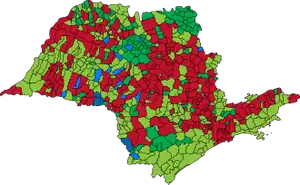 Candidate with the most votes per municipality: Aloizio Mercadante | ||||||||||||||||
| ||||||||||||||||


The 2002 state elections in São Paulo took place on October 6 as part of the general elections held in the Federal District and 26 states.[1] The governor, the lieutenant governor, two senators, seventy federal deputies, and 94 state deputies were elected. Since no gubernatorial candidate received a majority of the valid votes, a runoff election was held on October 27, and, in accordance with the Constitution, the governor and vice governor-elect were to take office on January 1, 2003, for a four-year term.[2][3][a]
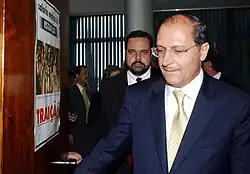
Mário Covas (PSDB), who was elected governor in 1994 and reelected in 1998, died in March 2001.[4][5] The lieutenant governor, Geraldo Alckmin (PSDB), was sworn in as governor and ran for reelection in 2002.[6] In the first round, Alckmin received 38.2% of the vote, beating José Genoino (PT), with 32.4%, and Paulo Maluf (PPB), with 21.3%. In the second round, Alckmin was reelected with 58.6% of the vote, receiving 3.5 million more votes than Genoino.[6] Cláudio Lembo (PFL) was elected lieutenant governor.[6]
In the elections for the National Congress, Aloizio Mercadante (PT) and Romeu Tuma (PFL) were elected senators with 29.8% and 20.7% of the vote, respectively.[7] For the Chamber of Deputies, the Workers' Party (PT) elected eighteen federal deputies and the Brazilian Social Democracy Party (PSDB), eleven. Eight of the elected federal deputies were members of the Liberal Front Party (PFL), six of the Party of the Reconstruction of the National Order (PRONA), five of the Brazilian Labour Party (PTB), and five of the Brazilian Socialist Party (PSB).[8] The Legislative Assembly of São Paulo (Alesp) was composed of 23 deputies from the PT, eighteen from the PSDB, eight from the Brazilian Progressive Party (PPB), six from the PTB, six from the PFL, five from the Popular Socialist Party (PPS), and five from the Green Party (PV), with the remaining 23 seats filled by politicians affiliated with nine other parties.[1]
Background
Mário Covas was the 55th Governor of São Paulo from January 1, 1995, to January 22, 2001, when he stepped down from office due to cancer.[4][5] Since Mário Covas did not resign from office, he remained Governor on medical leave until his death on March 6, 2001. In the meantime, Geraldo Alckmin governed the state as Acting Governor.[6]A member of the Brazilian Social Democracy Party (PSDB), Geraldo Alckmin was chosen as the party’s candidate in an effort to keep the party in power in São Paulo.[6]
The Workers' Party (PT) opted for a ticket consisting entirely of its own members, comprising former guerrilla fighter José Genoíno and labor union leader Luiz Marinho.[9] Paulo Maluf (PPB), the former governor of São Paulo and former mayor of the state capital, also ran for the office in an effort to return to the Palácio dos Bandeirantes.[10]
Dates
The first round was held on October 6, 2006.[1] The second round, meanwhile, was held on October 27, 2002.[11]
State gubernatorial election
Governor-elect
A medical doctor who graduated from the University of Taubaté (UNITAU), Geraldo Alckmin was born in Pindamonhangaba, where he headed the Department of Anesthesiology at Santa Casa de Misericórdia; in Lorena, he taught at the Salesian University Center of São Paulo and at the Santa Teresa Institute. Elected city councilman in his hometown by the Brazilian Democratic Movement (MDB) in 1972, he assumed the presidency of the City Council during that legislative term, and in 1976 he was elected mayor of Pindamonhangaba. With the restoration of the multi-party system under President João Figueiredo, he joined the PMDB and, under that party banner, was elected state representative in 1982 and federal representative in 1986. Two years later, he was one of the founders of the Brazilian Social Democracy Party (PSDB) and signed the 1988 Constitution, winning reelection as a federal deputy in 1990. He voted in favor of the impeachment of Fernando Collor de Mello in 1992, was elected vice governor of São Paulo on Mário Covas’s ticket in 1994, and reelected in 1998. As a candidate for mayor of São Paulo in 2000, he did not even make it to the runoff. Early the following year, he became interim governor following the incumbent’s removal from office, and after Covas’s death on March 6, 2001, he was confirmed as governor. Alckmin ran for reelection in 2002 and was reelected in the runoff after defeating José Genoino of the Workers’ Party (PT).[12]
Vice Governor-elect
A lawyer born in São Paulo and a graduate of the University of São Paulo (USP), Cláudio Lembo worked at Banco Itaú, where he remained for nearly forty years. A professor at Mackenzie Presbyterian University, he served as the institution’s president. A member of National Renewal Alliance (ARENA), he served as Secretary of Extraordinary Affairs during Olavo Setúbal’s tenure as mayor of São Paulo and assumed the state presidency of the party. Defeated by Franco Montoro in the 1978 senatorial election, he returned to political life by joining the PFL. Close to Marco Maciel, he served as that politician’s chief of staff at the Ministry of Education and advised him during his tenure as Vice President of the Republic. He served the São Paulo City Hall as Secretary of Legal Affairs during Jânio Quadros’s second term and was a vice-presidential candidate on Aureliano Chaves’s ticket in 1989. Secretary of Planning during Paulo Maluf’s second term as mayor of São Paulo, he was elected lieutenant governor on Alckmin’s ticket after leaving the presidency of Mackenzie University in 2002, and four years later assumed the governorship when the incumbent resigned to run for the presidency.[13]
Results
First round

| Candidates for state governor | Candidates for lieutenant governor | Number | Coalition | Votes | Percentage |
|---|---|---|---|---|---|
| Geraldo Alckmin | Cláudio Lembo | 45 | São Paulo em Boas Mãos
(PSDB, PFL, PSD) |
7.505.486 | 38,28% |
| José Genoino | Luiz Marinho | 13 | São Paulo quer Mudança
(PT, PCdoB, PCB) |
6.361.747 | 32,45% |
| Paulo Maluf | Heitor Pinto Filho | 11 | Resolve São Paulo
(PPB, PL, PSDC, PTN) |
4.190.706 | 21,37% |
| Carlos Apolinário | Egeferson Craveiro | 30 | São Paulo nas Mãos de Deus
(PGT, PHS, PST) |
703.858 | 3,59% |
| Lamartine Posella[b] | Alda Marco Antônio
PMDB |
15 | — | 259.317 | 1,32% |
| Carlos Roberto Pittoli | Raimundo dos Santos Oliveira | 40 | — | 216.369 | 1,10% |
| Antônio Cabrera | Celso Jatene | 14 | Frente Trabalhista
(PTB, PDT, PPS) |
200.839 | 1,03% |
| Antonio Pinheiro Pedro | Cláudio Turtelli | 43 | — | 52.068 | 0,27% |
| Robson Malek | Adalton Nimtz | 56 | — | 38.545 | 0,20% |
| Dirceu Travesso | Cidinha Lamas | 16 | — | 35.556 | 0,18% |
| Ciro Moura | Eduardo Souza Costa | 36 | Bandeira Paulista
(PTC, PSC, PRP, PTdoB) |
17.854 | 0,09% |
| Levy Fidelix | Luís Roberto Brunello | 28 | — | 8.654 | 0,04% |
| Roberto Siqueira Gomes | Edward Ferraz | 17 | — | 7.648 | 0,04% |
| Anaí Caproni | Edinaldo Augusto | 29 | — | 4.634 | 0,02% |
| Osmar Lins | Roberto Machioni | 26 | — | 3.418 | 0,02% |
Second round
| Candidates for state governor | Candidates for lieutenant governor | Number | Coalition | Votes | Percentage | Ref. |
|---|---|---|---|---|---|---|
| Geraldo Alckmin | Cláudio Lembo | 45 | São Paulo em Boas Mãos
(PSDB, PFL, PSD) |
12.008.819 | 58,64% | [16] |
| José Genoino | Luiz Marinho | 13 | São Paulo quer Mudança
(PT, PCdoB, PCB) |
8.470.863 | 41,36% |
Elected senators
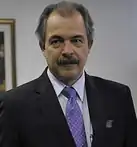

Alozio Mercadante
The son of retired General Osvaldo Muniz Oliva, economist Aloizio Mercadante was born in Santos and opposed the 1964 military dictatorship while studying at the USP, from which he graduated in 1976. Two years later, he earned a master’s degree from the State University of Campinas (Unicamp) and began teaching at the Pontifical Catholic University of São Paulo (PUC-SP), heading the Department of Economics and coordinating the Research Center. He earned a Ph.D. in Economics from the University of Campinas in 1988; prior to that, he had served as president of the National Association of Higher Education Faculty (ANDES) during the João Figueiredo administration and was among the founders of the Central Única dos Trabalhadores (CUT). A member of the PT’s national executive committee, he was elected to the Chamber of Deputies in 1990, voted to initiate the impeachment proceedings against Fernando Collor in 1992, and ran as the vice-presidential candidate on Luiz Inácio Lula da Silva’s ticket in 1994, though he was not elected. In 1998, he was elected to the Chamber of Deputies.[17]
Romeu Tuma
Born in São Paulo and holding a bachelor’s degree in law from the PUC-SP, Romeu Tuma joined the civil police in 1951 and served as a police officer, investigator, and police chief before being appointed as an advisor to Sérgio Paranhos Fleury at the Department of Political and Social Order (DOPS). When Paulo Egydio Martins was governor of São Paulo, Tuma took over the leadership of the DOPS at the behest of the Secretary of Security, Erasmo Dias. Superintendent of the Federal Police in São Paulo during the administration of President João Figueiredo, he was appointed director-general of the agency by José Sarney. Kept in office by Fernando Collor, he combined this role with that of Secretary of the Federal Revenue Service, and in 1991 he assumed one of the vice-presidencies of Interpol. With a police career that included work on the cases of Nazis Gustav Wagner and Josef Mengele and mafia boss Tommaso Buscetta, he served as special advisor to Governor Luiz Antônio Fleury Filho. A cousin of Nicolau Tuma and father of Robson Tuma, he was elected senator for the PL in 1994. After a brief stint with the Social Liberal Party (PSL), he switched to the PFL and ran unsuccessfully for mayor of São Paulo in 2000, but was re-elected to the Senate in 2002.[18]
Results
| Senatorial candidates | Candidates for alternate senator | Numbr | Coalition | Votes | Percentage |
|---|---|---|---|---|---|
| Aloizio Mercadante | José Giacomo Baccarin | 131 | São Paulo quer Mudança
(PT, PCdoB, PCB) |
10.491.345 | 29,86% |
| Romeu Tuma | Alfredo Cotait[c]
Alexandre Thiollier |
252 | São Paulo em Boas Mãos
(PSDB, PFL, PSD) |
7.278.185 | 20,71% |
| Orestes Quércia | Nildo Masini
Sebastião Biazzo |
151 | — | 5.550.803 | 15,80% |
| José Aníbal | Almir Pazzianotto
José Ricardo Franco |
451 | São Paulo em Boas Mãos
(PSDB, PFL, PSD) |
4.957.173 | 14,11% |
| Wagner Gomes | Maria José Jandreice
Davi Gonçalves |
651 | São Paulo quer Mudança
(PT, PCdoB, PCB) |
3.473.198 | 9,88% |
| Cunha Bueno | Marino Pazzaglini
Adalberto Camargo |
111 | Resolve São Paulo
(PPB, PL, PSDC, PTN) |
1.794.415 | 5,11% |
| Eliseu Gabriel | Evaldo Pereira
Evaldo Vicentini |
123 | Frente Trabalhista
(PTB, PDT, PPS) |
259.142 | 0,74% |
| José Luiz Penna | Carlos Gilberto
Vera Lúcia |
434 | — | 226.029 | 0,64% |
| Rubens Calvo | Claudines Beltrami
Antônio Francisco |
401 | — | 220.738 | 0,63% |
| Willians Rafael | João Zangrandi
Manoel Coelho |
147 | Frente Trabalhista
(PTB, PDT, PPS) |
149.606 | 0,43% |
| Mohamad Said Mourad | João Paulo Galvez
Vicente Augusto |
402 | — | 133.925 | 0,38% |
| Paulo Corrêa | Aurino Rocha
Lindete Almeida |
561 | — | 101.371 | 0,29% |
| Ademar Barros Bezerra | Aziz Gabriel
Odyr Rodrigues |
301 | São Paulo nas Mãos de Deus
(PGT, PHS, PST) |
80.617 | 0,23% |
| Mauro Puerro | Ary Blinder
Marisa Mendes |
161 | — | 75.779 | 0,22% |
| Floriano Leandrini | Sandra Aguiar
Francisco Assis Rodrigues |
152 | — | 72.909 | 0,21% |
| Thereza Ruiz | João Dárcio
Valdemar dos Santos |
190 | — | 67.802 | 0,19% |
| José Maria Marin | Dirceu Resende
Carlos Alberto da Silva |
200 | Bandeira Paulista
(PTC, PSC, PRP, PTdoB) |
63.659 | 0,18% |
| José Raul Brasiliense | Rubens Cascaldi
Antônio Carlos Inácio |
312 | São Paulo nas Mãos de Deus
(PGT, PHS, PST) |
41.395 | 0,12% |
| Renato Bento Luiz | Alfredo Silva
Marcus Vinícius |
162 | — | 37.732 | 0,11% |
| Lucas Albano | Iara Perali dos Santos
Teresinha Carvalho Dias |
333 | — | 22.934 | 0,07% |
| Paulo Fortunato | Ariovaldo Gobatti
José Alfredo Machado |
270 | — | 17.888 | 0,05% |
| Wlamisa Feltrim | Afrânio Raes
Consuelo dos Santos |
291 | — | 6.939 | 0,02% |
| Firmino Rosa | Elza Costa
Silvia Quirino |
292 | — | 5.327 | 0,01% |
| Carlos Henrique Darde | Daniel Oltramari
Aldinéa Fidelix |
281 | — | 4.845 | 0,01% |
| José Costa | Ivonete Pasternack
João Rezende Neto |
266 | — | 4.439 | 0,01% |
Elected federal deputies
The list includes the elected candidates along with additional information from the Chamber of Deputies. Enéas Carneiro, of the Party of the Reconstruction of the National Order (PRONA), was elected to the Chamber of Deputies with 1.5 million votes. Enéas thus became the most-voted-for federal deputy in Brazilian history up to that point. His vote effectively elected five other deputies from his party, who together received 20,235 votes.[8]
| Federal deputies electeds | Party | Votes | Percentage | Birthplace |
| Enéas Carneiro | PRONA | 1.573.642 | 8,02% | Rio Branco |
| José Dirceu[d] | PT | 556.768 | 2,83% | Passa Quatro |
| José Eduardo Cardozo | PT | 303.033 | 1,54% | São Paulo |
| Celso Russomanno | PPB | 261.635 | 1,33% | São Paulo |
| Vicente Paulo da Silva | PT | 254.221 | 1,29% | Santa Cruz |
| Michel Temer | PMDB | 252.229 | 1,28% | Tietê |
| Aloysio Nunes | PSDB | 250.936 | 1,27% | São José do Rio Preto |
| Gilberto Nascimento | PSB | 240.664 | 1,22% | São Paulo |
| Gilberto Kassab[e] | PFL | 234.509 | 1,19% | São Paulo |
| José Pinotti | PMDB | 209.105 | 1,06% | São Paulo |
| Luíza Erundina | PSB | 207.396 | 1,05% | Uiraúna |
| Salvador Zimbaldi | PSDB | 199.930 | 1,01% | Campinas |
| João Paulo Cunha | PT | 196.945 | 1,00% | Caraguatatuba |
| Walter Feldman | PSDB | 186.216 | 0,94% | São Paulo |
| José Mentor | PT | 182.956 | 0,93% | Santa Isabel |
| Vanderval Santos | PL | 177.456 | 0,90% | Rio de Janeiro |
| Robson Tuma | PFL | 175.366 | 0,89% | São Paulo |
| Arnaldo Madeira | PSDB | 175.312 | 0,89% | Santos |
| Iara Bernardi | PT | 166.138 | 0,84% | Sorocaba |
| Alberto Goldman[f] | PSDB | 165.381 | 0,84% | São Paulo |
| Telma de Souza | PT | 161.198 | 0,82% | Santos |
| Carlos Sampaio | PSDB | 160.963 | 0,82% | Campinas |
| Valdemar Costa Neto[g] | PL | 158.510 | 0,80% | São Paulo |
| Ângela Guadagnin | PT | 153.931 | 0,78% | Rio de Janeiro |
| Jefferson Campos | PSB | 153.622 | 0,78% | Ourinhos |
| Corauci Sobrinho | PFL | 149.971 | 0,78% | Ribeirão Preto |
| Luiz Eduardo Greenhalgh | PT | 147.819 | 0,75% | São Paulo |
| Mendes Thame | PSDB | 143.313 | 0,73% | Piracicaba |
| Professor Luizinho | PT | 142.812 | 0,72% | Cândido Mota |
| Júlio Semeghini | PSDB | 138.907 | 0,70% | Fernandópolis |
| Arlindo Chinaglia | PT | 136.402 | 0,69% | Serra Azul |
| Zulaiê Cobra | PSDB | 134.776 | 0,69% | São José do Rio Pardo |
| Aldo Rebelo | PCdoB | 134.241 | 0,68% | Viçosa |
| Ricardo Berzoini | PT | 132.176 | 0,67% | Juiz de Fora |
| Delfim Neto | PPB | 131.399 | 0,67% | São Paulo |
| Devanir Ribeiro | PT | 130.574 | 0,66% | Getulina |
| Milton Monti | PMDB | 130.235 | 0,66% | São Manuel |
| Paulo Lima | PFL | 130.158 | 0,66% | Presidente Prudente |
| Neuton Lima | PFL | 127.677 | 0,65% | São Paulo |
| Antonio Carlos Pannunzio | PSDB | 125.570 | 0,64% | Sorocaba |
| Orlando Fantazzini | PT | 123.163 | 0,63% | Guarulhos |
| Bispo João Batista | PFL | 121.255 | 0,61% | Rio de Janeiro |
| Edna Macedo | PTB | 118.474 | 0,60% | Rio das Flores |
| Dimas Ramalho | PPS | 116.581 | 0,59% | Taquaritinga |
| Luiz Carlos Santos | PFL | 116.286 | 0,59% | Araxá |
| Luciano Zica | PT | 115.341 | 0,59% | Biquinhas |
| Lobbe Neto | PSDB | 114.586 | 0,58% | São Paulo |
| Roberto Gouveia | PT | 113.494 | 0,57% | Ituiutaba |
| Ivan Valente | PT | 110.034 | 0,56% | São Paulo |
| Marcos Roberto Abramo | PFL | 109.468 | 0,55% | Porto Ferreira |
| Vadão Gomes | PPB | 108.533 | 0,55% | Populina |
| Luiz de Medeiros | PL | 108.474 | 0,55% | Eirunepé |
| Vicente Cascione | PSB | 108.094 | 0,55% | Santos |
| Jovino Cândido | PV | 99.357 | 0,50% | Florínea |
| Ricardo Izar | PTB | 99.320 | 0,50% | São Paulo |
| Durval Orlato | PT | 95.591 | 0,48% | Jundiaí |
| Jamil Murad | PCdoB | 95.301 | 0,48% | José Bonifácio |
| Nelson Marquezelli | PTB | 89.531 | 0,45% | Pirassununga |
| João Herrmann Neto | PPS | 87.090 | 0,44% | Campinas |
| Arnaldo Faria de Sá | PTB | 86.490 | 0,44% | São Paulo |
| Claudio Magrão | PPS | 86.108 | 0,43% | Osasco |
| Luiz Antônio Fleury Filho | PTB | 82.429 | 0,42% | São José do Rio Preto |
| Hélio Santos[h] | PDT | 74.213 | 0,37% | Corumbá |
| Dr. Evilásio[i] | PSB | 63.710 | 0,32% | Cabaceiras |
| Marcelo Ortiz | PV | 36.486 | 0,18% | Penápolis |
| Amauri Gasques | PRONA | 18.421 | 0,09% | São Paulo |
| Irapuan Teixeira | PRONA | 673 | zero | Porto Alegre |
| Elimar Damasceno | PRONA | 484 | zero | Santa Maria do Suaçuí |
| Ildeu Araujo | PRONA | 382 | zero | Serrania |
| Vanderlei Assis | PRONA | 275 | zero | Rio de Janeiro |
Elected state deputies
A total of 94 state representatives were elected to the São Paulo State Legislative Assembly (Alesp).[26]
| Elected state representatives | Party | Vote(s) | Percentage | Birthplace |
| Havanir Nimtz | PRONA | 682.219 | 3,48% | Itabaiana |
| Conte Lopes | PPB | 207.006 | 1,06% | São Paulo |
| Afanásio Jazadji | PFL | 157.602 | 0,80% | São Paulo |
| Edson Aparecido | PSDB | 148.650 | 0,76% | São Paulo |
| Campos Machado | PTB | 145.647 | 0,74% | Cerqueira César |
| Rodrigo Garcia | PFL | 137.738 | 0,70% | Tanabi |
| Vaz de Lima | PSDB | 132.427 | 0,68% | Fernandópolis |
| Hamilton Pereira | PT | 131.637 | 0,67% | Sorocaba |
| Waldir Agnello | PSB | 130.069 | 0,67% | Santos |
| Pedro Tobias | PSDB | 123.960 | 0,63% | Bekarzla |
| Ricardo Tripoli | PSDB | 120.746 | 0,62% | São Paulo |
| Antonio Mentor | PT | 120.470 | 0,62% | São Paulo |
| Ênio Tatto | PT | 118.233 | 0,61% | Frederico Westphalen |
| Edson Ferrarini | PTB | 144.597 | 0,59% | São Paulo |
| Eli Corrêa Filho | PFL | 114.039 | 0,58% | São Paulo |
| Carlinhos Almeida | PT | 111.602 | 0,57% | Santa Rita de Jacutinga |
| Célia Leão | PSDB | 109.741 | 0,56% | São Paulo |
| Celino Cardoso | PSDB | 108.274 | 0,55% | Terra Rica |
| Mauro Menuchi | PT | 107.248 | 0,55% | Caieiras |
| Maria Lúcia Prandi | PT | 106.444 | 0,54% | Potirendaba |
| João Caramez | PSDB | 104.649 | 0,53% | Itapevi |
| Vanderlei Macris | PSDB | 104.223 | 0,53% | Americana |
| Duarte Nogueira | PSDB | 103.851 | 0,53% | Ribeirão Preto |
| Emídio de Souza | PT | 102.331 | 0,52% | Inúbia Paulista |
| Analice Fernandes | PSDB | 100.134 | 0,51% | Jales |
| Roberto Morais | PPS | 97.372 | 0,50% | Charqueada |
| Geraldo Tenuta Filho | PSDB | 96.857 | 0,50% | São Paulo |
| Simão Pedro Chiovetti | PT | 94.089 | 0,48% | Tapira |
| Renato Simões | PT | 93.886 | 0,48% | Campinas |
| Ítalo Cardoso | PT | 91.206 | 0,47% | Araçuaí |
| Edmir Chedid | PFL | 88.021 | 0,45% | Campinas |
| Vicente Cândido | PT | 86.901 | 0,44% | Bom Jesus do Galho |
| Donisete Braga | PT | 86.877 | 0,44% | Flora Rica |
| Alberto Hiar | PSDB | 86.474 | 0,44% | São Paulo |
| Gonzaga | PSDB | 86.366 | 0,44% | Tatuí |
| Adriano Diogo | PT | 85.515 | 0,44% | São Paulo |
| Valdomiro Lopes | PPB | 84.918 | 0,43% | São José do Rio Preto |
| Ary Fossen | PSDB | 84.354 | 0,43% | Jundiaí |
| Wagner Salustiano | PPB | 82.793 | 0,42% | São Paulo |
| Cândido Vaccarezza | PT | 82.793 | 0,42% | Senhor do Bonfim |
| Rodolfo da Costa e Silva | PSDB | 81.576 | 0,42% | Goiânia |
| Sidney Beraldo | PSDB | 81.328 | 0,42% | São João da Boa Vista |
| Vanderlei Siraque | PT | 81.089 | 0,42% | Santa Cruz do Rio Pardo |
| Jorge Caruso | PMDB | 80.502 | 0,41% | São Paulo |
| José Zico Prado | PT | 77.707 | 0,40% | Macaubal |
| Baleia Rossi | PMDB | 77.641 | 0,40% | São Paulo |
| Arnaldo Jardim | PPS | 76.708 | 0,39% | Altinópolis |
| Mário Reali | PT | 75.656 | 0,39% | São Paulo |
| Maria Lúcia Amary | PSDB | 75.456 | 0,39% | São Paulo |
| Sebastião Almeida | PT | 73.864 | 0,38% | Guaporema |
| Benedito Roberto Alves | PTB | 73.059 | 0,37% | Taubaté |
| Souza Santos | PL | 72.635 | 0,37% | Nova Londrina |
| Milton Vieira | PFL | 70.781 | 0,36% | Iepê |
| Geraldo Vinholi | PDT | 69.927 | 0,36% | Itápolis |
| Marquinho Tortorello | PPS | 69.440 | 0,36% | São Joaquim da Barra |
| Ana do Carmo | PT | 67.752 | 0,35% | São Paulo |
| Vitor Sapienza | PPS | 67.531 | 0,34% | São Paulo |
| Ana Maria Martins | PCdoB | 67.278 | 0,34% | São Paulo |
| José Caldini Crespo | PFL | 67.027 | 0,34% | Sorocaba |
| Maria de Jesus | PTN | 66.067 | 0,34% | São Paulo |
| Marcelo Cândido[j] | PT | 65.611 | 0,34% | Marília |
| José Carlos Stangarlini | PSDB | 65.478 | 0,33% | São Paulo |
| Romeu Tuma Júnior | PPS | 63.523 | 0,33% | São Paulo |
| Rafael Silva | PSB | 62.498 | 0,32% | Jardinópolis |
| Paschoal Thomeu | PTB | 61.646 | 0,31% | São Paulo |
| Fausto Figueira | PT | 61.387 | 0,31% | São Paulo |
| Roque Barbiere | PTB | 61.092 | 0,31% | Coroados |
| Beth Sahão | PT | 60.042 | 0,31% | Urupês |
| Adilson Rossi | PTB | 60.019 | 0,31% | Itatiba |
| Rogério Nogueira | PDT | 59.097 | 0,30% | Indaiatuba |
| Vinícius Camarinha | PSB | 58.409 | 0,30% | Marília |
| José Dilson de Carvalho | PDT | 58.198 | 0,30% | São Paulo |
| Tião Arcanjo | PT | 57.174 | 0,29% | Campinas |
| Luiz Carlos Gondim | PV | 56.967 | 0,29% | Fortaleza |
| Nivaldo Santana Silva | PCdoB | 56.708 | 0,29% | São Paulo |
| Ubiratan Guimarães | PPB | 56.155 | 0,29% | São Paulo |
| Aldo Demarchi | PPB | 55.995 | 0,29% | Rio Claro |
| Antônio Salim Curiati | PPB | 54.333 | 0,28% | Avaré |
| Marcelo Siqueira Bueno | PDT | 52.508 | 0,27% | São Paulo |
| Orlando Morando | PSB | 50.400 | 0,26% | São Bernardo do Campo |
| Gilson de Souza | PPB | 48.723 | 0,25% | Delfinópolis |
| Artur Alves Pinto | PL | 45.732 | 0,23% | São Paulo |
| Rosmary Corrêa | PMDB | 44.648 | 0,23% | São Paulo |
| Edson Gomes | PPB | 43.821 | 0,22% | Fernandópolis |
| Zuza Abdul Massih | PRP | 43.716 | 0,22% | Beirute |
| Geraldo Lopes | PMDB | 43.017 | 0,22% | São Miguel do Anta |
| José Afonso Lobato | PV | 41.334 | 0,21% | Redenção da Serra |
| Paulo César Neme | PV | 39.154 | 0,20% | Cotia |
| José Bittencourt | PGT | 35.778 | 0,18% | Tobias Barreto |
| Giba Marson | PV | 34.895 | 0,18% | São Bernardo do Campo |
| Ricardo Castilho | PV | 28.662 | 0,15% | Glicério |
| Ahmad Said Mourad | PRONA | 13.137 | 0,07% | São Paulo |
| Paulo Sérgio Rodrigues Alves | PRONA | 11.616 | 0,06% | Guarulhos |
| Adilson Barroso | PRONA | 9.928 | 0,05% | Leme do Prado |
Notes
- ↑ The inauguration of the elected lawmakers was scheduled for February 1, 2003, for federal deputies, and March 15, 2003, for state deputies.
- ↑ He replaced the writer Fernando Morais, who withdrew from the race for governor of São Paulo ,[14] claiming that he did not want to give Orestes Quércia any airtime.[15]
- ↑ Following Tuma's death, he took his seat in the Senate on November 3, 2010, and remained in office until 2011.[19]
- ↑ He initially took a leave of absence from his parliamentary seat to serve as Chief of Staff, but as soon as he left the Executive Branch, his seat was revoked on December 1, 2005, for breach of parliamentary decorum, and Mariângela Duarte was subsequently appointed to fill the vacancy.[20]
- ↑ Elected deputy mayor of São Paulo in 2004, he resigned from his parliamentary seat in favor of Paulo Kobayashi.[21]
- ↑ Elected lieutenant governor of São Paulo in 2006, he resigned from his parliamentary seat in the final month of the legislative session to make way for Xico Graziano.[22]
- ↑ He resigned from his parliamentary seat on August 1, 2005, and Fernando Estima was subsequently appointed to the position.[23]
- ↑ Elected mayor of Campinas in 2004, he resigned from his parliamentary seat in favor of Ary Kara.[24]
- ↑ Elected mayor of Taboão da Serra in 2004, he resigned from his parliamentary seat in favor of Edinho Montemor.[25]
- ↑ He resigned from office in favor of his alternate, Carlos Neder, upon being elected mayor of Suzano in 2004.[27]
References
- 1 2 3 Rodrigues, Fernando. "Eleições 2002 - Resultados - Presidente - 1º turno". Universo Online. Archived from the original on January 25, 2019. Retrieved May 7, 2026.
- ↑ "Constituição de 1988". Palácio do Planalto. October 5, 1988. Archived from the original on May 6, 2026. Retrieved May 7, 2026.
- ↑ Maciel, Marco (September 30, 1997). "Lei Nº 9.504, de 30 de setembro de 1997". Palácio do Planalto. Archived from the original on May 3, 2026. Retrieved May 9, 2026.
- 1 2 "Morre Mário Covas, governador de São Paulo". Legislative Assembly of São Paulo (in Brazilian Portuguese). March 6, 2001. Archived from the original on July 24, 2025. Retrieved May 8, 2026.
- 1 2 "Brasil de luto por Covas". Jornal do Brasil. 110 (332): 1. March 7, 2021.
- 1 2 3 4 5 "Geraldo Alckmin toma posse no cargo de governador em 1º de janeiro". Legislative Assembly of São Paulo (in Brazilian Portuguese). December 30, 2002. Archived from the original on January 15, 2026. Retrieved May 9, 2026.
- ↑ Natali, João (October 7, 2002). "Senado: Mercadante e Tuma se elegem em SP". Folha de S.Paulo. Archived from the original on May 9, 2026. Retrieved May 9, 2026.
- 1 2 "Veja a lista dos 70 deputados federais eleitos por São Paulo". Folha de S. Paulo. October 9, 2002. Archived from the original on February 13, 2023. Retrieved May 9, 2026.
- ↑ "Candidatos na Folha/ Genoino: Genoino prega "força" contra violência". Folha de S. Paulo. August 27, 2002. Archived from the original on April 15, 2026. Retrieved May 9, 2026.
- ↑ Christofoletti, Lilian (October 13, 2002). "Maluf pressentiu maior derrota na véspera -". Folha de S. Paulo. Archived from the original on May 9, 2026. Retrieved May 9, 2026.
- ↑ "Cronologia das eleições". Superior Electoral Court (in Brazilian Portuguese). Archived from the original on April 20, 2026. Retrieved May 9, 2026.
- ↑ "Biografia do Vice-Presidente da República". Palácio do Planalto. Archived from the original on April 19, 2026. Retrieved May 8, 2026.
- ↑ "Cláudio Lembo". Legislative Assembly of São Paulo (in Brazilian Portuguese). Archived from the original on June 11, 2024. Retrieved May 8, 2026.
- ↑ "Fernando Morais abandona a sucessão paulista". Terra. August 19, 2002. Archived from the original on November 26, 2002. Retrieved November 26, 2002.
- ↑ "Morais não quis dar tempo de TV para Quércia". Terra. August 19, 2002. Archived from the original on December 6, 2017. Retrieved December 6, 2017.
- ↑ "Eleições 2002 - Governador". PSDB (in Brazilian Portuguese). February 2, 2022. Archived from the original on June 21, 2025. Retrieved May 8, 2026.
- ↑ "Aloizio Mercadante". Brazilian Development Bank. Archived from the original on June 18, 2025. Retrieved May 8, 2026.
- ↑ "Romeu Tuma". Memorias da Ditadura (in Brazilian Portuguese). Archived from the original on March 16, 2026. Retrieved May 9, 2026.
- ↑ Guerreiro, Gabriela (November 3, 2010). "Alfredo Cotait assume vaga de Romeu Tuma no Senado". Folha de S.Paulo. Archived from the original on March 1, 2023. Retrieved May 9, 2026.
- ↑ "Câmara cassa mandato de José Dirceu". Senado Federal (in Brazilian Portuguese). December 1, 2005. Archived from the original on July 23, 2025. Retrieved May 9, 2026.
- ↑ "Biografia do(a) Deputado(a) Federal PAULO KOBAYASHI". Portal da Câmara dos Deputados (in Brazilian Portuguese). Archived from the original on May 9, 2026. Retrieved May 9, 2026.
- ↑ Sampaio, Paulo (January 28, 2007). "Congresso vive "casual January" no recesso". Folha de S.Paulo. Archived from the original on May 9, 2026. Retrieved May 9, 2026.
- ↑ Pedrosa, Fábio (August 1, 2005). "Valdemar Costa Neto renuncia ao mandato de deputado". Portal da Câmara dos Deputados (in Brazilian Portuguese). Archived from the original on May 9, 2026. Retrieved May 9, 2026.
- ↑ "Biografia do(a) Deputado(a) Federal ARY KARA". Portal da Câmara dos Deputados (in Brazilian Portuguese). Archived from the original on December 12, 2024. Retrieved May 9, 2026.
- ↑ Amato, Fábio (August 7, 2005). "Presidente do PL diz que PT o botou na "maior fria"". Folha de S. Paulo. Archived from the original on August 9, 2005. Retrieved May 9, 2026.
- ↑ "Deputados estaduais". Folha de S. Paulo. Archived from the original on November 25, 2025. Retrieved May 9, 2026.
- ↑ "Liminar garante posse de suplente". Legislative Assembly of São Paulo (in Brazilian Portuguese). January 6, 2005. Archived from the original on December 11, 2024. Retrieved May 9, 2026.