o-Coumaric acid
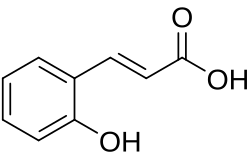 | |
| Names | |
|---|---|
| Preferred IUPAC name
(2E)-3-(2-Hydroxyphenyl)prop-2-enoic acid | |
| Other names
ortho-Coumaric acid 2-Hydroxycinnamic acid | |
| Identifiers | |
3D model (JSmol) |
|
| ChEBI | |
| ChemSpider | |
| ECHA InfoCard | 100.009.444 |
PubChem CID |
|
| UNII | |
CompTox Dashboard (EPA) |
|
| |
| |
| Properties | |
| C9H8O3 | |
| Molar mass | 164.16 g/mol |
| Hazards | |
| GHS labelling:[1] | |
  | |
| Danger | |
| H301, H315, H319, H335 | |
| P261, P264, P270, P271, P280, P301+P310, P302+P352, P304+P340, P305+P351+P338, P312, P321, P330, P332+P313, P337+P313, P362, P403+P233, P405, P501 | |
Except where otherwise noted, data are given for materials in their standard state (at 25 °C [77 °F], 100 kPa).
Infobox references | |

o-Coumaric acid is a hydroxycinnamic acid, an organic compound that is a hydroxy derivative of cinnamic acid. There are three isomers of coumaric acids — o-coumaric acid, m-coumaric acid, and p-coumaric acid — that differ by the position of the hydroxy substitution of the phenyl group.
Natural occurrence
o-Coumaric acid can be found in vinegar.
Biosynthesis
In some plants such as Melilotus species, o-coumaric acid is produced directly from cinnamic acid by the enzyme trans-cinnamate 2-monooxygenase.[2]


Metabolism
2-Coumarate reductase is an enzyme that converts o-coumaric acid to melilotic acid using reduced nicotinamide adenine dinucleotide (NADH).[3] This enzyme participates in phenylalanine metabolism.[4]


2-coumarate O-beta-glucosyltransferase forms a glucoside by transferring glucose from UDP-glucose:


This occurs in Melilotus alba and gives uridine diphosphate (UDP) as byproduct.[5]
References
- ↑ GHS: PubChem
- ↑ Gestetner, Benjamin; Conn, Eric E. (1974). "The 2-hydroxylation of trans-cinnamic acid by chloroplasts from Melilotus alba desr". Archives of Biochemistry and Biophysics. 163 (2): 617–624. doi:10.1016/0003-9861(74)90522-0. PMID 4153528.
- ↑ Enzyme 1.3.1.11 at KEGG Pathway Database.
- ↑ Levy, Carl C.; Weinstein, Gerald D. (1964). "The Metabolism of Coumarin by a Microorganism. II. The Reduction of o-Coumaric Acid to Melilotic Acid". Biochemistry. 3 (12): 1944–7. doi:10.1021/bi00900a027. PMID 14269315.
- ↑ Poulton JE, McRee BE, Conn EE (1980). "Intracellular localization of two enzymes involved in coumarin biosynthesis in Melilotus alba". Plant Physiol. 65 (2): 171–175. doi:10.1104/pp.65.2.171. PMC 440292. PMID 16661155.
External links