1984 Islington nursery strike
The Islington nursery strike began on 16 April 1984, when 154 nursery workers employed by the London Borough of Islington began a period of indefinite strike action, in response to the council's refusal to accept their demands for a 20% increase in pay, improved staffing ratios, and 70 more staff.[1][2][3] At the time, the nursery workers had a take-home pay of £85 per week.[2] The strike lasted 15 weeks and closed all 12 of the social service run nurseries and day centres.[4] It was led by the National and Local Government Officers' Association (NALGO) and the National Union of Public Employees (NUPE) against the local authority of Islington.[4] Demonstrations were often held at Islington's Town Hall.[5] The strike ended on 30 July and resulted in improved working conditions and staff-to-child ratios of 1:4.[4] The 1984 Islington nursery strike was later the subject of a three-part audio documentary series, Nursery Workers Bite Back, produced by On the Record.[6]
Background
Unworkable conditions
In the early 1980s, Islington Council's Children's Day Centres were chronically understaffed.[7] While the official staffing ratio was one worker to every four and a half children, the absence of cover for staff leave frequently resulted in individual workers being solely responsible for groups of twelve or more young children.[8]
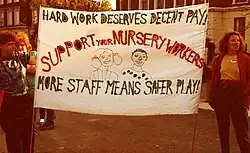
NALGO claim
In October 1983, the National and Local Government Officers' Association (NALGO) submitted a claim calling for improved staff-to-child ratios, higher pay, a regrading of the pay structure, and the removal of the qualifications bar. Nursery workers stated these changes would be "an investment in our children's future".[9]
The Strike
Strike action begins
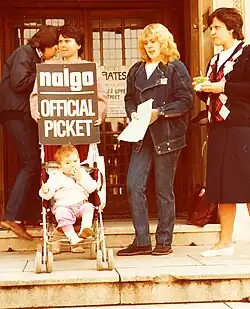

On 10 April 1984, a mass meeting was held and the nursery workers voted almost unanimously to strike on Monday 16 April 1984.[4] In the Spare Rib, strikers described the difficult decision to strike, "those worst hit are not the council, who have consistently refused to take our demands seriously, but the women and children we service".[8]
The Strike News

During the 1984 Islington Nursery Strike, strikers produced and distributed The Strike News once a week using a printing machine supplied by a community-run printmakers on Holloway Road.[4]
Occupation of Islington Town Hall
At the end of April, a group of parents occupied Islington's Town Hall with their children by camping in the lobby, as reported in Strike News 3 and The Guardian newspaper.[10]
Tea with the Miners' Wives
In early June, a delegation of miners' wives from Kent were invited to Islington Town Hall to meet the Mayor, Rosie Dale, as a gesture of support for the ongoing miners' strike.[11] They refused to cross the nursery workers' picket line and so had tea with the Mayor, and the striking nursery workers, on the front steps of the hall instead.[11]
Islington NALGO branch one-day strike
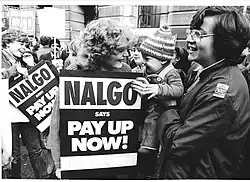
On Monday 21 May, the Islington branch of the National and Local Government Officers' Association (NALGO), which had approximately 2,000 members, held a one-day strike.[1]
Support from miners and Arthur Scargill

With support from the miners of the 1984–1985 United Kingdom miners' strike, in early June, the National Union of Public Employees (NUPE) and the National Graphical Association (NGA) invited Arthur Scargill, leader of the National Union of Mineworkers (NUM), to speak at Islington Town Hall in support of the strikers.[1] During the event, one of the striking nursery workers, Terry Conway, addressed the audience about the ongoing dispute and Scargill signed a petition in support of the nursery workers.[4]
Council meeting action

On the evening of the 19 June, a large march of around 400 people was held from Highbury Fields to the Islington Town Hall, where a council meeting was taking place.[12] Parents and nursery workers packed the public gallery and disrupted the meeting, while nursery workers climbed onto the roof and flew their banner from the town hall's flagpole.[12]
NALGO escalation
400 council workers were called out on indefinite strike in support of the nursery workers from Tuesday 3 July.[1]
The nursery workers called for a ballot of the entire NALGO branch which was successfully agreed upon by the NALGO national executive.[4]
Resolution
By the end of July the strike was resolved and was the longest in Islington Council's history.[4] The nursery workers had voted to accept the council's offer of 26 additional staff posts, deputy managers being made supernumery (meaning they were no longer counted in the ratios) removal of the qualification bar and recognition of a wider range of qualifications and a pay increase of £3 a week.[3]
Outcome
The strike ended without full demands being met but successes included:
- Qualification bar was abolished meaning workers without a qualification could proceed;
- Recognised qualifications broadened to include CQSW (Certificate of Qualification in Social Work), Advanced playgroup and nursery teachers certificate;
- Pay increase of £3 a week;
- 26 extra staff appointed, one extra per centre to replace Deputies who will become supernumerary.[4][3][13]
Margaret Hodge controversy
Margaret Hodge, leader of Islington Council, came under criticism for advertising for a "Mothers' help" in The Lady magazine during the industrial action.[14][2] In response to this, one of the strikers in The Daily Telegraph said "by refusing to meet our demands she is prolonging the strike and stopping Islington mothers having the use of nurseries for their children".[2]
Events after the strike
A further industrial dispute involving nursery workers in Islington took place in 1989.[13] This indefinite strike was prompted by the suspension of Children's Day Centre managers who had refused to apply an increased child-to-staff ratio of 8:1.[13] As a result of the strike action the number of children in the nurseries increased by 11% rather than 27% [4]
References
- 1 2 3 4 "Walk-out threat by council 5000". The Evening Standard. 29 May 1984. p. 8.
- 1 2 3 4 Silk, Brian (28 June 1984). "Nanny for Labour leader angers nursery strikers". The Daily Telegraph. p. 6.
- 1 2 3 Gaunt, Catherine. "Remembering the Islington nursery workers strike 40 years on". Nursery World. Retrieved 2 April 2024.
- 1 2 3 4 5 6 7 8 9 10 Schling, Rosa, ed. (2025). We've Had Enough Of Not Having Enough. London: On The Record. ISBN 9780992739355. OCLC 1551360090.
- ↑ "The Town Hall Follies". The Sunday Times. 13 May 1984.
- ↑ "Nursery Workers Bite Back Episode 1 | Childcare Voices". 15 April 2025.
- ↑ Harrington, Patrick (5 May 2025). "'One to Four and Not One More': The Islington Nursery Workers' Strike and Why It Still Matters". Solidarity Trade Union.
- 1 2 Loach, Loretta (September 1984). "Striking For Care". Spare Rib.
- ↑ "Gripes in the Nursery". The Gazette. 11 May 1984.
- ↑ Hanson, Michele (20 May 1984). "Vanity Fair, Warding off a few evil spirits". The Guardian. p. 9.
- 1 2 Wiard, Andrew (7 June 1984). "Kent Miners Wives with NALGO Nursery Workers" (PDF). Socialist Organiser. p. 3.
- 1 2 Hanson, Michele (27 August 1984). "Vanity Fair". The Guardian. p. 8.
- 1 2 3 Gaunt, Catherine (16 April 2025). "The story of the Islington nursery workers strike in their own words told in a new podcast". Nursery World.
- ↑ "The Times Diary, Mind Out There". The Times. No. 61867. 26 June 1984. p. 10. Retrieved 2 July 2025.
External links
- The subject of Nursery Workers Bite Back audio documentary produced by On the Record
- Featured in Grow Your Own's Childcare History Map
- In 2025, some of the strikers and those involved in producing the Nursery Workers Bite Back audio documentary reflected on their collaboration in "The Islington Nursery Strike" episode on The History Workshop Podcast