14th Pennsylvania Cavalry Regiment
| 14th Pennsylvania Cavalry Regiment | |
|---|---|
 State flag of Pennsylvania, c. 1863 | |
| Active | November 23, 1862, to August 24, 1865 |
| Country | United States |
| Allegiance |  Union  Pennsylvania |
| Branch | Union Army |
| Type | Cavalry |
| Size | Regiment |
| Engagements | American Civil War 1863: Battle of White Sulphur Springs, Battle of Droop Mountain 1864: Battle of Cove Mountain, Battle of Lynchburg, Second Battle of Kernstown, Battle of Moorefield, Third Battle of Winchester, Battle of Fisher's Hill, Battle of Cedar Creek, Action at Nineveh |
| Commanders | |
| Colonel | James M. Schoonmaker |
| Lt. Col | William Blakeley |
| Major | Thomas Gibson |
| Major | John M. Daily |
| Major | Shadrack Foley |
| Captain | Ashbell F. Duncan |
The 14th Pennsylvania Cavalry Regiment (also known as the 159th Pennsylvania Volunteers) was a cavalry regiment of the Union Army during the American Civil War. Most of its fighting happened in the last half of 1863 and full year 1864. The regiment fought mainly in West Virginia and Virginia, often as part of a brigade or division commanded by Brigadier General William W. Averell and later Brigadier General William Powell.
The regiment was organized near Pittsburgh between August and November 1862. With the exception of one company from the Philadelphia area, its recruits were from western Pennsylvania. The regiment's original commander, Colonel James M. Schoonmaker, was one of the youngest regimental commanders in the Union Army at 20 years old. Pittsburgh attorney William Blakeley was the regiment's original lieutenant colonel.
The regiment saw significant action at the Battle of White Sulphur Springs, Battle of Droop Mountain, Battle of Moorefield, and the Third Battle of Winchester. The regiment had two officers and 97 enlisted men killed or mortally wounded, while disease killed 296 enlisted men. The three original majors were Thomas Gibson, Shadrack Foley, and John M. Daily. Captain Thomas R. Kerr won the Medal of Honor for capturing a regimental flag at Moorefield where he was an advance scout, while Schoonmaker received the same award for action at the Third Battle of Winchester.
Formation and organization
James M. Schoonmaker, of Pittsburgh, began recruiting during August 1862. At the time, he was a lieutenant in the Union's 1st Maryland Cavalry Regiment.[1] With the exception of Philadelphia's Company A, recruiting was conducted in western Pennsylvania. The men were mustered into service from August 21 through November 4, 1862, for three years.[2] The regiment was mustered into service on November 23, 1862, as the 14th Pennsylvania Volunteer Cavalry.[3] In Pennsylvania, the regiment was also known as the One Hundred and Fifty-Ninth Pennsylvania Volunteers, since it was the 159th regiment of any branch raised in Pennsylvania.[4]
Original leadership was Schoonmaker as Colonel and William H. Blakeley as lieutenant colonel.[3][Note 1] Thomas Gibson, Shadrack Foley, and John M. Daily were majors commanding the First, Second, and Third battalions, respectively.[3] Schoonmaker was only 20 years and four months old at the time, making him one of the youngest regiment commanders in the Union Army.[7] The regiment spent time at Camp Howe and Camp Montgomery, near Pittsburgh, before moving to Hagerstown, Maryland on November 24, where it received horses, arms, and equipment. On December 28, the regiment moved to Harper's Ferry, Virginia, where it was assigned picket and reconnaissance (scouting) duty.[8]
On May 7, 1863, a detachment of unmounted men was left in Harper's Ferry under the command of Major Foley, while the remaining portion of the regiment joined the 4th Separate Brigade of the VIII Army Corps at Grafton, Virginia (now West Virginia).[8] Grafton had a terminal for the Baltimore and Ohio Railroad (a.k.a. B&O Railroad), and the Union Army used the railroad for hauling soldiers and supplies.[9] The regiment was initially tasked with duty protecting the nearby communities of Philippi, Beverly and Webster.[10] On May 23, Brigadier General William W. Averell took command of the brigade, relieving Brigadier General Benjamin S. Roberts. Averell's 4th Separate Brigade consisted of one cavalry regiment, three mounted infantry regiments, two infantry regiments, a cavalry battalion, and two batteries.[11][Note 2]
Early action

On July 2, 1863, the 10th West Virginia Infantry Regiment was attacked by 1,700 Confederate soldiers and nearly surrounded near its camp in Beverly.[12] Two squadrons of the 14th Pennsylvania Cavalry, under the command of Major Gibson, were sent to Beverly, and arrived about four miles (6.4 km) north of town around 3:00 am on July 3. They surprised Confederate infantry along the Cheat River at about 8:00 am, and drove them back to a breastworks.[13]
The regiment took part in the pursuit of Robert E. Lee's Army of Northern Virginia as it was retreating after the Battle of Gettysburg] to Virginia. On July 4, Major Foley led a force of 300 men (including men from the 14th Pennsylvania Cavalry and other regiments) that burned a bridge over the Potomac River and captured enemy soldiers.[14] On July 13, Colonel Schoonmaker led most of the regiment as it was involved with capturing one of Lee's supply trains and several hundred prisoners.[15] Foley's detachment rejoined the regiment shortly after July 15.[8]
Averell's raids in 1863
Averell's raid in West Virginia

Averell received new orders, dated August 12, to retrieve law books from Lewisburg and attack several targets at points in between.[16] Significant fighting began on the morning of August 26 west of White Sulphur Springs when Averell's advance guard was intercepted by Confederate troops.[17]
A soldier from another regiment wrote that during the battle the 14th Pennsylvania "made one of the most daring charges of the war, not only facing a murderous storm of leaden hail from the front but also, to their surprise, received an enfilading fire along their flank from a large body of infantry concealed in a cornfield...."[18] The charge was led by Colonel Schoonmaker and Captain John Bird from Company G. Bird was wounded, captured, and eventually taken to Libby Prison.[19] Schoonmaker's horse was shot but he escaped on a dead soldier's horse.[20]
Over 100 men from the 14th Pennsylvania Cavalry were killed, wounded, or captured in the battle—nearly half of all Union casualties.[21] Fighting ended by the morning of the next day as both sides were almost out of ammunition. The battle became known as the Battle of White Sulphur Springs, and Averell was prevented from reaching Lewisburg.[22]
Averell's Lewisburg and railroad raid

On October 23, Averell was ordered to capture, or drive away, a Confederate force stationed near Lewisburg in Greenbrier County, West Virginia. After Lewisburg, Averell was to attack the Virginia and Tennessee Railroad near Dublin Station if practicable, and destroy the railroad bridge over the New River.[23]
Averell departed on November 1, and his force was intercepted before it could get to Lewisburg.[24] At Droop Mountain on the November 6, Schoonmaker commanded a portion of Averell's force that included the 14th Pennsylvania Cavalry and most of the artillery. They created a diversion that enabled two of Averell's infantry regiments to flank the Confederate mountaintop position, causing Confederate troops to be partially surrounded before they fled south to Lewisburg.[25] When the fighting was mostly over, Gibson's Battalion was used to pursue the retreating Confederates.[26] The Confederate troops were soundly defeated, but many escaped and the raid on the railroad was called off.[27]
Salem raid

Averell's raid on the Salem depot of the Virginia and Tennessee Railroad began on December 8, when his brigade departed from New Creek (present day Keyser, West Virginia).[28] Colonel Schoonmaker was sick and hospitalized, so the 14th Pennsylvania Cavalry was commanded by Lieutenant Colonel William H. Blakeley. Majors Daily and Foley were also with the regiment, and Major Gibson led his independent command.[29]
The objective of the raid was to destroy portions of the Virginia and Tennessee Railroad.[30] The 14th Pennsylvania Cavalry was armed with Spencer seven-shot carbines, Colt's Navy revolvers, and sabers.[31] After moving over 200 miles (320 km) in rain and snow, Averell's force reached Salem, Virginia, on December 16.[32] The brigade spent only six hours destroying railroad infrastructure because they discovered that Major General Fitzhugh Lee's Cavalry Brigade was on a train moving to Salem.[33]
On the return north, Averell split his command with Averell leading one column and Lieutenant Colonel Blakeley leading the other. They needed to cross a bridge across the Jackson River near Covington, Virginia.[34] Averell's column was able to cross the bridge, but Blakeley's column met Confederate troops on the evening of December 19. Company A from the 14th Pennsylvania Cavalry and Blakeley were in the front of the column, and they were able to cross the bridge to join Averell. The remaining portion of the column (including most of the regiment) was cut off from the bridge as it was burned to slow the Confederate pursuit.[35]
Fighting continued all night, with most of the regiment on the wrong side of the burnt bridge and Averell's column moving north. Confederate officers contacted the regiment's Major Foley demanding surrender, but Foley refused—and men from the regiment began shouting "the 14th Pennsylvania Cavalry never surrenders".[35] A place about two miles (3.2 km) upriver was successfully used to ford the river, and Foley's assumed-captured force caught up with Averell in the Allegheny Mountains.[36][Note 3] Casualties for the regiment were six drowned, five wounded, and 25 captured in the attempted bridge crossing.[38]
Crook-Averell 1864 Raid on the Virginia and Tennessee Railroad
At the beginning of 1864, Averell's Brigade, including the 14th Pennsylvania Cavalry, had its winter quarters at Martinsburg, West Virginia.[39] Averell was given command of the 2nd Cavalry Division, which included the 14th Pennsylvania Cavalry in a brigade commanded by Colonel Schoonmaker. Brigadier General Duffié commanded the other brigade.[40] The 14th Pennsylvania Cavalry was commanded by Major Daily.[41]
In late April, Averell's division joined Brigadier General George Crook for dual raids on the Virginia and Tennessee Railroad. Averell led a cavalry force of 2,079 men and attacked further west from Crook.[42] Averell abandoned an attack on a salt mine when he discovered his route to the mine was blocked by a larger force.[43] He proceeded east toward Wytheville and its lead mine, to "prevent the enemy from concentrating against General Crook".[44] On May 10, Averell's cavalry fought in the Battle of Cove Mountain. Schoonmaker's brigade started the fighting in the four-hour battle.[45] In inconclusive fighting, Averell's cavalry was prevented from moving through Cove Gap to Wytheville and a lead mine.[46] Union losses were 114 casualties.[47] Averell's force escaped at night over the mountains using a difficult route, and eventually destroyed 26 bridges and portions of railroad track between Christiansburg and the New River.[48]
Hunter's attack on Lynchburg
Averell and Crook arrived in Staunton on June 8 as ordered by Hunter, and the 14th Pennsylvania Cavalry and its detachment were reunited.[49] The cavalry was reorganized on June 9, with Duffié in command of the 1st Division and Averell in command of the 2nd Division. Schoonmaker commanded one of three brigades in the 2nd Division, and it consisted of the 8th Ohio Cavalry Regiment and the 14th Pennsylvania Cavalry.[50] Major Daily commanded the 14th Pennsylvania Cavalry.[51]

Advancing toward Lynchburg, Averell's division arrived in Lexington on June 11, with the 14th Pennsylvania Cavalry in the advance.[51] Schoonmaker's brigade drove away Confederate troops commanded by Brigadier General John McCausland—and cadets from the Virginia Military Institute (a.k.a. VMI). Hunter ordered the VMI buildings bombed and destroyed, and relieved Schoonmaker from command because Schoonmaker did not burn VMI immediately when he took the town.[52][Note 4] On the next day, Hunter ordered Schoonmaker to proceed south with his brigade, and handed Schoonmaker a paper that said Hunter's treatment of Schoonmaker "had been under a misapprehension".[53]
At sunrise on June 17, Averell moved toward Lynchburg until it was about four miles (6.4 km) away.[54] At that time, a battle began with Schoonmaker's brigade arriving first and deploying on the left side of the pike. The other two brigades arrived next. The cavalry fought dismounted until late in the afternoon, when it was replaced by infantry and artillery.[55] Fighting continued on the next day with the cavalry back in front, although the Union forces were on the defensive instead of attacking. That evening the Union Army retreated westward.[56] The regiment's casualties from June 10 through June 23 totaled 27.[57] Losses for all divisions were 938.[58]
Near Winchester

In early July, the regiment left Charleston, West Virginia, and took a three-day train ride with their horses from Parkersburg to the rail station at Martinsburg.[59] They were part of the 1st Brigade, 2nd Cavalry Division, Army of West Virginia. The regiment, brigade, and division commanders were still the same, and Hunter was still commander of the Department of West Virginia, but Brigadier General Crook commanded the army in the field.[60] While portions of the Union army were still arriving in the Martinsburg area, Averell's partial force won the July 20 Battle of Rutherford's Farm.[61] Prior to the battle, Averell sent portions of the regiment to the east and west sides of the eventual battlefield, so the 14th Pennsylvania Cavalry did not participate in the fighting.[62]
Kernstown
On July 24, Crook ordered Averell to conduct a flanking maneuver near the Front Royal road to cut off what Crook believed was a small band of Confederates.[63] By 11:00 am, Schoonmaker's brigade began the maneuver as the advance.[64] Schoonmaker discovered a huge Confederate force trying to turn the Union left flank.[65] Soon Averell's force of 1,500 men had 3,000 Confederate infantry soldiers on the right and 2,200 enemy cavalry soldiers on the left.[66] While Crook's infantry was falling back, Confederate infantry tried to cut off Averell from the rest of Crook's army. Confederate infantry on foot could not outrace Averell's cavalry, but they did cause a panic—especially Schoonmaker's brigade that had absorbed the brunt of the initial attack.[66] Union forces retreated through Winchester, continued across the Potomac River, and finally stopped at Hagerstown, Maryland. The Second Battle of Kernstown was a major defeat for Crook.[67] Union casualties were 1,185 killed, wounded or missing; including 13 for the 14th Pennsylvania Cavalry.[68]
Chambersburg and Moorefield
During late July and early August, Colonel Schoonmaker was running a camp for dismounted cavalry in Pleasant Valley, Maryland.[69] Lieutenant Colonel Blakeley led a detachment from the dismounted cavalry camp that assisted Brigadier General Wesley Merritt's division in August, and he was badly injured in an incident with his horse.[70] The remaining portion of the regiment was with Averell, who was stationed in Hagerstown and had troops guarding nearby fords along the Potomac River. Averell had only 1,260 men and two pieces of artillery in his command.[71] Major Gibson, who had been leading an independent cavalry battalion, returned to the regiment, and was assigned command of the 1st Brigade. Captain Thomas R. Kerr was assigned command of the regiment.[72]
Chambersburg

After Early's victory in the Second Battle of Kernstown, he sent two cavalry brigades north under the command of McCausland. On July 30, McCausland burnt the town of Chambersburg, Pennsylvania, and then moved west. The 14th Pennsylvania Cavalry, led by Major Gibson, entered the town's main street too late to save anything.[73]
On August 3, Averell received an order to continue his pursuit of McCausland and attack "wherever found".[74] He learned that McCausland was moving south toward Moorefield, West Virginia.[74] Averell also received 500 reinforcements, increasing his force to 1,760 soldiers.[75] McCausland's cavalry had about 3,000 riders plus a battery of four guns.[76] McCausland set up camp in West Virginia on the pike where it crosses the South Branch Potomac River near Moorefield. His brigade camped on the south side of the river, while Bradley Johnson's Brigade camped on the north side.[77]
Moorefield
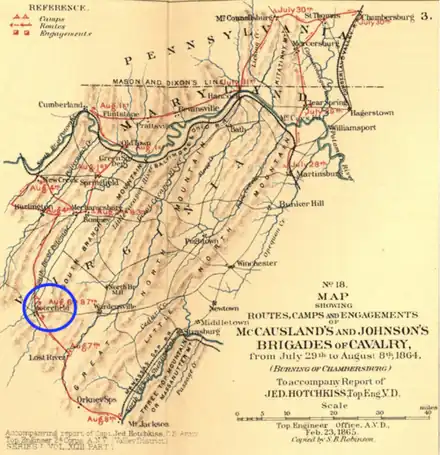
Averell's main force continued south from Romney at 1:00 am on August 7. The force was led by a group of scouts dressed in Confederate uniforms, followed by the main force far enough behind that it could not be detected. The scouts were led by Captain Kerr of the 14th Pennsylvania Cavalry.[78] Kerr selected his soldiers for the mission, and most were from Company C or D. They moved forward on foot in darkness and fog.[76] At about 2:30 am, Kerr's scouts began deceiving and capturing various squads of pickets posted along the main road.[79]
Early in the morning, about 60 of Kerr's scouts, wearing Confederate uniforms, entered Johnson's camp and calmly moved further south past the Confederate 1st Maryland Cavalry. Then Gibson's Brigade, including the 14th Pennsylvania Cavalry, attacked Johnson's surprised men, and captured more than they could control. Johnson himself was captured, but escaped after being sent to the rear unrecognized.[80] Kerr was shot in the face and thigh, and his horse killed—yet he captured the flag of the 8th Virginia Cavalry and rode away on the color bearer's horse.[81]
McCausland's Brigade had some warning of the attack, but was defeated and scattered by one of Averell's other brigades. In total, Averell captured 27 officers and 393 enlisted men, 4 artillery pieces, and 400 horses. The Confederate killed and wounded was unknown. Union losses were 7 killed and 21 wounded.[82] A Union soldier estimated that the "loss to the enemy in killed, wounded and captured was near eight hundred".[83] Captain Thomas R. Kerr, of the 14th Pennsylvania Cavalry, was awarded the Medal of Honor.[84]
Shenandoah Valley
In mid-August, Major General Philip Sheridan reorganized his cavalry. Brigadier General Alfred Torbert was made commander of the Cavalry Corps. Averell was made commander of the 2nd Division, with Schoonmaker and Colonel William H. Powell as his brigade commanders. Schoonmaker's 1st Brigade of cavalry regiments consisted of the 14th Pennsylvania, 22nd Pennsylvania, and 8th Ohio. The 14th Pennsylvania Cavalry would now be fighting in the Shenandoah Valley as part of a large army.[85]
Third Battle of Winchester

On September 19, Sheridan's army of 40,000 soldiers defeated Early's army of 15,000 in the Third Battle of Winchester (a.k.a. the Battle of Opequon Creek). While a large portion of the Union Army attacked from the east, Averell's cavalry and an additional cavalry division attacked from the north.[86] Major Foley had been wounded earlier in the month, so Captain Ashbel F. Duncan led the regiment.[87]
Close to the north edge of town, Averell ordered Schoonmaker's brigade to capture Star Fort, which stood on a hill on the northwest side. The fort had a well-supported battery, and the brigade's first charge was unsuccessful.[88] A new line of about 300 fighters from the 14th Pennsylvania Cavalry was formed and led by Captain Duncan, who attempted to capture the fort's guns while another portion of the regiment moved around the flank of the enemy. While this was happening, Schoonmaker was notified that Duncan had been killed while partially up the hill. Schoonmaker hurried up the hill to lead in person, and found the badly–wounded Duncan still alive and mounted. The regiment captured one of the Confederate cannons and about 300 soldiers while the rest of the Confederates fled before they were surrounded.[89]
Duncan was shot seven times, and was carried off the field to die.[90] Captain William W. Miles became the regiment's commander.[91] The 14th Pennsylvania Cavalry had 14 of the 19 casualties for Schoonmaker's brigade.[92] Schoonmaker was later awarded the Medal of Honor for the capture of the fort.[93] Summarizing the battle, Confederate General Early wrote that his army "deserved the victory, and would have had it, but for the enemy's immense superiority in cavalry, which alone gave it to him".[94]
Fisher's Hill
The Battle of Fisher's Hill occurred on September 21–22, 1864. Sheridan's army again defeated Early's army. The battle took place further south of Winchester near the Valley Pike, slightly south of Strasburg, Virginia.[95] In this battle, Schoonmaker's brigade attacked the front of the Confederate left while Crook's infantry flanked the Confederate left using a concealed approach from North Mountain.[96] Early's men fled south in disorder, and were pursued by the other half of Averell's division, Powell's Brigade.[97] Casualties were light for the 14th Pennsylvania Cavalry, one man wounded of the brigade's total of two.[98] After the battle, Sheridan pressured his commanders to pursue Early's retreating army, and became impatient with Averell. On September 23, Averell was replaced with Powell.[99] Averell chose two companies from the 14th Pennsylvania Cavalry, Companies A and H, to escort him to Winchester.[100]
Weyer's Cave and the Burning

Following the Battle of Fisher's Hill, the two armies continued south along the pike. Major Daily commanded the regiment while Schoonmaker commanded the 1st Brigade. Lieutenant Colonel Blakeley was in Pittsburgh for a court martial case, Major Gibson was under arrest, and Major Foley was still in a hospital for his wounds.[101] Powell's Division patrolled the areas around Harrisonburg, Mount Crawford, and Staunton.[102]
The division arrived at Weyer's Cave in the afternoon of September 26, and Schoonmaker's Brigade crossed the South River and attacked enemy cavalry. The brigade drove the Confederate cavalry east until it encountered infantry and artillery. Fighting until dark, the brigade returned to Weyer's Cave on the west side of the river.[103] On the morning of September 27, a Confederate artillery shell flew through Schoonmaker's headquarters and exploded harmlessly beyond it. The 14th Pennsylvania Cavalry was quickly formed in line and charged the enemy. Soon it was discovered that they were fighting as many as five Confederate divisions, and the regiment was driven back. The regiment contested its position so well that the Adjutant General of Pennsylvania ordered them to have an inscription on their regimental battle flag that read: "Weyer's Cave September 27th 1864 For Gallantry in Battle."[104]
Near the close of the skirmish at Weyer's Cave, Major General George Armstrong Custer arrived to succeed Powell as commander of the division. Early's army moved to Staunton and Waynesboro, and Powell's/Custer's Division moved to Port Republic.[105] For the next two weeks, much of the farming infrastructure (over 2,000 barns and 70 mills) and food between Harrisonburg and Staunton was destroyed by detachments from Sheridan's Army.[106] Custer's 2nd Division, including the 14th Pennsylvania Cavalry, was among those assigned with this task.[107] On September 30, Custer was transferred to command the 3rd Cavalry Division, and Powell returned to command the 2nd Cavalry Division.[108]
Cedar Creek

The Battle of Cedar Creek started as a surprise attack by Early's army in the early morning hours of October 19, 1864.[109] Early struck the Union Army's left flank where the only Union cavalry nearby was the 1st Cavalry Brigade from Powell's (Second Cavalry) Division. The brigade was composed of three cavalry regiments: the 14th and 22nd Pennsylvania, and the 8th Ohio.[110] The 1st Cavalry Brigade was commanded by Colonel Alpheus Moore of the 8th Ohio Cavalry, and Major Gibson commanded the (14th Pennsylvania) regiment.[111]
The 14th Pennsylvania was awakened before daylight when pickets from the 8th Ohio Cavalry galloped into camp with Confederate cavalry following them and screaming the rebel yell. During the morning fighting, the "officer in command of the brigade" (Colonel Moore) refused to dismount his men to support the division of Brigadier General Thomas Devin.[112] The battle appeared to be a defeat for the Union until General Sheridan arrived and rallied his troops for a Union victory.[109] Only one soldier from the 14th Pennsylvania Cavalry was wounded.[113] After the battle, Colonel Moore was placed under arrest, and Major Gibson became commander of the 1st Brigade.[114]
November 1864
Beginning November 10, the 21st New York Cavalry Regiment was assigned to the 1st Brigade of Powell's 2nd Division. Colonel William B. Tibbits, from the 21st New York Cavalry, was assigned to command the 1st Brigade, relieving Major Gibson.[114] Separately, Major Daily was dismissed for absence without leave effective November 11, but reinstated seven months later as a lieutenant colonel.[115] The 2nd Division fought a portion of Major General Lunsford L. Lomax's cavalry division on November 12 near Nineveh, Virginia, but it was Powell's 2nd Brigade that won the fight after a retreat by the 1st Brigade.[116] [Note 5]
Mosby
Powell's Division skirmished near Rude's Hill for about six hours on November 23. Afterwards, it went into camp between Front Royal and Winchester.[117] While cooking turkeys on Thanksgiving Day (November 24), the regiment was attacked by Mosby's guerrillas.[119] Mosby was quickly chased off by the regiment, and ten of Mosby's men were killed or wounded.[119] The historian of the 14th Pennsylvania Cavalry wrote that probably "no regiment in the Civil War had more encounters with Mosby or lost so many killed and wounded or captured by Mosby".[119]
Major Gibson was assigned command of the 1st Brigade on December 7.[120] A few weeks later on December 17, Captain William Miles of Company I led 100 men on a scouting expedition toward Ashby's Gap.[121] Mosby ambushed this scouting party from a woods near Millwood, Virginia, killing Miles and about a dozen others. About 20 others were wounded, and nearly everybody else was captured. Mosby set one man free after slashing his face with a saber, allowing him to return to camp to tell the story of the ambush. The wounded and dead were recovered on the next day.[119] Mosby sent his prisoners to Libby Prison.[122]
Winter 1864-1865 and war's end
Winter
The regiment's winter camp was located in Winchester. The organization of Sheridan's Middle Military Division at the end of 1864 had Powell in command of the 2nd Cavalry Division, Tibbits in command of the division's 1st Brigade, and Schoonmaker in command of the 14th Pennsylvania Cavalry.[123] Lieutenant Colonel Blakeley, who had been dismissed, was restored to commission.[124][Note 6] Powell resigned from the army during January.[126] The regiment's final expedition of the winter began on February 19, 1865, and ended with Major Gibson and his men ambushed by Mosby between Ashby's Gap and the Shenandoah River. Gibson's horse was shot and fell on him, although he was eventually able to find another horse and escape. Gibson's loss was one officer wounded, and 80 men missing.[127]
Fighting ends
The regiment left winter camp on April 4, and moved up the Shenandoah Valley. Major Foley resigned on April 6.[128] Confederate General Lee surrendered at Appomattox on April 9, and the regiment was ordered to Washington on April 20. For the next month, they camped in Virginia at Arlington, Fairfax Court House, and Alexandria.[129] The men of the regiment whose term of enlistment expired prior to October 1, 1865, mustered out in late May and early June.[130] Lieutenant Colonel Blakeley resigned effective June 6.[128]
The remainder of the regiment was consolidated into six companies and left the Washington area on June 11. They arrived in Fort Leavenworth in Kansas on June 28, and the reinstated Major Daily was promoted to lieutenant colonel on that day.[128] Most of the men mustered out on July 31, including Colonel Schoonmaker. On August 5, Company A escorted General Grenville M. Dodge on a trip across the plains. The remaining men other than Company A were mustered out on August 24. Company A, after returning from its western plains trip, mustered out on November 2.[130]
Summary
The regiment fought mostly as part of a brigade or division commanded by William W. Averell. Later in the war, they were often part of a division commanded by William H. Powell. The regiment did most of its fighting in West Virginia and Virginia. It began its fighting in Beverly, West Virginia, on July 3, 1863. Its last fight was in Virginia at Ashby's Gap on February 19, 1865. In between, members of the regiment fought in nearly 90 skirmishes and battles.[131] In 31 of those engagements, the regiment suffered casualties.[132] The regiment had two Medal of Honor winners, and two of its men (Schoonmaker and Gibson) commanded brigades.[133] During the war, the regiment lost 2 officers and 97 enlisted men killed or mortally wounded. Disease resulted in the death of 296 enlisted men.[10]
See also
Notes
Footnotes
- ↑ The spelling of Lieutenant Colonel William H. Blakeley's surname used herein is "Blakeley", which matches the spelling in his 1899 obituary and additional sources.[5] Other sources, including the regimental historian and Averell, have spelled it as "Blakely".[6]
- ↑ Averell's brigade consisted of the following regiments: 10th West Virginia Infantry, 28th Ohio Infantry, 2nd West Virginia Mounted Infantry, 3rd West Virginia Mounted Infantry, 8th West Virginia Mounted Infantry, and the 14th Pennsylvania Cavalry. Other units were Company A of the 1st West Virginia Cavalry, Company C of the 3rd West Virginia Cavalry, 3rd Independent Company Ohio Cavalry, Company C of the 16th Illinois Cavalry, Battery B of the 1st West Virginia Artillery (six guns), and Battery G of the 1st West Virginia Artillery (four guns).[11]
- ↑ A Pennsylvania newspaper says Blakeley remained with the regiment, as does at least one of Blakeley's obituaries.[37] Reverend Slease of Company C of the 14th Pennsylvania Cavalry, when discussing the 14th "never surrenders" in his book, says "The friends of Lieut. Col. Blakely ascribed it to him. It is certain it was not he, for he, with Co. A., was already on the opposite side of the river."[35]
- ↑ Schoonmaker being relieved started rumors that he was arrested because he refused to burn VMI. That was not true—he followed orders to have VMI burned, but not as soon as he entered the town.[53]
- ↑ The historian of the 14th Pennsylvania Cavalry gave an account of the battle differs from Powell's report.[117] Conflicting with the historian's version, two men from the 2nd Brigade received the Medal of Honor for capturing enemy battle flags.[118]
- ↑ Blakeley was hospitalized after being thrown from his horse on August 12. While in the hospital, his detachment left its post, causing his dismissal. The general in charge did not know Blakeley was in the hospital. After a petition from officers in the regiment, and with a letter from Major General Torbert saying the recommendation for dismissal came under misapprehension of the facts, Blakeley was reinstated December 14.[125]
Citations
- ↑ Bates 1869, p. 851
- ↑
- [Unlisted] 1908, p. 470;
- Slease & Gancas 1999, pp. 16–17
- 1 2 3 Slease & Gancas 1999, p. 16
- ↑
- "Guide to Civil War Holdings of the Pennsylvania State Archives (p.44)" (PDF). Pennsylvania State Archives. Retrieved March 23, 2026.;
- "Union Pennsylvania Volunteers - 14th Regiment, Pennsylvania Cavalry (159th Volunteers)". U.S. National Park Service. Retrieved March 23, 2026.
- ↑
- Breck 1899, p. 137;
- Bates 1869, p. 851;
- "Soldier Details - Blakeley, William". National Park Service, U.S. Department of the Interior. Archived from the original on June 28, 2021. Retrieved June 28, 2021.
- ↑
- Slease & Gancas 1999, p. 16;
- Averell 1890b, p. 926
- ↑ Slease & Gancas 1999, p. 18
- 1 2 3 [Unlisted] 1908, p. 470
- ↑
- "Grafton, West Virginia - Our History". City of Grafton. Archived from the original on May 15, 2021. Retrieved May 15, 2021.;
- Whisonant 2015, p. 157
- 1 2 "Union Pennsylvania Volunteers - 14th Regiment, Pennsylvania Cavalry (159th Volunteers)". National Park Service, U.S. Department of the Interior. Archived from the original on May 14, 2021. Retrieved May 15, 2021.
- 1 2 Averell 1889, p. 209
- ↑ "From the Tenth Va. Regiment -- Bill Jackson's Attack on Beverly (p.2 col.3)". Wheeling Daily Intelligencer (from Chronicling America: Historic American Newspapers. Lib. of Congress). July 17, 1863. Archived from the original on May 16, 2021. Retrieved July 13, 2021.
- ↑
- Slease & Gancas 1999, pp. 83–84;
- "From the Tenth Va. Regiment -- Bill Jackson's Attack on Beverly (p.2 col.3)". Wheeling Daily Intelligencer (from Chronicling America: Historic American Newspapers. Lib. of Congress). July 17, 1863. Archived from the original on May 16, 2021. Retrieved July 13, 2021.
- ↑ Wittenberg, Petruzzi & Nugent 2008, p. 160
- ↑ Slease & Gancas 1999, pp. 85–86
- ↑ Wittenberg 2011, pp. 38–39
- ↑ Averell 1890, pp. 34–35
- ↑ Reader 1890, p. 205
- ↑ Slease & Gancas 1999, p. 54
- ↑ Slease & Gancas 1999, p. 91
- ↑ Averell 1890, p. 41
- ↑ Wittenberg 2011, p. 101, 107–108, 124
- ↑ Kelley 1890, pp. 499–502
- ↑ Lowry 1996, pp. 61, 95
- ↑
- Lowry 1996, pp. 104–105, 159;
- United States War Department (1890). Atlas to Accompany the Official Records of the Union and confederate Armies (Image 162, lower left corner) (Map). Washington, DC: Government Printing Office. Retrieved March 10, 2026.
- ↑ Lowry 1996, pp. 172–173
- ↑
- Kelley 1890, p. 500;
- Lowry 1996, pp. 199, 221–222
- ↑ Kelley 1890a, pp. 920–921
- ↑ Slease & Gancas 1999, pp. 113–114
- ↑ Kelley 1890a, p. 920
- ↑ Slease & Gancas 1999, p. 114
- ↑ Reader 1890, p. 225
- ↑ Slease & Gancas 1999, p. 118
- ↑ Slease & Gancas 1999, p. 120
- 1 2 3 Slease & Gancas 1999, p. 121
- ↑ Reader 1890, p. 228
- ↑
- "The Heroism (bottom of page 2)". American Citizen - Butler, Pennsylvania (from Chronicling America: Historic American Newspapers. Lib. of Congress). January 20, 1864. Archived from the original on July 12, 2021. Retrieved July 13, 2021.;
- Breck 1899, p. 137
- ↑ Averell 1890b, p. 932
- ↑ Slease & Gancas 1999, p. 126
- ↑ Slease & Gancas 1999, p. 127
- ↑ Barnes, D.M. (June 10, 1864). "Gen. Averill's Operations; Spirited Account of the Great Southern Virginia Raid. Its Object—Destruction of Railroads, Bridges and Medical Stores—A Gallant and Obstinate Fight—Gen. Averill Wounded—Incidents". New York Times. Archived from the original on June 2, 2021. Retrieved June 2, 2021.
- ↑
- Averell 1891, p. 41;
- Sutton 2001, pp. 113–114
- ↑ Averell 1891, p. 41
- ↑
- Duncan 1998, p. 79;
- Sutton 2001, pp. 113–114
- ↑ Averell 1891, p. 43
- ↑
- "Battle Detail – Cove Mountain". National Park Service, U.S. Department of the Interior. Archived from the original on June 2, 2021. Retrieved June 8, 2021.;
- "Virginia Center for Civil War Studies - Wytheville (scroll down toward end)". Virginia Center for Civil War Studies, Virginia Polytechnic Institute and State University. Archived from the original on April 17, 2021. Retrieved May 28, 2021.
- ↑ Sutton 2001, p. 116
- ↑ Duncan 1998, pp. 62–63, 83–84
- ↑ Slease & Gancas 1999, pp. 136–139
- ↑ Averell 1902, pp. 145–146
- 1 2 Slease & Gancas 1999, p. 139
- ↑ Slease & Gancas 1999, pp. 139–140
- 1 2 Slease & Gancas 1999, pp. 149–150
- ↑ Averell 1902, p. 147
- ↑ Slease & Gancas 1999, p. 142
- ↑ Sutton 2001, p. 130
- ↑ [Unlisted] 1902a, p. 105
- ↑ [Unlisted] 1902a, p. 106
- ↑ Sutton 2001, p. 138
- ↑
- Crook 1902, p. 286;
- Averell 1891a, p. 10
- ↑ "Battle Detail - Rutherford's Farm". National Park Service, U.S. Department of the Interior. Retrieved May 22, 2026.
- ↑ Patchan 2007, pp. 137–138
- ↑ Patchan 2007, p. 227
- ↑ Patchan 2007, p. 188
- ↑ Slease & Gancas 1999, p. 155
- 1 2 Patchan 2007, p. 228
- ↑ "Second Battle of Kernstown". American Battlefield Trust. Archived from the original on January 5, 2023. Retrieved June 15, 2021.
- ↑ [Unlisted] 1902b, p. 290
- ↑ Parsons 1902, p. 738
- ↑ Schoonmaker 1902, p. 797
- ↑ Patchan 2007, p. 330
- ↑ Mowrer 1899, p. 21
- ↑ Slease & Gancas 1999, p. 158
- 1 2 Averell 1893, p. 493
- ↑ Patchan 2007, p. 290
- 1 2 Slease & Gancas 1999, p. 160
- ↑ Patchan 2007, p. 292
- ↑ Patchan 2007, p. 296
- ↑ Sutton 2001, p. 149
- ↑
- Patchan 2007, p. 299;
- Averell 1893, p. 495
- ↑ Slease & Gancas 1999, p. 161
- ↑ Kelley 1902, p. 3
- ↑ Sutton 2001, p. 150
- ↑ "Thomas R. Kerr". Congressional Medal of Honor Society. Archived from the original on July 13, 2021. Retrieved June 17, 2021.
- ↑ Slease & Gancas 1999, p. 175
- ↑ "Third Battle of Winchester". National Park Service, U.S. Department of the Interior. Archived from the original on May 2, 2021. Retrieved June 23, 2021.
- ↑
- Slease & Gancas 1999, p. 177;
- Slease & Gancas 1999, p. 185
- ↑ Farrar 1911, p. 377
- ↑ Slease & Gancas 1999, p. 239
- ↑ Slease & Gancas 1999, p. 185
- ↑ [Unlisted] 1902c, p. 111
- ↑ [Unlisted] 1902d, p. 117
- ↑ "James M. Schoonmaker". Congressional Medal of Honor Society. Archived from the original on June 8, 2021. Retrieved March 7, 2021.
- ↑ Early & Early 1912, pp. 426–427
- ↑ "FISHER'S HILL". American Battlefield Trust. Archived from the original on June 25, 2021. Retrieved June 25, 2021.
- ↑ Slease & Gancas 1999, p. 191
- ↑ Sutton 2001, p. 161
- ↑ [Unlisted] 1902e, p. 124
- ↑ Averell 1893, p. 505
- ↑ Slease & Gancas 1999, p. 194
- ↑ Slease & Gancas 1999, pp. 198–199
- ↑ Powell 1902, pp. 506–507
- ↑ Farrar 1911, p. 392
- ↑ Slease & Gancas 1999, pp. 199–200
- ↑ Slease & Gancas 1999, p. 201
- ↑ "The Burning - The Shenandoah Valley in Flames". National Park Service, U.S. Department of the Interior. Archived from the original on June 28, 2021. Retrieved June 28, 2021.
- ↑ Slease & Gancas 1999, p. 202
- ↑ Farrar 1911, p. 400
- 1 2 "Overview of the Battle of Cedar Creek". National Park Service, U.S. Department of the Interior. Archived from the original on July 9, 2021. Retrieved June 30, 2021.
- ↑ Slease & Gancas 1999, p. 206
- ↑ [Unlisted] 1902f, p. 130
- ↑ Devin 1902, p. 478
- ↑ [Unlisted] 1902g, p. 136
- 1 2 Rumsey 1893, p. 595
- ↑
- [Unlisted] 1864, p. 202;
- Pennsylvania General Assembly 1866, p. 458
- ↑
- Powell 1902, p. 512;
- Beach 1902, pp. 448–450
- 1 2 Slease & Gancas 1999, p. 218
- ↑
- "U.S. Civil War - U.S. Army - James F. Adams". Congressional Medal of Honor Society. Archived from the original on July 9, 2021. Retrieved July 1, 2021.;
- "U.S. Civil War - U.S. Army - Levi Shoemaker". Congressional Medal of Honor Society. Archived from the original on July 9, 2021. Retrieved July 1, 2021.
- 1 2 3 4 Slease & Gancas 1999, p. 219
- ↑ Rumsey 1893a, p. 753
- ↑ Slease & Gancas 1999, p. 259
- ↑ Slease & Gancas 1999, p. 260
- ↑ [Unlisted] 1893, p. 854
- ↑ [Unlisted] 1864, p. 283
- ↑ "Lieut. Col. Blakely, 14th Pa. Cavalry (right side of page 2)". American Citizen - Butler, Pennsylvania (from Chronicling America: Historic American Newspapers. Lib. of Congress). January 25, 1865. Archived from the original on July 12, 2021. Retrieved July 13, 2021.
- ↑
- "Biographical Sketch of Brig. Gen. W.H. Powell..." Daily Intelligencer (Wheeling). January 25, 1865. p. 1 (col. 4) – via Chronicling America.
- ↑
- Slease & Gancas 1999, p. 261;
- Gibson 1894, p. 466
- 1 2 3 Bates 1869, p. 858
- ↑ Slease & Gancas 1999, pp. 283–285
- 1 2 Slease & Gancas 1999, pp. 286–288
- ↑ Slease & Gancas 1999, Supplement p. 121-123
- ↑ Slease & Gancas 1999, pp. 289–291
- ↑
- "Search For Medals of Honor - 14th Pennsylvania Cavalry". National Park Service, U.S. Department of the Interior. Archived from the original on July 9, 2021. Retrieved July 4, 2021.;
- Mowrer 1899, pp. 11, 17
References
- Averell, William W. (1889). "Reports of Brig. Gen. William W. Averell...operations May 22–July 28, 1863". In Scott, Robert N. (ed.). The War of the Rebellion: a Compilation of the Official Records of the Union and Confederate Armies Series I Volume XXVII - Part II - Reports. Washington, DC: Government Printing Office. pp. 205–211. OCLC 318422190. Retrieved March 4, 2026.
- Averell, William W. (1890). "Reports of Brig. Gen. William W. Averell...operations August 5–31". In Scott, Robert N. (ed.). The War of the Rebellion: a Compilation of the Official Records of the Union and Confederate Armies Series I Volume XXIX - Part I - Reports. Washington, DC: Government Printing Office. pp. 32–40. OCLC 318422190. Retrieved March 4, 2026.
- Averell, William W. (1890b). "Reports of Brig. Gen. William W. Averell...expedition to Virginia and Tennessee Railroad". In Scott, Robert N. (ed.). The War of the Rebellion: a Compilation of the Official Records of the Union and Confederate Armies Series I Volume XXIX - Part I - Reports. Washington, DC: Government Printing Office. pp. 924–933. OCLC 318422190. Retrieved March 4, 2026.
- Averell, William W. (1891). "Report of Brig. Gen. William W. Averell....". In Davis, George B.; Perry, Leslie J.; Kirkley, Joseph W. (eds.). The War of the Rebellion: a Compilation of the Official Records of the Union and Confederate Armies Series I Volume XXXVII - Part I - Reports, Correspondence, etc. Washington, DC: Government Printing Office. pp. 41–44. OCLC 318422190. Retrieved March 12, 2026.
- Averell, William W. (1891a). "Correspondence of Brig. Gen. William W. Averell to Lieut. Col. Charles G. Halpine". In Davis, George B.; Perry, Leslie J.; Kirkley, Joseph W. (eds.). The War of the Rebellion: a Compilation of the Official Records of the Union and Confederate Armies Series I Volume XXXVII - Part II - Correspondence, Etc. Washington, DC: Government Printing Office. p. 10. OCLC 427057. Archived from the original on February 12, 2023. Retrieved July 3, 2021.
- Averell, William W. (1893). "Reports of Bvt. Maj. Gen. William W. Averell...August 3–September 23, 1864". In Davis, George B.; Perry, Leslie J.; Kirkley, Joseph W. (eds.). The War of the Rebellion: a Compilation of the Official Records of the Union and Confederate Armies Series I Volume XLIII - Part I - Reports, Correspondence, etc. Washington, DC: Government Printing Office. pp. 493–506. OCLC 427057. Retrieved March 15, 2026.
- Averell, William W. (1902). "Report of Brig. Gen. William W. Averell....". In Ainsworth, Fred C.; Kirkley, Joseph W. (eds.). The War of the Rebellion: a Compilation of the Official Records of the Union and Confederate Armies Series I Volume XXXVII - Additions and Corrections. Washington, DC: Government Printing Office. pp. 145–150. OCLC 318422190. Retrieved March 13, 2026.
- Bates, Samuel P. (1869). History of Pennsylvania Volunteers, 1861-5: Prepared in Compliance with Acts of the Legislature. Harrisburg, Pennsylvania: B. Singerly, State Printer. OCLC 1887553. Archived from the original on 2023-02-12. Retrieved 2021-11-27.
- Beach, William Harrison (1902). The First New York (Lincoln) Cavalry from April 19, 1861, to July 7, 1865. New York: Lincoln Cavalry Association. p. 448. OCLC 44089779.
Nineveh Powell chased.
- Breck, E.Y., ed. (1899). Pittsburgh Legal Journal (p.137). Pittsburgh, Pennsylvania: John S. Murray. Archived from the original on 2023-02-12. Retrieved 2021-06-28.
- Crook, George (1902). "Reports of Bvt. Maj. Gen. George Crook...July 16–26.....". In Ainsworth, Fred C.; Kirkley, Joseph W. (eds.). The War of the Rebellion: a Compilation of the Official Records of the Union and Confederate Armies Series I Volume XXXVII - Additions and Corrections. Washington, DC: Government Printing Office. pp. 286–288. OCLC 318422190. Retrieved March 13, 2026.
- Devin, Thomas C. (1902). "Reports of Bvt. Brig. Gen. Thomas C. Devin...July 4–October 21, 1864". In Ainsworth, Fred C.; Kirkley, Joseph W. (eds.). The War of the Rebellion: a Compilation of the Official Records of the Union and Confederate Armies Series I Volume XLIII - Additions and Corrections. Washington, DC: Government Printing Office. pp. 470–484. OCLC 427057. Retrieved March 18, 2026.
- Duncan, Richard R. (1998). Lee's Endangered Left: The Civil War in Western Virginia, Spring of 1864. Baton Rouge, Louisiana: Louisiana State University Press. OCLC 940541407.
- Early, Jubal A.; Early, Ruth H. (1912). Lieutenant General Jubal Anderson Early, C.S.A. Autobiographical Sketch and Narrative of the War Between the States. Philadelphia, Pennsylvania: J.B. Lippincott Co. OCLC 1370161. Archived from the original on 2023-02-12. Retrieved 2020-11-13.
- Farrar, Samuel Clarke (1911). The Twenty-Second Pennsylvania Cavalry and the Ringgold Battalion. Pittsburgh, Pennsylvania: New Werner Company. OCLC 1018148044. Archived from the original on 2023-02-12. Retrieved 2021-06-24.
- Gibson, Thomas (1894). "Report of Major Thomas Gibson....". In Davis, George B.; Perry, Leslie J.; Kirkley, Joseph W. (eds.). The War of the Rebellion: a Compilation of the Official Records of the Union and Confederate Armies Series I Volume XLVI - Part I - Reports. Washington, DC: Government Printing Office. pp. 463–467. OCLC 12241509. Retrieved March 5, 2026.
- Kelley, Benjamin F. (1890). "Report of Brig. Gen. Benjamin F. Kelley....". In Scott, Robert N. (ed.). The War of the Rebellion: a Compilation of the Official Records of the Union and Confederate Armies Series I Volume XXIX - Part I - Reports. Washington, DC: Government Printing Office. pp. 499–502. OCLC 318422190. Retrieved March 4, 2026.
- Kelley, Benjamin F. (1890a). "Report of Brig. Gen. Benjamin F. Kelley....". In Scott, Robert N. (ed.). The War of the Rebellion: a Compilation of the Official Records of the Union and Confederate Armies Series I Volume XXIX - Part I - Reports. Washington, DC: Government Printing Office. pp. 920–923. OCLC 318422190. Retrieved March 10, 2026.
- Kelley, Benjamin F. (1902). "Report of Bvt. Maj. Gen. Benjamin F. Kelley....". In Ainsworth, Fred C.; Kirkley, Joseph W. (eds.). The War of the Rebellion: a Compilation of the Official Records of the Union and Confederate Armies Series I Volume XLIII - Additions and Corrections. Washington, DC: Government Printing Office. pp. 2–3. OCLC 427057. Retrieved March 13, 2026.
- Lowry, Terry (1996). Last Sleep: The Battle of Droop Mountain, November 6, 1863. Charleston, West Virginia: Pictorial Histories Publishing Company. ISBN 978-1-57510-024-1. OCLC 36488613.
- Mowrer, George H. (1899). History of the Organization and Service, During the War of the Rebellion, of Company A, 14th Pennsylvania Cavalry. Survivor's Association. OCLC 228711541. Archived from the original on 2021-07-09. Retrieved 2021-07-09.
- Parsons, E. B. (1902). "General Orders, No. 6". In Ainsworth, Fred C.; Kirkley, Joseph W. (eds.). The War of the Rebellion: A Compilation of the Official Records of the Union and Confederate Armies, Additions and Corrections to Series I Volume XLIII. Washington, DC: Government Printing Office. p. 738. OCLC 427057. Retrieved March 15, 2026.
- Patchan, Scott C. (2007). Shenandoah Summer: The 1864 Valley Campaign. Lincoln, NE: University of Nebraska Press. ISBN 978-0-8032-0700-4. OCLC 122563754.
- Pennsylvania General Assembly (1866). Miscellaneous Documents, Read in the Legislature of the Commonwealth of Pennsylvania, during the Session which Commenced at Harrisburg on the 2nd Day of January, 1866 - Vol. II. Harrisburg, Pennsylvania: Singerly & Myers, State Printers. OCLC 228664952. Archived from the original on 2023-02-12. Retrieved 2021-07-04.
- Pond, George E. (1912). The Shenandoah Valley in 1864. New York: Charles Scribner's Sons. OCLC 13500039.
- Powell, William H. (1902). "Reports of Brig. Gen. William H. Powell...September 24–October 27 and November 12, 1864". In Ainsworth, Fred C.; Kirkley, Joseph W. (eds.). The War of the Rebellion: a Compilation of the Official Records of the Union and Confederate Armies Series I Volume XLIII - Additions and Corrections. Washington, DC: Government Printing Office. pp. 506–513. OCLC 427057. Retrieved March 15, 2026.
- Reader, Frank S. (1890). History of the Fifth West Virginia Cavalry, Formerly the Second Virginia Infantry, and of Battery G, First West Virginia Light Artillery. New Brighton, Pennsylvania: Daily News, Frank S. Reader, Editor and Proprietor. Retrieved 2021-04-05.
- Rumsey, Will (1893). "Special Orders No. 18...November 10, 1864". In Davis, George B.; Perry, Leslie J.; Kirkley, Joseph W. (eds.). The War of the Rebellion: A Compilation of the Official Records of the Union and Confederate Armies Series I Volume XLIII Part II Correspondence, Etc. Washington, DC: Government Printing Office. p. 595. OCLC 12241509. Archived from the original on 2023-02-12. Retrieved 2021-11-27.
- Rumsey, Will (1893a). "Corespondence to Maj. T. Gibson...December 7, 1864". In Davis, George B.; Perry, Leslie J.; Kirkley, Joseph W. (eds.). The War of the Rebellion: A Compilation of the Official Records of the Union and Confederate Armies Series I Volume XLIII Part II Correspondence, Etc. Washington, DC: Government Printing Office. p. 753. OCLC 12241509. Retrieved March 19, 2026.
- Schoonmaker, James N. (1890). "Report of Col. James N. Schoonmaker....". In Scott, Robert N. (ed.). The War of the Rebellion: a Compilation of the Official Records of the Union and Confederate Armies Series I Volume XXIX - Part I - Reports. Washington, DC: Government Printing Office. pp. 517–520. OCLC 318422190. Retrieved March 4, 2026.
- Schoonmaker, James M. (1902). "Correspondence with Capt. Will Rumsey August 14, 1864". In Ainsworth, Fred C.; Kirkley, Joseph W. (eds.). The War of the Rebellion: A Compilation of the Official Records of the Union and Confederate Armies, Additions and Corrections to Series I Volume XLIII. Washington, DC: Government Printing Office. p. 797. OCLC 427057. Retrieved March 15, 2026.
- Slease, William Davis; Gancas, Ron (1999) [1915]. The Fourteenth Pennsylvania Cavalry in the Civil War: A History of the Fourteenth Pennsylvania Volunteer Cavalry from its Organization until the Close of the Civil War, 1861-1865. Pittsburgh, Pennsylvania: Soldiers' & Sailors' Memorial Hall and Military Museum. ISBN 978-0-96449-529-6. OCLC 44503009.
- Sutton, Joseph J. (2001) [1892]. History of the Second Regiment, West Virginia Cavalry Volunteers, During the War of the Rebellion. Huntington, WV: Blue Acorn Press. ISBN 978-0-9628866-5-2. OCLC 263148491.
- [Unlisted] (1864). The United States Army and Navy Journal and Gazette of the Regular and Volunteer Forces - Vol. II 1864-65. New York, New York: Publication Office Number 39 Park Row. OCLC 3157857. Archived from the original on 2023-02-12. Retrieved 2021-07-04.
- [Unlisted] (1893). "Organization of troops in the Middle Military Division...December 31, 1864". In Davis, George B.; Perry, Leslie J.; Kirkley, Joseph W. (eds.). The War of the Rebellion: a Compilation of the Official Records of the Union and Confederate Armies Series I Volume XLIII - Part II - Correspondence, Etc. Washington, DC: Government Printing Office. pp. 847–857. Retrieved March 19, 2026.
- [Unlisted] (1902). "Composition of the Union forces...at New Market, Va., May 15, 1864". In Ainsworth, Fred C.; Kirkley, Joseph W. (eds.). The War of the Rebellion: a Compilation of the Official Records of the Union and Confederate Armies Series I Volume XXXVII - Additions and Corrections. Washington, DC: Government Printing Office. p. 77. OCLC 318422190. Retrieved March 13, 2026.
- [Unlisted] (1902a). "Composition and losses of the Union Forces June 10–23". In Ainsworth, Fred C.; Kirkley, Joseph W. (eds.). The War of the Rebellion: a Compilation of the Official Records of the Union and Confederate Armies Series I Volume XXXVII - Additions and Corrections. Washington, DC: Government Printing Office. pp. 103–106. OCLC 318422190. Retrieved March 14, 2026.
- [Unlisted] (1902b). "Return of Casualties in the Union forces...July 24–25 the Union Forces June 10–23". In Ainsworth, Fred C.; Kirkley, Joseph W. (eds.). The War of the Rebellion: a Compilation of the Official Records of the Union and Confederate Armies Series I Volume XXXVII - Additions and Corrections. Washington, DC: Government Printing Office. pp. 288–290. OCLC 318422190. Retrieved March 15, 2026.
- [Unlisted] (1902c). "Organization of the Union Forces commanded by Maj. Gen. Philip H. Sheridan...September 19, 1864". In Ainsworth, Fred C.; Kirkley, Joseph W. (eds.). The War of the Rebellion: a Compilation of the Official Records of the Union and Confederate Armies Series I Volume XLIII - Additions and Corrections. Washington, DC: Government Printing Office. pp. 107–112. OCLC 427057. Retrieved March 13, 2026.
- [Unlisted] (1902d). "Return of Casualties in the Union forces commanded by Maj. Gen. Philip H. Sheridan...September 19, 1864". In Ainsworth, Fred C.; Kirkley, Joseph W. (eds.). The War of the Rebellion: a Compilation of the Official Records of the Union and Confederate Armies Series I Volume XLIII - Additions and Corrections. Washington, DC: Government Printing Office. pp. 112–119. OCLC 427057. Retrieved March 13, 2026.
- [Unlisted] (1902e). "Return of Casualties in the Union forces commanded by Maj. Gen. Philip H. Sheridan...September 21–22, 1864". In Ainsworth, Fred C.; Kirkley, Joseph W. (eds.). The War of the Rebellion: a Compilation of the Official Records of the Union and Confederate Armies Series I Volume XLIII - Additions and Corrections. Washington, DC: Government Printing Office. pp. 120–124. OCLC 427057. Retrieved March 18, 2026.
- [Unlisted] (1902f). "Organization of the Union forces commanded by Maj. Gen. Philip H. Sheridan...October 19, 1864". In Ainsworth, Fred C.; Kirkley, Joseph W. (eds.). The War of the Rebellion: a Compilation of the Official Records of the Union and Confederate Armies Series I Volume XLIII - Additions and Corrections. Washington, DC: Government Printing Office. pp. 125–130. OCLC 427057. Retrieved March 18, 2026.
- [Unlisted] (1902g). "Return of Casualties in the Union forces commanded by Maj. Gen. Philip H. Sheridan...October 19, 1864". In Ainsworth, Fred C.; Kirkley, Joseph W. (eds.). The War of the Rebellion: a Compilation of the Official Records of the Union and Confederate Armies Series I Volume XLIII - Additions and Corrections. Washington, DC: Government Printing Office. pp. 131–139. OCLC 427057. Retrieved March 18, 2026.
- [Unlisted] (1908). The Union Army; A History of Military Affairs in the Loyal States, 1861-65 — Records of the Regiments in the Union Army — Cyclopedia of Battles — Memoirs of Commanders and Soldiers — Volume I. Madison, Wisconsin: Federal Publishing Company. OCLC 1473658. Archived from the original on 2023-02-12. Retrieved 2021-05-14.
- Whisonant, Robert C. (2015). Arming the Confederacy : How Virginia's Minerals Forged the Rebel War Machine. Cham, Switzerland: Springer International Publishing. ISBN 978-3-319-14508-2. OCLC 903929889.
- Wittenberg, Eric J.; Petruzzi, J. David; Nugent, Michael F. (2008). One Continuous Fight: the Retreat from Gettysburg and the Pursuit of Lee's Army of Northern Virginia, July 4–14, 1863. New York: Savas Beatie. ISBN 978-1-9327144-3-2. OCLC 185031178.
- Wittenberg, Eric J. (2011). The Battle of White Sulphur Springs: Averell Fails to Secure West Virginia. Charleston, South Carolina: History Press. ISBN 978-1-61423-326-8. OCLC 795566215.
External links
