12-hydroxydihydrochelirubine 12-O-methyltransferase
| 12-hydroxydihydrochelirubine 12-O-methyltransferase | |||||||||
|---|---|---|---|---|---|---|---|---|---|
| Identifiers | |||||||||
| EC no. | 2.1.1.120 | ||||||||
| CAS no. | 158736-40-4 | ||||||||
| Databases | |||||||||
| BRENDA | enzyme data | ||||||||
| ExPASy | NiceZyme view | ||||||||
| KEGG | enzyme entry | ||||||||
| MetaCyc | metabolic pathway | ||||||||
| Rhea | reactions | ||||||||
| PDB structures | RCSB PDB PDBe PDBsum | ||||||||
| Gene Ontology | AmiGO / QuickGO | ||||||||
| |||||||||
12-hydroxydihydrochelirubine 12-O-methyltransferase (EC 2.1.1.120) is an enzyme that catalyzes the chemical reaction


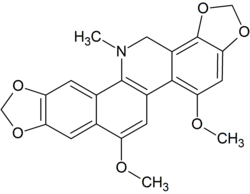
This is a methylation reaction in which the benzylisoquinoline alkaloid, 12-hydroxydihydrochelirubine, is converted to dihydromacarpine. The methyl group comes from the cofactor, S-adenosyl methionine (SAM), which becomes S-adenosyl-L-homocysteine (SAH). The enzyme was characterised from Thalictrum bulgaricum.[1]
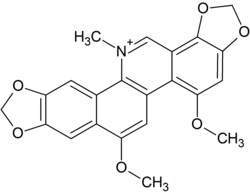
This enzyme belongs to the family of transferases, specifically those transferring one-carbon group methyltransferases. The systematic name of this enzyme class is S-adenosyl-L-methionine:12-hydroxydihydrochelirubine 12-O-methyltransferase.[2] The reaction is a late step in the biosynthesis of benzophenanthridine alkaloid, macarpine.[1]
References
- 1 2 Kammerer L, De-Eknamkul W, Zenk MH (1994). "Enzymic 12-hydroxylation and 12-O-methylation of dihydrochelirubine in dihydromacarpine formation by Thalictrum bulgaricum". Phytochemistry. 36 (6): 1409–1416. Bibcode:1994PChem..36.1409K. doi:10.1016/S0031-9422(00)89732-0.
- ↑ Enzyme 2.1.1.120 at KEGG Pathway Database.
Categories: