(S)-tetrahydroprotoberberine N-methyltransferase
| (S)-tetrahydroprotoberberine N-methyltransferase | |||||||||
|---|---|---|---|---|---|---|---|---|---|
| Identifiers | |||||||||
| EC no. | 2.1.1.122 | ||||||||
| CAS no. | 106878-42-6 | ||||||||
| Databases | |||||||||
| BRENDA | enzyme data | ||||||||
| ExPASy | NiceZyme view | ||||||||
| KEGG | enzyme entry | ||||||||
| MetaCyc | metabolic pathway | ||||||||
| Rhea | reactions | ||||||||
| PDB structures | RCSB PDB PDBe PDBsum | ||||||||
| Gene Ontology | AmiGO / QuickGO | ||||||||
| |||||||||
(S)-tetrahydroprotoberberine N-methyltransferase (EC 2.1.1.122) is an enzyme that catalyzes related methylation reactions in the biosynthesis of benzylisoquinoline alkaloids.
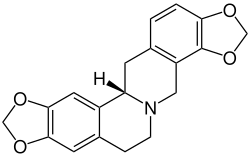


For example, (S)-stylopine is converted to (S)-cis-N-methylstylopine. The methyl group comes from the cofactor, S-adenosyl methionine (SAM), which becomes S-adenosyl-L-homocysteine (SAH). The enzyme was characterised from Eschscholtzia californica. It methylates (S)-canadine and (S)-tetrahydropalmatine in a similar way.[1]
This enzyme belongs to the family of transferases, specifically those transferring one-carbon group methyltransferases. The systematic name of this enzyme class is S-adenosyl-L-methionine:(S)-7,8,13,14-tetrahydroprotoberberine cis-N-methyltransferase. This enzyme is also called tetrahydroprotoberberine cis-N-methyltransferase. It participates in alkaloid biosynthesis.[2]
References
- ↑ Rueffer M, Zumstein G, Zenk MH (1990). "Partial purification and characterization of S-adenosyl-L-methionine:(S)-tetrahydroprotoberberine cis-N-methyltransferase from suspension-cultured cells of Eschscholtzia and Corydalis" (PDF). Phytochemistry. 29 (12): 3727–3733. doi:10.1016/0031-9422(90)85321-6.
- ↑ Enzyme 2.1.1.122 at KEGG Pathway Database.
Categories: