(468861) 2013 LU28
| Discovery[1] | |
|---|---|
| Discovered by | Mount Lemmon Srvy. |
| Discovery site | Mount Lemon Obs. |
| Discovery date | 8 June 2013 |
| Designations | |
| 2014 LJ9 · 2015 KB157 | |
| TNO[2] · centaur[3][4][5] damocloid · distant[1] | |
| Orbital characteristics[2] | |
| Epoch 09 June 2026 (JD 2461200.5) | |
| Uncertainty parameter 0 | |
| Observation arc | 12.82 yr (4,684 d) |
| Aphelion | 348.86 AU |
| Perihelion | 8.748851AU |
| 178.808 AU | |
| Eccentricity | 0.951071 |
| 2433.62 yr | |
| 359.24° | |
| 0° 0m 1.484s / day | |
| Inclination | 125.309096° |
| 276.050762° | |
| 153.16585° | |
| Jupiter MOID | 3.87262 AU |
| TJupiter | -2.065 |
| Physical characteristics | |
| 106 km (est.)[4] 114 km (est.)[6] | |
| 0.08 (est.)[6] 0.09 (est.)[4] | |
| Prominent water (H 2O/"bowl" type)[7]: 6 | |
| 8.21[1][2][6] | |
(468861) 2013 LU28 is a highly eccentric trans-Neptunian object, retrograde centaur and damocloid from the outer regions of the Solar System. It was discovered on 8 June 2013 by astronomers with the Mount Lemmon Survey at the Mount Lemmon Observatory in Arizona, United States.[1]
2013 LU28 is approximately 110 kilometers (68 miles) in diameter.[4] It was numbered in 2016 and has not been named since.
Discovery and naming
Discovery

2013 LU28 was discovered on 8 June 2013 by astronomers with the Mount Lemmon Survey at the Mount Lemmon Observatory in Arizona, United States.[1]
Naming and numbering
This distant minor planet was numbered by the Minor Planet Center on 20 June 2016 (M.P.C. 100585).[8] As of 2025, it has not been named.[1]
Orbit and classification
2013 LU28 orbits the Sun at a distance of 8.7–353.1 AU once every 2434 years (888,879 days; semi-major axis of 180.92 AU). Its orbit has an exceptionally high eccentricity of 0.95 and an inclination of 125° with respect to the ecliptic.[2] The body's observation arc begins with its official discovery observation at Mount Lemmon in June 2013.[1]
TNO, centaur and damocloid
With a semi-major axis larger than that of Neptune, 2013 LU28 is generically classified as a trans-Neptunian object.[2] It is also considered an (extended) centaur, due to its eccentric orbit with a low perihelion of 8.7 AU and a higher-than-90°-inclination, which gives it a retrograde orbit.[3][4] There are only about a hundred known retrograde minor planets out of nearly 800,000 observed bodies, and, together with 2008 YB3 and 2011 MM4, it is among the largest such objects.[3] 2013 LU28 also meets the orbital definition for being a damocloid, a cometary-like object without a coma or tail and a Tisserand's parameter with respect to Jupiter of less than 2 besides a retrograde orbit.
Physical characteristics
Diameter and albedo
According to Johnston's Archive and astronomer Michael Brown, 2013 LU28 measures 106 and 114 kilometers in diameter, based on an absolute magnitude of 8.1 and an assumed albedo for the body's surface of 0.08 and 0.09, respectively.[4][6] As of 2018, no physical characteristics have been determined from photometric observations. The body's rotation period, pole and shape remain unknown.[2][9]
Observations
On 12 April 2024, the James Webb Space Telescope (JWST) observed 2013 LU28 using its Mid-Infrared Instrument (MIRI). Published results are expected at a later date.[10]
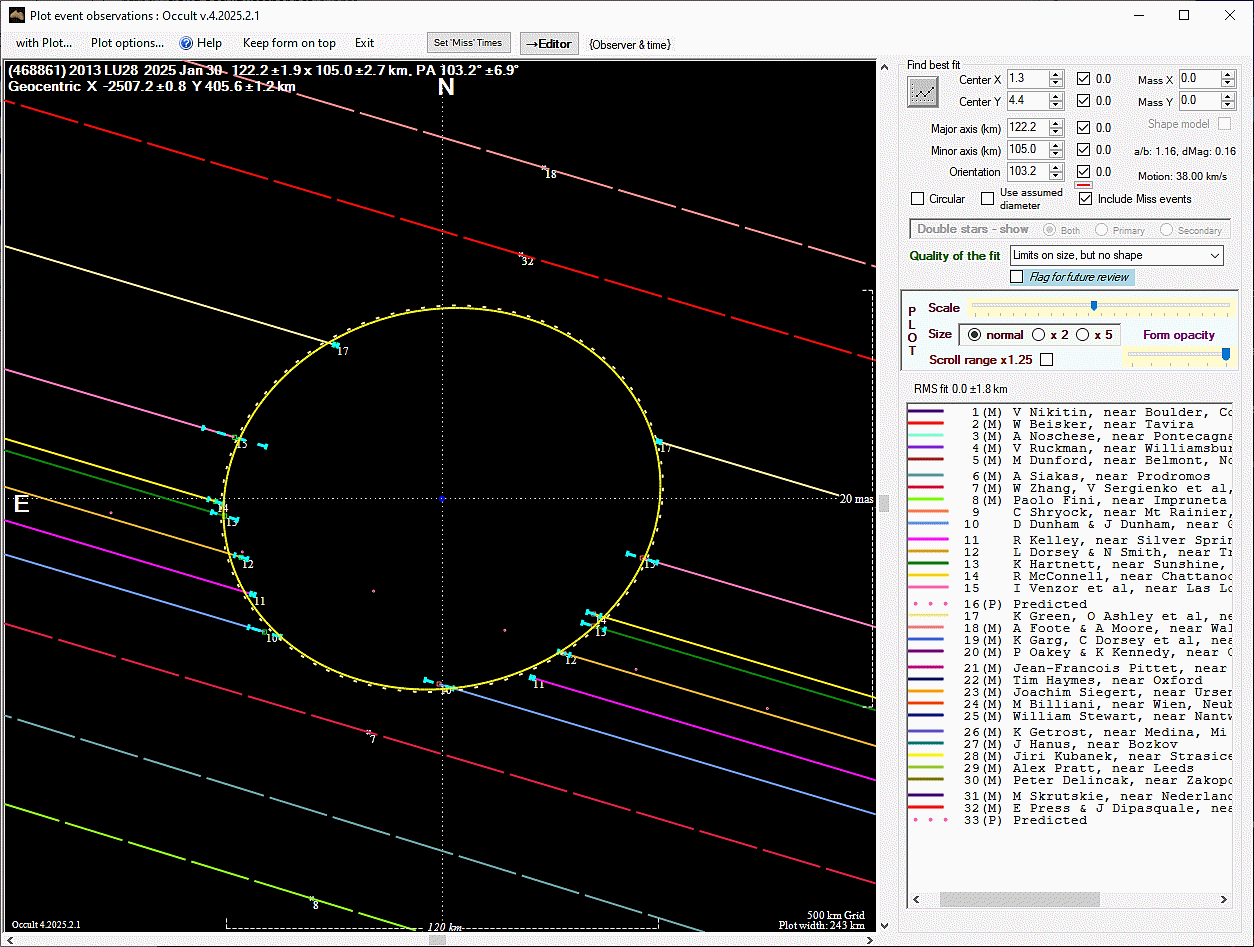
On 30 January 2025, 2013 LU28's shadow, cast by a magnitude 12 star (TYC 2449-01891-1), swept across the eastern US and central Europe. Out of 31 stations, 7 successfully observed the occultation, from which a 122.2 km x 105.0 km profile was derived.[11]
References
- 1 2 3 4 5 6 7 "468861 (2013 LU28)". Minor Planet Center. Retrieved 17 October 2018.
- 1 2 3 4 5 6 "JPL Small-Body Database Browser: 468861 (2013 LU28)" (2026-04-05 last obs.). Jet Propulsion Laboratory. Retrieved 29 June 2026.
- 1 2 3 de la Fuente Marcos, C.; de la Fuente Marcos, R. (August 2014). "Large retrograde Centaurs: visitors from the Oort cloud?". Astrophysics and Space Science. 352 (2): 409–419(Ap&SSHomepage). arXiv:1406.1450. Bibcode:2014Ap&SS.352..409D. CiteSeerX 10.1.1.749.7255. doi:10.1007/s10509-014-1993-9. S2CID 119255885.
{{cite journal}}: Cite uses deprecated parameter|citeseerx=(help) - 1 2 3 4 5 6 Johnston, Wm. Robert (7 October 2018). "List of Known Trans-Neptunian Objects". Johnston's Archive. Retrieved 17 October 2018.
- ↑ "List Of Centaurs and Scattered-Disk Objects". Minor Planet Center. Retrieved 17 October 2018.
- 1 2 3 4 Brown, Michael E. "How many dwarf planets are there in the outer solar system?". California Institute of Technology. Retrieved 17 October 2018.
- ↑ Pinilla-Alonso, Noemí; Brunetto, Rosario; De Prá, Mário N.; Holler, Bryan J.; Hénault, Elsa; Feliciano, Ana Carolina de Souza; et al. (December 2024). "A JWST/DiSCo-TNOs portrait of the primordial Solar System through its trans-Neptunian objects" (PDF). Nature Astronomy. 9 (2): 230–244. Bibcode:2025NatAs...9..230P. doi:10.1038/s41550-024-02433-2. S2CID 274932942.
- ↑ "MPC/MPO/MPS Archive". Minor Planet Center. Retrieved 17 October 2018.
- ↑ "MinorPlanet.info: One Asteroid Information". Asteroid Lightcurve Database (LCDB). Search using Number = "468861"
- ↑ "JWST Schedule". James Webb Space Telescope. Retrieved 17 April 2024.
- ↑ "Asteroidal Occultation Reviewed Results for North America". International Occultation Timing Association (IOTA). Retrieved 12 February 2025.
External links
- List Of Centaurs and Scattered-Disk Objects, Minor Planet Center
- Discovery Circumstances: Numbered Minor Planets (465001)-(470000) – Minor Planet Center
- Asteroid (468861) 2013 LU28, Small Bodies Data Ferret
- (468861) 2013 LU28 at AstDyS-2, Asteroids—Dynamic Site
- (468861) 2013 LU28 at the JPL Small-Body Database