(363027) 1998 ST27
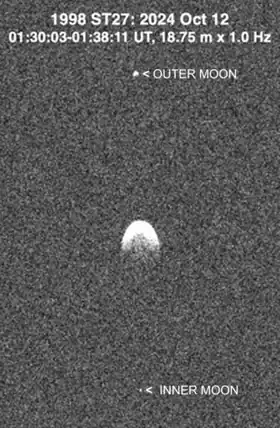 Radar echo of 1998 ST27 and its two moons | |
| Discovery[1] | |
|---|---|
| Discovered by | LINEAR |
| Discovery site | Lincoln Laboratory ETS |
| Discovery date | 24 September 1998 |
| Designations | |
| NEO · Aten · PHA | |
| Orbital characteristics[2] | |
| Epoch 21 November 2025 (JD 2461000.5) | |
| Uncertainty parameter 0 | |
| Aphelion | 1.2541 AU |
| Perihelion | 0.38550 AU |
| 0.81982 AU | |
| Eccentricity | 0.8188 |
| 271.127 d (0.7423 yr) | |
| 88.4052° | |
| 1.3278° / d | |
| Inclination | 21.0507° |
| 197.515° | |
| 322.439° | |
| Known satellites | 2 |
| Earth MOID | 0.009813 AU |
| TJupiter | 6.975 |
| Physical characteristics | |
| ~800–900 m[3] | |
| ~2.7 h[3] | |
| 0.059±0.066[2] | |
| C?[4] | |
| 19.58[2] | |
(363027) 1998 ST27 is a triple near-Earth asteroid (NEA) in the inner Solar System. It was discovered on 24 September 1998 by the LINEAR program at Lincoln Laboratory ETS in New Mexico, United States.[1] It is about 800 to 900 metres (2,600 to 3,000 ft) in diameter and rotates once every 2.7 hours.
1998 ST27 has two unnamed moons. Its inner and outer moon were discovered by radar observation in 2024 and 2001, respectively. The very small inner moon is no larger than 50 metres (160 ft). The larger, 100 metres (330 ft) outer moon lies on a wide orbit, with an orbital period of at least seven days. Its rotation period is shorter, so it is not tidally locked.
Orbit
1998 ST27 orbits the Sun at an average distance—its semi-major axis—of 0.82 astronomical units, taking 271.1 Earth days to complete one orbit. It has an orbital eccentricity of 0.82, causing its distance from the Sun to range from 0.39 AU at perihelion to 1.25 AU at aphelion.[2] Since it is an Earth-crossing near-Earth asteroid with a semi-major axis of less than 1 AU, it is categorized as an Aten asteroid.[5] Its orbit is inclined by 21° with respect to the ecliptic.[2] Its orbit crosses those of every terrestrial planet,[6]: 15 and it frequently has close encounters with Mercury and Earth.[3]
Physical characteristics
Radar observations of 1998 ST27 show that it is about 800 to 900 metres (2,600 to 3,000 ft) in diameter. It is oblate in shape, with a relatively smooth surface.[3] It has a low[7]: 3146 albedo of 0.059,[2] and its surface color properties are consistent with a C-type classification.[4]
Its rotation period is approximately 2.7 hours long, and it spins in a prograde direction.[3]
Moon system
1998 ST27 has two unnamed moons. Its outer moon may have formed in a fissioning event, with its orbit raised by other dynamics after formation,[8]: 12 such as very close encounters with the planets.[6]: 15 Upon the outer moon's discovery, the 1998 ST27 system was the first wide NEA binary known with an asynchronously rotating secondary.[6]: 13
Inner moon
The inner moon was discovered using Goldstone Observatory radar observations on 11 October 2024, as 1998 ST27 was undergoing a close encounter with Earth.[3][4] It orbits 1998 ST27 "much more closely" than the outer moon, and it appears to be smaller than 50 metres (160 ft) in diameter.[3]
Outer moon
The outer moon was discovered by a team of astronomers led by Lance A. M. Benner. They used Arecibo delay-Doppler radar observations taken on 7 and 9 October 2001. The satellite's discovery was announced in an International Astronomical Union Circular on 9 October.[9] It is on an unusually wide orbit, with a separation of at least 5 kilometres (3.1 mi) and an orbital period greater than seven days. It is asynchronously rotating—that is, not tidally locked—spinning faster than its orbital period.[3][8]: 2 It is about 100 metres (330 ft) in diameter.[3]
See also
Other triple NEAs:
References
- 1 2 "(363027) = 1998 ST27". Minor Planet Center. Retrieved 22 May 2026. (1048 obs)
- 1 2 3 4 5 6 "JPL Small-Body Database Lookup: 363027 (1998 ST27)" (2024-10-14 last obs.). Jet Propulsion Laboratory. Retrieved 22 May 2026.
- 1 2 3 4 5 6 7 8 9 "1998 ST27, 2006 UY64, 2020 WG, and 1998 TU3". echo.jpl.nasa.gov. 2024. Retrieved 22 May 2026.
- 1 2 3 Petrescu, Elisabeta; et al. (April 2025). "Lightcurves of Near-Earth Asteroids 2024 ON, 2024 MK and 1998 ST27 As Observed From Trappist". The Minor Planet Bulletin. 52 (2): 150–152. Bibcode:2025MPBu...52..150P.
- ↑ "NEO Groups". NASA/JPL Near-Earth Object Program Office. Archived from the original on 2 February 2002. Retrieved 4 June 2012.
- 1 2 3 Jacobson, Seth A.; Scheeres, Daniel J.; McMahon, Jay (11 December 2013). "FORMATION OF THE WIDE ASYNCHRONOUS BINARY ASTEROID POPULATION". The Astrophysical Journal. 780 (1): 60. arXiv:1311.4887. doi:10.1088/0004-637X/780/1/60. ISSN 0004-637X.
- ↑ Hromakina, T; et al. (February 2023). "NEOROCKS project: surface properties of small near-Earth asteroids". Monthly Notices of the Royal Astronomical Society. 520 (2): 3143–3150. arXiv:2302.01165. doi:10.1093/mnras/stad330. ISSN 0035-8711.
- 1 2 Fang, Julia; Margot, Jean-Luc (1 January 2012). "NEAR-EARTH BINARIES AND TRIPLES: ORIGIN AND EVOLUTION OF SPIN-ORBITAL PROPERTIES". The Astronomical Journal. 143 (1): 24. arXiv:1111.2794. doi:10.1088/0004-6256/143/1/24. ISSN 0004-6256.
- ↑ Benner, L. A. M.; et al. (October 2001). "1998 ST_27". International Astronomical Union Circular. 7730 (2). Bibcode:2001IAUC.7730....2B.
External links
- (363027) 1998 ST27 at NeoDyS-2, Near Earth Objects—Dynamic Site
- ST27 (363027) 1998 ST27 at ESA–space situational awareness
- (363027) 1998 ST27 at the JPL Small-Body Database