't Hooft symbol

The 't Hooft symbol is a rank-3 tensor which mixes the properties of both the Kronecker delta and the Levi-Civita symbol. It was introduced by Gerard 't Hooft in 1976 in order to compute the properties of a dilute gas of instantons, specifically BPST instantons. It is a collection of numbers which allows one to express the generators of the SU(2) Lie algebra in terms of the generators of the Lorentz group Lie algebra.

Definition

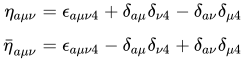
is the 't Hooft symbol: Where and are instances of the Kronecker delta, and is the Levi–Civita symbol.

In other words, the symbols are defined by

()

where the latter are the anti-self-dual 't Hooft symbols.

Matrix form

In matrix form, the 't Hooft symbols are and their anti-self-duals are the following:

Properties

They satisfy the self-duality and the anti-self-duality properties:

Some other properties are[1][2]

The same holds for except for

and

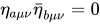
Furthermore, due to different duality properties.
See also

References

  1. ↑ 't Hooft, G. (1976). "Computation of the quantum effects due to a four-dimensional pseudoparticle". Physical Review D. 14 (12): 3432–3450. Bibcode:1976PhRvD..14.3432T. doi:10.1103/PhysRevD.14.3432.
  2. ↑ Belitsky, A. V.; Vandoren, S.; Nieuwenhuizen, P. V. (2000). "Yang-Mills and D-instantons". Classical and Quantum Gravity. 17 (17): 3521–3570. arXiv:hep-th/0004186. Bibcode:2000CQGra..17.3521B. doi:10.1088/0264-9381/17/17/305. S2CID 16107344.