Željko Mejakić
Željko Mejakić | |
|---|---|
Жељко Мејакић | |
 Mejakić at the ICTY | |
| Born | 2 August 1964 Petrov Gaj near Omarska in Bosnia and Herzegovina |
| Occupation | police officer |
| Employer(s) | Yugoslav Public Security Service and Bosnian Serb police |
| Known for | crimes against humanity |
| Convictions | murder, imprisonment, torture, sexual violence, other inhumane acts, and persecution (as crimes against humanity) |
Criminal charge | murder, imprisonment, torture, sexual violence, other inhumane acts, and persecution (as crimes against humanity) |
Penalty | 21 years' imprisonment |
Capture status | surrendered |
| Details | |
| Victims | Non-Serb detainees from the Prijedor region |
| Country | Bosnia and Herzegovina |
| Location | Omarska concentration camp |
Date apprehended | 1 July 2003 |
Željko Mejakić (Serbian Cyrillic: Жељко Мејакић; born 2 August 1964) is a Bosnian Serb and former police officer who was found guilty by the Court of Bosnia and Herzegovina (Court of BiH) of murder, imprisonment, torture, sexual violence, other inhumane acts, and persecution – constituting crimes against humanity under the criminal code of Bosnia and Herzegovina – committed at the Omarska concentration camp near Prijedor, Bosnia and Herzegovina, during the Bosnian War.
Mejakić was born near Prijedor and worked as a policeman in the nearby mining town of Omarska in the Prijedor municipality. In late May 1992, he was serving as a police officer at Omarska when the Omarska camp opened. It held almost exclusively non-Serb detainees from the surrounding districts who had been rounded up during the ethnic cleansing of central Bosanska Krajina. The detainees were kept in deplorable conditions and an atmosphere of severe physical and psychological violence, and had limited access to inadequate and poor quality food, water and medical care. While the camp was operating, Mejakić was the commander of the guard force at the camp and responsible for visitors to the camp. He did not have control over military visitors, interrogators and camp employees, but he was in control of the regular and reserve police officers who made up the guard force, and had the power to prevent and punish crimes committed by them against detainees. Mejakić played a significant role in and made a decisive contribution to the systematic joint criminal enterprise (JCE) constituted by the operation of the camp. The camp was closed in late August following international outcry in the wake of a visit and reporting by British journalist Ed Vulliamy.
Mejakić was indicted by the International Criminal Tribunal for the former Yugoslavia (ICTY) in February 1995, as part of one of the "most important indictments" made by the ICTY.[1] On 1 July 2003, he surrendered to the authorities of Serbia and Montenegro and was transferred into ICTY custody. He entered pleas of not guilty to all counts under the operative indictment. In April 2006, the ICTY referral chamber decided to transfer the prosecution of Mejakić and his co-accused Momčilo Gruban, Dušan Fuštar and Dušan Knežević to the Court of BiH as part of the process of the ICTY concluding its mandate. They were then indicted with crimes against humanity by the prosecutor of Bosnia and Herzegovina and entered not guilty pleas. Their trial began in December 2006, and the court separated Fuštar from the case in April 2008 under a plea agreement. On 30 May 2008 the court found Mejakić and his remaining co-accused guilty of crimes against humanity, including in his case as a direct perpetrator in one instance of mistreatment, under command responsibility as the de facto commander of the Omarska camp, and under the JCE for furthering the camp's system of mistreatment and persecution of detainees. He was sentenced to long-term imprisonment for twenty-one years. On 16 July 2009, the appellate division of the Court of BiH affirmed his conviction, but on the basis of his participation in the JCE only, and upheld his sentence.
In 2013, Mejakić was a defence witness during the ICTY trial of the former president of the self-proclaimed Bosnian Serb proto-state, Republika Srpska, Radovan Karadžić , and claimed that only isolated incidents and irregularities had occurred at the Omarska camp, and that the guard force was not involved in them. On 25 January 2019, Mejakić was granted conditional release as he had served two-thirds of his sentence, including time served between his surrender and sentencing.
Personal details
Željko Mejakić was born on 2 August 1964 in the village of Petrov Gaj near Prijedor, SR Bosnia and Herzegovina, Yugoslavia.[2] He is of Bosnian Serb ethnicity.[3] Prior to the outbreak of the Bosnian War he was a police officer in the mining town of Omarska near Prijedor.[4]
Establishment of concentration camps at Prijedor


In September 1991, as Yugoslavia continued to break up, several Bosnian Serb autonomous regions were proclaimed in Bosnia and Herzegovina, which then each established what was known as a crisis staff. Each crisis staff consisted of the leaders of the Bosnian Serb-dominated Serb Democratic Party (SDS), the local Yugoslav People's Army (JNA) commander, and Bosnian Serb police officials. Initially the Serb Autonomous Region of Krajina (ARK) did not include the Prijedor municipality – which incorporated the town itself and some outlying villages. Before the war, the population of the municipality was 44 per cent Bosnian Muslim, 42.5 per cent Bosnian Serb, 5.6 per cent Bosnian Croat, with the rest identifying as Yugoslav, Ukrainian, Russian or Italian. Within the municipality the local government was run by the Bosnian Muslim-dominated Party of Democratic Action (SDA), which had a small majority. On 30 April 1992, the SDS, assisted by police and military forces, took over the town of Prijedor, and JNA soldiers occupied all the prominent institutions in the town. A local crisis staff was created, reporting to the ARK crisis staff in the city of Banja Luka 50 km (31 mi) to the east.[5] Immediately after the Bosnian Serb takeover of the municipality, non-Serbs were targeted for abusive treatment.[6] After the JNA elements in Bosnia and Herzegovina became the Bosnian Serb Army (VRS) on 20 May, majority non-Serb villages in the Prijedor area were attacked by the VRS, and the population rounded up, although some fled. This occurred in Prijedor town itself on 30 May. Older men, and women and children were separated from men of fighting age, who were transported to the police station in Prijedor then bussed to either the Omarska or Keraterm concentration camps. The elderly men, women and children were generally taken to the Trnopolje concentration camp. All three camps were in the wider Prijedor municipality. Non-Serb community leaders were included in the roundup and sent to one of the camps.[7][8]
Mejakić's activities at the Omarska concentration camp

The Omarska camp was situated at the Ljubija iron ore mine.[9] Preparations for its operation began around 25 May 1992,[10] and the first group of detainees arrived on the night of 27–28 May and the last arrived around 21 August.[11] Every detainee was interrogated at least once, usually involving severe mental and physical abuse.[12] According to the Bosnian Serb authorities, a total of 3,334 detainees were held at the camp for some time during its almost three month operation,[13] but other sources place the number around 5,000 to 7,000. The bulk of the detainees were men,[10] although 36 to 38 women were also detained in the camp.[11] The detainees were almost all Bosnian Muslims or Bosnian Croats, with a few Bosnian Serbs held due to suspicions they had been collaborating with Bosnian Muslims.[14] While held at the camp, detainees were kept in appalling conditions,[15] and there was a pervasive atmosphere of extreme mental and physical violence. Intimidation, extortion, beatings, and torture were commonplace.[16] Murder was common.[17] Food and water provided were of poor quality and medical care was grossly inadequate.[12][1][18]
From 24 May to 30 August 1992, Mejakić was the chief of security at the Omarska camp, responsible for the guards and visitors.[4] He did not have control of the Territorial Defence members, interrogators, Bosnian Serb Army soldiers or camp employees, but was in charge of the regular and reserve police officers who were members of the camp guard force. In this role, he had the "authorisation and authority" to prevent and punish crimes by the guards against detainees. Mejakić played a significant role in and made a decisive contribution to the systematic joint criminal enterprise (JCE) constituted by the operation of the camp.[19]
On 7 August 1992, the British journalist Ed Vulliamy reported on the shocking conditions in the Omarska and Trnopolje camps, having visited them in the preceding days at the invitation of the president of the self-proclaimed Bosnian Serb proto-state, Republika Srpska, Radovan Karadžić.[20] Mejakić was responsible for ejecting Vulliamy and his colleagues from the Omarska camp.[21] The international outcry that arose from Vulliamy's reporting and photographs of emaciated detainees caused the Bosnian Serbs to close the Omarska camp soon after, although many of the detainees were just moved to other camps.[22]
Indictment, surrender and transfer of case to Bosnia and Herzegovina
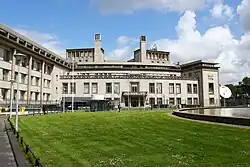
In 1993, the International Criminal Tribunal for the former Yugoslavia (ICTY) was established by the United Nations (UN) to prosecute war crimes that took place in the Balkans in the 1990s.[23] On 10 February 1995, Mejakić, along with 18 other persons allegedly involved in the running of the Omarska camp, was indicted by the ICTY under Case Number IT-95-4.[24] This indictment was described as one of the "most important indictments" made by the ICTY.[1] On 20 December 1995, the Bosnian War ended when the Dayton Agreement came into force, along with the North Atlantic Treaty Organisation (NATO)-led multi-national peace enforcement operation known as the Implementation Force (IFOR). After a year during which the peace agreement between the former warring parties was successfully implemented, the NATO-led Stabilisation Force (SFOR) took over on 20 December 1996.[25] From November 1996 on, Mejakić lived in Serbia.[26]
On 8 May 1998, the ICTY prosecutor withdrew the charges against eleven of the nineteen people indicted over the operation of the Omarska camp under Case Number IT-95-4. As a result, the amended Omarska indictment included only Mejakić, Dušan Knežević, Momčilo Gruban and five others. The prosecutor stated that the withdrawal of these accused people from the indictments resulted from a re-evaluation of the investigative and prosecutorial strategies of the ICTY to prioritise the most serious cases, and the fact that none of those against whom charges had been withdrawn had yet been arrested or surrendered to the court, increasing the anticipated number of separate trials.[27] On 9 November 1998, the ICTY announced that its prosecutor had been granted leave to withdraw four accused from the amended Omarska and Keraterm indictments and consolidate their charges under a single and separate indictment.[28] This left Mejakić, Knežević, Gruban and one other accused on the amended Omarska indictment. In April 2000, the fourth accused on the Omarska indictment was severed from it and joined to another case. In November 2001, Predrag Banović, who had been indicted for alleged crimes committed at the Keraterm concentration camp, was transferred to ICTY custody[29] and a new Keraterm case was established under Case Number IT-95-8/1, in which he was included. When another Keraterm indictee, Dušan Fuštar, was transferred into ICTY custody in January 2002,[30] he was joined to the new case.[31]
At this point Mejakić was still at large, but Gruban surrendered to the authorities of Serbia and Montenegro on 2 May 2002, and was transferred into the custody of the ICTY on the same day.[32][33] Knežević surrendered to the authorities of Bosnia and Herzegovina on 18 May 2002,[34] and was transferred into the custody of the ICTY on the following day.[35] In September 2002, the remaining three accused on the original Omarska indictment Case Number IT-95-4 (Gruban, Mejakić and Knežević) were joined to those accused in the new Keraterm indictment Case Number IT-95-8/1 (Knežević, Banović and Fuštar) and a new consolidated case was created against Case Number IT-02-65.[36] On 21 November 2002 this consolidated indictment became the operative ICTY indictment against the five co-accused.[36] In June 2003, Banović came to a plea agreement with the prosecution and was withdrawn from the operative indictment and dealt with separately.[37] On 1 July 2003, Mejakić surrendered to the authorities of Serbia and Montenegro,[38] and was transferred into ICTY custody on 4 July.[37] He made his first appearance before the court on 7 July 2003 when he entered pleas of not guilty to all charges against him.[26]
The operative indictment comprised the following counts against Mejakić on the basis of individual responsibility under Article 7(1) and command responsibility under Article 7(3) of the ICTY statute:[31][36]
- Count 1 – Persecutions on political, racial or religious grounds, a crime against humanity – Article 5(h)
- Count 2 – Murder, a crime against humanity – Article 5(a)
- Count 3 – Murder, a violation of the laws or customs of war – Article 3
- Count 4 – Inhumane acts, a crime against humanity – Article 5(i)
- Count 5 – Cruel treatment, a violation of the laws or customs of war – Article 3
On 7 April 2006, the ICTY announced that its appeals chamber had upheld a decision to transfer the prosecution of Mejakić, Knežević, Gruban and Fuštar to the Court of Bosnia and Herzegovina (Court of BiH) under ICTY Rule 11bis.[39] In 2005, as part of the process of concluding its mandate pursuant to resolutions of the United Nations Security Council, the ICTY had begun transferring middle and lower-level indictees to the courts of the countries of the former Yugoslavia. Such transfers were subject to various conditions. On 9 May 2006, the case against Mejakić, Knežević, Gruban and Fuštar was transferred to Bosnia and Herzegovina for trial,[40] and they were all transferred into the custody of Bosnia and Herzegovina on the same day.[41] From this point on, the ICTY monitored proceedings at the Court of BiH and received regular progress reports from the Organization for Security and Co-operation in Europe's mission to Bosnia and Herzegovina on the prosecution, sentencing and appeals.[42]
Trial, sentencing, appeal and release
On 7 July 2006, the prosecutor of Bosnia and Herzegovina issued an indictment charging Mejakić, Knežević, Gruban and Fuštar with crimes against humanity. Mejakić was indicted for the following crimes under various subparagraphs of Article 172(1) of the Criminal Code of Bosnia and Herzegovina, namely:[43]
- (a) depriving another person of his life (murder);
- (e) imprisonment (arbitrary and unlawful confinement of camp detainees);
- (f) torture (beatings and other physical abuse);
- (g) sexual violence (rapes and other forms of sexual abuse);
- (k) other inhumane acts (confinement in inhumane conditions, harassment, humiliation and other psychological abuse); and
- (h) persecution.
The indictment was confirmed by the Court of BiH a week later. On 28 July 2006, all four accused pleaded not guilty. The trial commenced on 20 December 2006.[2][3] The court separated Fuštar from the case on 17 April 2008 as he wished to enter into a plea agreement. The trial of Mejakić, Knežević and Gruban continued, and the court rendered its first instance verdict on 30 May 2008.[2]
Mejakić was found guilty of all the crimes against humanity under article 172(1) with which he had been indicted. This finding was as a direct perpetrator in one instance of mistreatment, under command responsibility as the de facto commander of the Omarska camp, and under the JCE for furthering the camp's system of mistreatment and persecution of detainees. He was sentenced to long-term imprisonment[a] for twenty-one years. His co-defendants were also found guilty of crimes against humanity. Mejakić appealed the first instance verdict, claiming that there had been violations of the Criminal Code, the Criminal Procedure Code, and in the establishment of facts, and on the basis of issues related to his sentencing.[45][46][47]
On 20 July 2009, the appellate panel of the Court of BiH rendered its final and binding verdict in the case, described by the OSCE as "deemed generally as a clear and well-structured decision". The panel accepted part of Mejakić's appeal, finding that he was not the de facto camp commander or commander of security for Omarska camp, but was the commander of the security guards at the camp, although this did not affect his guilt for the crimes he had committed. It also revised the basis of Mejakić's conviction, stating that the basis for his criminal liability was under the JCE, which, as the broadest form of responsibility, encompassed any command or individual liability.[45][48] The OSCE observed that the appeal panel in this case had clarified several previously unsettled aspects of the domestic law of Bosnia and Herzegovina regarding JCE. Firstly, that JCE could legally be applied to domestic war crimes prosecutions, and also how JCE should relate to direct and command responsibility for crimes.[49]
On 24 July 2009, Mejakić began his sentence at the Penal Correctional Institution in Foča, the only facility in the Republika Srpska entity of Bosnia and Herzegovina that can house prisoners serving sentences of long-term imprisonment.[49] In November 2013, he gave evidence for the defence in the ICTY trial of Karadžić, during which he claimed that "irregularities" and "isolated incidents" had occurred at the Omarska camp, but they had been committed by paramilitaries and other "uninvited guests", not his guards. When confronted by the prosecutor with his previous statement that only two men had died at the Omarska camp from "natural causes", he stated that he and others had been told to give the "official version" of events as reported by the Banja Luka police commission. The prosecutor noted that two of the four members of the Banja Luka police commission were inspectors who had interrogated detainees at Omarska.[50] On 25 January 2019, Mejakić was granted conditional release as he had served two-thirds of his sentence, including time served between his surrender and sentencing.[51]
Notes
- ↑ "Long-term imprisonment" is the most severe criminal sanction prescribed in the criminal law of Bosnia and Herzegovina. It is a special form of imprisonment, the term of which can range from 20 to 45 years. In comparison to "ordinary imprisonment", a slightly different regime applies to it (e.g. concerning punishment in conjunction, suspended sentence, pardon etc.). It is prescribed for the gravest forms of serious criminal offences perpetrated with intent. Under existing regulations, this punishment is prescribed for criminal offences against the integrity of the state and for crimes against humanity and values protected by international law.[44]
Footnotes
- 1 2 3 Williams & Scharf 2002, p. 51.
- 1 2 3 Alić 2010, p. 80.
- 1 2 Al Jazeera 2006.
- 1 2 Bartrop 2014, p. 314.
- ↑ Gow 2003, p. 121–126.
- ↑ Nielsen 2024, p. 85.
- ↑ Karčić 2022, pp. 115–122.
- ↑ Balkan Battlegrounds 2003, pp. 304–305.
- ↑ Prijedor Conference 2005, pp. 12 & 61.
- 1 2 Pierpaoli 2016, p. 165.
- 1 2 Alić 2010, p. 82.
- 1 2 Prijedor Conference 2005, p. 56.
- ↑ Prijedor Conference 2005, p. 61.
- ↑ Gow 2003, p. 135.
- ↑ Prijedor Conference 2005, p. 18.
- ↑ Rodley & Pollard 2011, p. 94.
- ↑ Gow 2003, pp. 134–137.
- ↑ Campbell 2015, Omarska.
- ↑ Alić 2010, pp. 81–82.
- ↑ Vulliamy 1992.
- ↑ Vulliamy 2013, Chapter Four.
- ↑ Holocaust Memorial Day Trust 2025.
- ↑ ICTY 2017.
- ↑ Cushman & Meštrović 1996, pp. 385–401.
- ↑ NATO 2004.
- 1 2 Bartrop 2014, p. 315.
- ↑ ICTY Prosecutor 8 May 1998.
- ↑ ICTY 30 November 1998.
- ↑ Boucher 2001.
- ↑ CNN 2002.
- 1 2 Case Information Sheet – ICTY, p. 4.
- ↑ BBC 2002.
- ↑ CBC 2002.
- ↑ Borger 2016, p. 340.
- ↑ McDonald 2002, p. 277.
- 1 2 3 Kiss & Lammers 2004, p. 193.
- 1 2 Kiss & Lammers 2004, p. 194.
- ↑ Kratovac 2003.
- ↑ ICTY 7 April 2006.
- ↑ OSCE 2010, pp. 8–9.
- ↑ Case Information Sheet – ICTY, p. 5.
- ↑ Status of Transferred Cases 2025.
- ↑ Court of BiH Adapted Indictment 2006, p. 20.
- ↑ Alić 2010, pp. 16–17.
- 1 2 Country Report – Bosnia and Herzegovina 2009, p. 1341.
- ↑ OSCE Final Progress Report 2009, p. 1.
- ↑ Dzidic 2008.
- ↑ OSCE Final Progress Report 2009, pp. 1–2.
- 1 2 OSCE Final Progress Report 2009, p. 2.
- ↑ SENSE 2013.
- ↑ Sorguc 2018.
References
Books, conference papers and reports
- Alić, Aida (2010). Time for Truth: Review of the Work of the War Crimes Chamber of the Court of Bosnia and Herzegovina 2005–2010 (PDF). Sarajevo: Balkan Investigative Reporting Network. ISBN 978-9958-9005-5-6. Archived (PDF) from the original on 31 March 2024.
- Balkan Battlegrounds: A Military History of the Yugoslav Conflict. Vol. 2. Washington: Central Intelligence Agency, Office of Russian and European Analysis. 2003. ISBN 978-0-16-066472-4.
 This article incorporates text from this source, which is in the public domain.
- Bartrop, Paul R. (2014). "Zeljko Mejakic". In Bartrop, Paul R.; Jacobs, Steven Leonard (eds.). Modern Genocide: The Definitive Resource and Document Collection. Vol. 1. Santa Barbara: ABC-CLIO. pp. 314–315. ISBN 978-1-61069-364-6.
- Borger, Julian (2016). The Butcher's Trail: How the Search for Balkan War Criminals Became the World's Most Successful Manhunt. New York: Other Press. ISBN 978-1-59051-606-5.
- "Bosnia and Herzegovina". Country Reports on Human Rights Practices for 2009. Vol. 2. US: US Government Printing Office. 2009. OCLC 6026722.
- Campbell, Bradley (2015). The Geometry of Genocide: A Study in Pure Sociology. Charlottesville: University of Virginia Press. ISBN 978-0-8139-3742-7.
- Case Information Sheet: The Prosecutor v. Željko Mejakić, Momčilo Gruban, Dušan Fuštar & Dušan Knežević (PDF). ICTY. Archived (PDF) from the original on 15 April 2026. Retrieved 7 March 2025.
- Cushman, Thomas; Meštrović, Stjepan Gabriel, eds. (1996). This Time We Knew: Western Responses to Genocide in Bosnia. New York: New York University Press. ISBN 978-0-8147-1535-2.
- Gow, James (2003). The Serbian Project and Its Adversaries: A Strategy of War Crimes. London: Hurst & Company. ISBN 978-1-85065-499-5.
- Karčić, Hikmet (2022). "Prijedor". Torture, Humiliate, Kill: Inside the Bosnian Serb Camp System. Ann Arbor: University of Michigan Press. ISBN 978-0-472-90271-2.
- Kiss, Alexandre-Charles; Lammers, Johan G., eds. (2004). Hague Yearbook of International Law (2003). Vol. 16. Boston: BRILL. ISBN 978-90-474-1391-2.
- McDonald, Avril (2002). "International Criminal Law". Yearbook of International Humanitarian Law. Vol. 5. The Hague: T. M. C. Asser Press. ISBN 978-90-6704-189-8.
- Nielsen, Christian Axboe (2024). Mass Atrocities and the Police: A New History of Ethnic Cleansing in Bosnia and Herzegovina. London: Bloomsbury Publishing. ISBN 978-1-350-20457-7.
- Pierpaoli, Paul G. (2016). "Omarska". In Bartrop, Paul R. (ed.). Bosnian Genocide: The Essential Reference Guide. Santa Barbara: ABC-CLIO. ISBN 978-1-4408-3869-9.
- Prijedor (PDF). Bridging the Gap between the ICTY and Communities in Bosnia and Herzegovina. The Hague: ICTY. 25 June 2005. Archived (PDF) from the original on 25 May 2025. Retrieved 12 April 2025.
- Rodley, Nigel; Pollard, Matt (2011). The Treatment of Prisoners under International Law (3 ed.). New York: Oxford University Press. ISBN 978-0-19-155051-5.
- The Processing of ICTY Rule 11bis cases in Bosnia and Herzegovina: Reflections on Findings from Five Years of OSCE Monitoring (PDF). Sarajevo: Organisation for Security and Co-operation in Europe Mission to Bosnia and Herzegovina. 2010. ISBN 978-92-9235-330-8. Archived (PDF) from the original on 23 April 2026.
- Thirteenth and Final Report in the Željko Mejakić et al. Case – Transferred to the State Court pursuant to Rule 11bis (PDF). Sarajevo: Organisation for Security and Co-operation in Europe Mission to Bosnia and Herzegovina. 6 October 2009. Archived (PDF) from the original on 22 March 2025.
- Vulliamy, Ed (2013). The War is Dead, Long Live the War – Bosnia: The Reckoning. London: Vintage Books. ISBN 978-1-4464-8477-7.
- Williams, Paul R.; Scharf, Michael P. (2002). Peace with Justice? War Crimes and Accountability in the Former Yugoslavia. Lanham: Rowman & Littlefield. ISBN 978-0-7425-1856-8.
News and websites
- "7 August 1992: British Journalists Gain Access to Omarska". Holocaust Memorial Day Trust. 2025. Archived from the original on 10 November 2025. Retrieved 22 April 2026.
- "About the ICTY". International Residual Mechanism for Criminal Tribunals. 31 December 2017. Archived from the original on 26 March 2026. Retrieved 22 April 2026.
- "Appeals Chamber Upholds Decision to Refer the Mejakic et al. Case to Bosnia and Herzegovina". International Residual Mechanism for Criminal Tribunals. Archived from the original on 20 August 2023. Retrieved 24 April 2026.
- "Bosnian Serb Surrendered to UN Court". CNN. Archived from the original on 19 August 2019. Retrieved 23 April 2026.
- Boucher, Richard (8 November 2001). "Belgrade Authorities Arrest Two ICTY Indictees". US Department of State. Retrieved 23 April 2026.
- Dzidic, Denis (3 June 2008). "Long Jail Terms for Prison Camp Accused". Institute for War & Peace Reporting. Archived from the original on 19 April 2025. Retrieved 22 April 2026.
- "History of the NATO-led Stabilisation Force (SFOR) in Bosnia and Herzegovina". NATO. 2 December 2004. Archived from the original on 20 March 2025. Retrieved 14 March 2025.
- Kratovac, Katarina (29 June 2003). "Bosnian Serb Indicted for War Crimes". Midland Daily News. Archived from the original on 23 April 2026. Retrieved 23 April 2026.
- "Mejakic: We Were Ordered to Give "Official Version"". SENSE Transitional Justice Center. 29 November 2013. Archived from the original on 25 September 2023. Retrieved 14 May 2026.
- "More War Crimes Suspects Surrender". CBC News. 2 May 2002. Archived from the original on 23 April 2026. Retrieved 23 April 2026.
- "More Yugoslav suspects "head for Hague"". BBC. 30 April 2002. Archived from the original on 9 June 2021. Retrieved 8 May 2026.
- Sorguc, Albina (14 November 2018). "Bosnia's Omarska Camp Security Chief Due for Release". Balkan Insight. Retrieved 7 March 2025.
- "Statement by the Prosecutor following the Withdrawal of the Charges against 14 Accused". International Residual Mechanism for Criminal Tribunals. Archived from the original on 18 November 2025. Retrieved 24 April 2026.
- "Status of Transferred Cases". International Residual Mechanism for Criminal Tribunals. Archived from the original on 12 January 2026. Retrieved 8 March 2025.
- "The Omarska and Keraterm Cases: Further Initial Appearance on 10 December 1998 of defendants Radic, Kvocka, Zigic and Kos". International Residual Mechanism for Criminal Tribunals. 30 November 1998. Archived from the original on 25 June 2024. Retrieved 24 April 2026.
- "Trial of Four Bosnian Serbs begins". Al Jazeera. 20 December 2006. Archived from the original on 18 November 2025. Retrieved 12 April 2025.
- Vulliamy, Ed (7 August 1992). "Shame of Camp Omarska". The Guardian. Archived from the original on 11 February 2026. Retrieved 16 March 2025.
- "Željko Mejakić, Momčilo Gruban, Dušan Fuštar & Dušan Knežević, Court of Bosnia and Herzegovina, Adapted Indictment" (PDF). International Crimes Database. 7 July 2006. Case: KT-RZ-91/06. Archived from the original (PDF) on 22 March 2025. Retrieved 8 March 2025.
Further reading
- "Željko Mejakić, Momčilo Gruban, Duško Knežević, Court of Bosnia and Herzegovina, first instance (30 May 2008) and second instance (16 February 2009)". International Committee of the Red Cross. 30 May 2008. Archived from the original on 12 April 2025. Retrieved 12 April 2025.
- People from Prijedor
- 1964 births
- Serbs of Bosnia and Herzegovina convicted of crimes against humanity
- People indicted by the International Criminal Tribunal for the former Yugoslavia
- Living people
- Bosnia and Herzegovina police officers
- Police officers convicted of murder
- People convicted of torture
- Bosnia and Herzegovina people convicted of murder
- Bosnia and Herzegovina prisoners and detainees
- Prisoners and detainees of Bosnia and Herzegovina