Śleszyński–Pringsheim theorem

In mathematics, the Śleszyński–Pringsheim theorem is a statement about convergence of certain continued fractions. It was discovered by Ivan Śleszyński[1] and Alfred Pringsheim[2] in the late 19th century.[3]

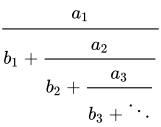
It states that if is a positive integer and , are sequences of real numbers such that for all , then

converges absolutely to a number satisfying ,[4] meaning that the series

where are the convergents of the continued fraction, converges absolutely.

Proof

Recall that the th convergents of , which will be denoted by in this article, can be computed from the following recurrence relation:

where , , , and . See this article for more detail.

nth convergent as a series

First, we will prove the following claim via mathematical induction

Claim—For all positive integers , then

Proof

The case is trivial.

Suppose the claim is true for . By using the two recurrence relation above, it follows that

which finishes the induction step.

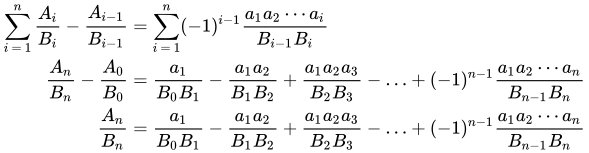
By dividing both sides of the claim by , the equation becomes

Thus,
Absolute value of nth convergent as a series

Now suppose that for all . Using the recurrence relation of , note that

Thus,

Since by assumption, then by using mathematical induction, one can show that
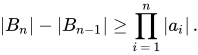
Consequently, the sequence of is monotone nondecreasing and bounded from below by . Moreover,

Since the right-hand side forms a telescoping series, it is easy to see that

for all values of . Furthermore, the nondecreasing property of the sequence also implies the nondecreasing property of the sequence . Thus, the sequence must converge, by the monotone convergence theorem.

Note that the left-hand side is the upper bound of series representation of after applying triangle inequality, which completes the proof.

See also

Notes and references

  1. ↑ Слешинскій, И. В. (1889). "Дополненiе къ замѣткѣ о сходимости непрерывныхъ дробей". Матем. Сб. (in Russian). 14 (3): 436–438.
  2. ↑ Pringsheim, A. (1898). "Ueber die Convergenz unendlicher Kettenbrüche". Münch. Ber. (in German). 28: 295–324. JFM 29.0178.02.
  3. ↑ W. J. Thron has found evidence that Pringsheim was aware of the work of Śleszyński before he published his article; see Thron, W. J. (1992). "Should the Pringsheim criterion be renamed the Śleszyński criterion?". Comm. Anal. Theory Contin. Fractions. 1: 13–20. MR 1192192.
  4. ↑ Lorentzen, L.; Waadeland, H. (2008). Continued Fractions: Convergence theory. Atlantic Press. p. 129.