Úrkút Manganese Ore Formation
| Úrkút Manganese Ore Formation | |
|---|---|
| Stratigraphic range: Toarcian ~ | |
 Ancient karst formation in an abandoned manganite quarry in Úrkút | |
| Type | Geological formation |
| Unit of | Úrkút Basin |
| Underlies | Épleny Limestone Formation |
| Overlies | Isztimér Formation |
| Thickness | 15 m (49 ft) |
| Lithology | |
| Primary | Manganese |
| Other | Rhodochrosite |
| Location | |
| Region | Central Mountains of Transdanubia |
| Country | Hungary |
| Extent | ~12 km (7.5 mi) by 4–6 km (2.5–3.7 mi) |
| Type section | |
| Named for | Úrkút |
| Named by | Drubina-Szabo[1] |
| Year defined | 1959 |
  Úrkút Manganese Ore Formation (Hungary) | |
The Úrkút Manganese Ore Formation is a Jurassic geologic formation in Hungary. It covers the Early Toarcian stage of the Early Jurassic, and it is one of the main regional units linked to the Toarcian Anoxic Events.[2][3] Different fossils heve been recovered on the locations, including marine life such as Ammonites Fish and terrestrial fossils, such as Palynomorphs and fossil wood.[4][5][6][7] Úrkút (17´38'E and 47´05'N) and Eplény (17´55'E and 47´12'N) are the main deposits of the Formation.[1] Are related to the Bakony Range, an ancient massif that was uplifted gradually and exposed to a long period of erosion, where the deposits of Úrkút appear to be a basin inclined gently to the north, while the highest point to the south is the basalt mass of Kab Mountain. Eplény region consists of a broad N-S trending open valley between fiat-topped, small hills.[1][8]
Geology
The Urkut Area is part of the Bakony Tectonic Block, with the abundant presence of faults dividing the region into several segments.[1] The terrain where the Manganese Ore is developed is characterised by a high fracturation, where the Jurassic beds and shale lent themselves readily to deformation, with minor folds, faults and shear zones.[9] During the geological evolution of the Bakony range a series of principal fractures were active repeatedly, yielding to vertical as well as horizontal forces that ultimately produced the structural make-up controlling the present topographic configuration of the area.[9] The Jurassic sediments, along the other Mesozoic aged strata were deposited in a branch of a Geosyncline, connected with the Alpine coeval biota.[1] On the Triassic-Jurassic boundary Kimmerian movements take place, as evidenced by the change observed on the texture of the local Calcareous sediments, interpreted as a gradual rising of the sea bottom.[9] To the end of the Lower Jurassic, on the Toarcian, there are several records of another series of pulses from Kimmerian movements, that resulted in partial emergence, which dates the beginning of Karst development on the Csirda Mountain. However, marine sedimentation continued over most of the region and the sea became more widespread.[1] On this time a global sea transgression occur, where on the Úrkút basin shallow-water sediments accumulated near the margins, and with progressive deepening of the sea bottom until the end of late Liassic time, sediments of correspondingly deeper water were deposited.[1] Due to a cut-off of water circulation there were a series of changes on the local development of the basin, which led to the accumulation of the manganese minerals.[1]
The Éplény Area shows a structure and geological development with minor differences from those of Úrkút, being considered overall identical. However, it suffered minor deformation during the late Kimmerian movements, and instead of the Austrian movements, the Subhercynian and Laramide movements produced important structures. After the Pyrenean and Savian movements, the Éplény area started to sink slowly and to receive marine sediments, emerging later on the Middle Miocene.[1] The manganese ore group of beds appears in an absolutely different way according to evolution in Eplény, where while in Úrkút 4 beds can be divided, in Eplény, the 3 beds appear usually with sharp boundary, in reduced thickness.[10]
Stratigraphy

The oldest formations on the Úrkút basin are referred to the Upper Triassic Dolomite range and the Dachstein Limestone of Raetian age. After the deposition of the Triassic rocks a series of Jurassic strata successions have overlain the older deposits, with its lowermost contact found on the uppermost strata of the own Dachstein Limestone, developing a lower Liassic sequence that is a white, yellowish-gray or pink, dense Limestone resembling that of the Dachstein.[1] Over it, there is a series of younger liassic strata and a Crinoid-Brachiopod and Rhynchonellatan bearing reddish Limestone, that resembles the Sinemurian Hierlatz Limestone of the Csárda Mountain, that is the last unit under the coeval Manganese deposits from there. Late Pliensbachian strata is composed by nodular and cherty red limestone with abundant ammonites and brachiopods, that belong to the Isztimér Formation.[11] On the uppermost Pliensbachian strata there is a series of beds that consists of greenish-gray limestone and marl, which also contain crinoids and brachiopods, being the last unit under the Manganese Ore.[1] The Upper Liassic (Toarcian) sequence is composed mostly by the Úrkút Manganese and the Éplény Limestone (Late Toarcian-Aalenian), and starts with thick-bedded, gray, Radiolaria-bearing, argillaceous marl containing several intercalations of manganese carbonate, or rarely, manganese oxides, with the top of the sequence being a brown to purple nodular Limestone with light green spots.[1] Middle Jurassic overlaying these deposits, being mostly a series of cherty Marlstone containing the genus Posidonomya and several types of Radiolaria.[12] The Late Jurassic strata is vanished locally, with the Cretaceous sedimentation starting with several continental beds with Bauxite and accompanying Laterites.[1] Finally, on the Tertiary, the Lower Eocene continental clay and bauxite are overlain by gray carbonaceous clay and sandstone, with the Jurassic beds and manganiferous beds eroded.[1]
Lithology

The Manganese Ore is the main component of the formation, and its distinctive characteristic element.[13] The Úrkút Manganese ores occur on marine sedimentary rocks composed mainly of bioclastic Limestone, radiolarian Clay Marlstone, and dark-gray to Black Shale. The Origin of the Local Manganese Ores based on the presence of siliceous manganese ores and antauthigenic Silica points to the volcanogenic-sedimentary origin of this Mn-ore deposits[14] Manganese nodules are widely distributed in the area in Jurassic rocks, mainly on the Lower Jurassic, but younger nodules also occur.[13] The Black Shale with Mn-carbonate get its maximum deposition on the Toarcian, concretely during the Tenuicostatum–Falciferum Ammonite zones in the coeval Sachrang Formation, Strubberg Formation and Allgäu Formation in the Northern Calcareous Alps and the Eastern Alps (Austria, Germany and Switzerland), while Úrkút and related deposits were the regional equivalent in the Transdanubian Range.[13] There are other deposits with Shale and associated Mn particles on contemporaneous oxic deposits occur that formed under similar environmental conditions.[15] The Úrkút Manganese deposit has been investigated geologically, mineralogically and chemically.[16] It has several properties, including very fine grain size (~ 1 μm), an enrichment of metals over a geologically very short time (-500 thousand years). Both Metals and the Manganese have been related with local hydrothermal vent systems, where the metal enrichment was a result of microbial activity.[17] There are at least three types of Manganese deposits that occur close in proximity. The first, those with cherty Fe–Mn-oxide ore, developed on the margins of the much larger carbonate ore body, whose origin has been related with proximal fracture systems, being composed by varicolored metalliferous Claystone. Other type includes the so-called Csárda-hill, where it is very cherty and iron-rich, and is suggested as originated from a low-temperature fluid flow along an associated fracture zone. This deposit is associated with sedimentary dykes, filled with red Lime-Mudstone, varicoloured Claystone, carbonate debris, or Mn oxides. The last type is the Black Shale-hosted Mn-carbonate, considered a distal ore-forming environment, where the Mn-carbonate proto-ore sediment accumulated. A hydrothermal/exhalative source of metals may have contributed to the formation of the deposits of Black Shale.[18]
There is a rhodochrosite ore, composed of laminated gray, green, brown, and black sections, and is associated with a diagenetic origin.[19] Rhodochrosite concretions with fish and plant fossils are common on the strata, composed by Mn-bearing Calcite with traces of hydroxyl-apatite, kutnohorite, smectite, quartz, feldspar, barite, pyrite, and quartz-cristobalite.[19] Mineralized sections do not contain fossils or traces of benthic fauna, and contain only rarely fish remnants, planktonic organisms as well as silicified, manganized, or coalified plant fragments.[20]
Celadonite and smectite, especially the first, had particular importance for understanding the genesis of the Úrkút manganese ore.[21] Celadonite and nontronite indicate paleo-oxygen level variations in the environment. There are well-crystallised celadonite occurrences that was formed by primary precipitation, differing from the known celadonite occurrences in that it is not found in direct association with submarine basic volcanic rocks, although being any evidence for volcanic contribution to the local ore genesis.[22] The Smectite is also found on the lower Pliensbachian Limestone. Nearly every Sample on Úrkút contains interstratified Illite/smectite.[23]
The Rn220 and Rn222 concentration in the Úrkút Manganese Formation is anomalously high, and it causes health risk for the attendants of the Úrkút Manganese Mine, which is considered to be related to active fossil Biomat (bacterial action) which leads local minerals to adsorb different atoms or ions, whether they are radiogenic or not.[24]
Paleoenvironment

Black Shale is present worldwide in the lower Toarcian, linked to the anoxic events that took place, in Úrkút locally related with deposits of Manganese Ore.[25] Being part of the Transdanubian Range, the Úrkút Manganese Ore was linked to the environmental evolution of the southern passive margin of the rifting Tethys Ocean.[9] After Hettangian drowning and Sinemurian-Pliensbachian extensional tectonics and subsidence, along with pelagic sedimentation and submarine topography, a pronounced horst developed over the local sea, with a depth on the Pliensbachian-Toarcian Basin of 600 m.[26] The environment of the Formation was linked to 2 settings: a series of pelagic basins, including the Zala Basin and the own Úrkút and Eplieny Basins, related to open marine conditions where bioturbation is scarce, but there is a great amount of planktonic organisms, associated with a suboxic to anoxic conditions.[25] Radiolarians, sponge spicules, crinoid ossicles, bivalves, gastropods, ammonites and fish were recovered as the main local biota, deposited on a 20–40 m basinal ore sequence.[25] The Other deposits come from the near emerged lands, that include the Gerecse Hills, Vértes Hills and the Bakony Hills, whose biota has been recovered on the formation by palynological analysis and fossil wood.[27]
More recent studies support the lack of any igneous event during Pliensbachian and Toarcian times in the Úrkút Basin.[23] The Smectite formation lacks igneous rocks, tuffs, or volcanic glasses.[23] Although, it can be due to changes in the fluctuation on the basin.[23] Observed Mn veins and their above-proposed formation mechanism do not eliminate the possibility of tectonically formed Neptunian dikes elsewhere in the basin, which could well fit in the local, general tectonic environment observed, for instance in Eplény.[9]
In this setting volcanism was the main local event, where eroded near basaltic sequences provided a metallic source for the ore, being channeled by suboxic waters to the Úrkút Basin.[25] The local tectonic activity created fractures and deep faults and there was a development of endogenic thermal effects, such as degassing and the release of solutions, along with the mixing of syngenetic ash falls that deposited Fe into the carbonate rocks.[28] The fine Volcanic material was altered on the Marine sediments. The local hydrothermal emanations in the deep fault zones, where bacterial activity caused the precipitation of large amounts of metal ions in the form of very fine-grained oxyhydroxides. Meanwhile, the accumulation of dead bacteria created a mass of very reactive organic matter. Under aerobic conditions, the action of the microbial oxidation led to the local accumulation of Mn oxides that ended being Ca-rhodochrosite, and supported Celadonite formation by mixing of geological fluids with seawater. It has been calculated 563 years for the duration of ore local formation based on an estimated 3 weeks for a microbial population growth cycle.[29]
The local manganese ore is, in reality, a Mn-ore series of stromatolite with a volcanic tuff component, that was later transformed by diagenetic processes.[28] The modern analog of this environment of the Úrkút Manganese Ore basinal deposits would be flourishing Prokaryotic bacteria colonies located in submarine vent systems, normally related with remnants of proto-rifts or failed rift systems on continental crust in a submarine environment. The local environments are interpreted as hydrothermal vent systems of cooler temperatures.[28]
Fossils
Bivalves
| Genus | Species | Material | Location | Notes | Images |
|---|---|---|---|---|---|
|
Pseudomytiloides[30] |
|
Shells |
Úrkút quarry. |
A Clam of the family Inoceramidae. |
|
|
Shells |
Úrkút quarry. |
A Clam of the family Solemyidae. |
|


Brachiopoda
The dominant group are the Terebratulids, while Strophomenids play a significant role.[31] While the Brachiopods and Gastropods are more abundant on the underlying Hiertlaz Formation, but also continuous on the Úrkút and Épleny quarries.[31] In the very rich fauna of the local seamount slope the orders Terebratulida and Rhynchonellida play an equally important role, but the basin areas are characterized by a low-diversity fauna dominated by large terebratulids.[31]
| Genus | Species | Material | Location | Notes | Images |
|---|---|---|---|---|---|
|
Linguithyris[31] |
|
Shells |
|
A Rhynchonellatan of the family Nucleatidae. |
Gastropoda
| Genus | Species | Material | Location | Notes | Images |
|---|---|---|---|---|---|
|
Amberleya[32] |
|
Shells |
|
A Sea Snail of the family Eucyclidae. |
Cephalopoda
| Genus | Species | Material | Location | Notes | Images |
|---|---|---|---|---|---|
|
Shells |
|
An Ammonite of the family Phylloceratidae. |
| |
|
Shells |
|
A Nautilidan of the family Cenoceratidae. |
| |
|
Shells |
|
An Ammonite of the family Dactylioceratidae. |
| |
|
Shells |
|
An Ammonite of the family Hildoceratidae. |
| |
|
Shells |
|
An Ammonite of the family Lytoceratidae. |
| |
|
Shells |
|
An Ammonite of the family Hildoceratidae. |
| |
|
Shells |
|
An Ammonite of the family Phylloceratidae. |


Fish
| Genus | Species | Material | Location | Notes | Images |
|---|---|---|---|---|---|
|
Single complete specimen |
|
| ||
|
Single complete specimen |
|
A bony fish of the family Dapediidae. |
| |
|
Single complete specimen |
|
A bony fish of the family Pycnodontiformes.[6] |
| |
|
More than 30 fishes |
|
A bony fish of the family Leptolepididae. |
|


Fungi
| Genus | Species | Material | Location | Notes | Images |
|---|---|---|---|---|---|
|
Hyphas |
|
Incertade Sedis |
||
|
Ornatisporites[36] |
|
Spores |
|
Incertade Sedis, probably Ophiostomatales. |
Palynology
| Genus | Species | Material | Location | Notes | Images |
|---|---|---|---|---|---|
|
Pollen |
|
Affinities with Corystospermales |
||
|
Bennettitaceaeacuminella[36] |
|
Pollen |
|
Affinities with Bennettitales. |
|
|
Cerebropollenites[36] |
|
Pollen |
|
Affinities with both Sciadopityaceae and Miroviaceae.[37] | |
|
Pollen |
|
Affinities with Cheirolepidiaceae. |
||
|
Spores |
|
Incertade Sedis Pteridopsida. |
||
|
Concavisporites[36] |
|
Spores |
|
Incertade Sedis Pteridopsida. |
|
|
Contignisporites[36] |
|
Spores |
|
Incertade Sedis Pteridopsida. |
|
|
Corollina[36] |
|
Pollen |
|
Affinities with Cheirolepidiaceae. |
|
|
Spores |
|
Incertade Sedis Pteridopsida. |
||
|
Cysts |
|
Affinities with Prasinophyceae. |
||
|
Caytonipollenites[35] |
|
Pollen |
|
Affinities with Caytoniales. |
|
|
Spores |
|
Affinities with Cyatheales. |
||
|
Cycadopites[36] |
|
Pollen |
|
Affinities with Cycadales. |
|
|
Spores |
|
Affinities with Matoniaceae. |
||
|
Spores |
|
Incertade Sedis | ||
|
Exesipollenites[5] |
|
Spores |
|
Affinities with Cheirolepidiaceae. |
|
|
Pollen |
|
Affinities with Erdtmanithecales. |
||
|
Ginkgoretectina[36] |
|
Pollen |
|
Affinities with Ginkgoaceae. |
|
|
Hamulatisporis[36] |
|
Spores |
|
Affinities with Lycopodiaceae. |
|
|
Hystrichosphaeridium[5] |
|
Cysts |
|
Affinities with Goniodomaceae (Dinophyceae). |
|
|
Inaperturopollenites[35] |
|
Pollen |
|
Affinities with Pinidae or Cupressaceae. |
|
|
Klukisporites[36] |
|
Spores |
|
Affinities with Schizaeaceae. |
|
|
Laevigatosporites[36] |
|
Spores |
|
Incertade Sedis Pteridopsida. |
|
|
Spores |
|
Incertade Sedis Pteridopsida. |
||
|
Lycopodiumsporites[35] |
|
Spores |
|
Affinities with Lycopodiaceae. |
|
|
Marattisporites[36] |
|
Spores |
|
Affinities with Marattiaceae. |
|
|
Acritarchs |
|
Probably related with Chloroplastida. |
||
|
Monocolpopollenites[35] |
|
Pollen |
|
Either Ginkgoaceae or Cycadophyta |
|
|
Pollen |
|
Affinities with Bennettitales, Ginkgoaceae or Cycadophyta. |
||
|
Spores |
|
Affinities with Lycopodiaceae. |
||
|
Paracirculina[5] |
|
Pollen |
|
Affinities with Bennettitales. |
|
|
Parvisaccites[36] |
|
Pollen |
|
Affinities with Podocarpaceae. |
|
|
Spores |
|
Affinities with Selaginellaceae |
||
|
Pleurozonaria[36] |
|
Cysts |
|
Affinities with Prasinophyceae. |
|
|
Pityosporites[5] |
|
Spores |
|
Incertade Sedis Pteridopsida. |
|
|
Spores |
|
Incertade Sedis Pteridopsida. |
||
|
Pollen |
|
Affinities with Umkomasiaceae. |
||
|
Spores |
|
Affinities with Lycopodiaceae. |
||
|
Sphagnumsporites[36] |
|
Spores |
|
Affinities with Sphagnaceae. |
|
|
Pollen |
|
Affinities with Cheirolepidiaceae. |
||
|
Staplinisporites[36] |
|
Spores |
|
Affinities with Bryophyta. |
|
|
Spores |
|
Incertade Sedis Pteridopsida. |
||
|
Spores |
|
Incertade Sedis Pteridopsida. |
||
|
Tricolporopollenites[35] |
|
Pollen |
|
Affinities with Caytoniales. |
|
|
Triplanosporites[36] |
|
Spores |
|
Incertade Sedis Pteridopsida. |
|
|
Tytthodiscus[36] |
|
Cysts |
|
Affinities with Prasinophyceae. |
|
|
Verrucosisporites[36] |
|
Spores |
|
Incertade Sedis Pteridopsida. |
|
|
Spores |
|
Affinities with Schizaeaceae. |
||
|
Spores |
|
Affinities with Caytoniales. |
Fossil Wood
| Genus | Species | Material | Location | Notes | Images |
|---|---|---|---|---|---|
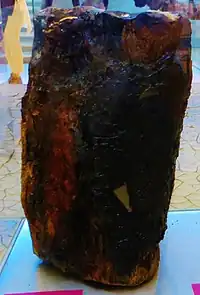
| Wood |
|
Affinities with Araucariaceae or Cheirolepidiaceae. |
 | ||
|
Wood |
|
Affinities with Cupressaceae.[39] |
||
|
Wood |
|
Affinities with Ginkgoaceae.[39] |
||
|
Wood |
|
Affinities with Podocarpaceae.[39] |
| |
|
Wood |
|
|||
|
Wood |
|
|||
|
Wood |
|
Incertae sedis.[39] |
||
|
Wood |
|
Affinities with Cheirolepidiaceae.[42] |
||
|
Wood |
|
Affinities with Cheirolepidiaceae.[40] |
||
|
Wood |
|
Affinities with Araucariaceae.[39] |
References
- 1 2 3 4 5 6 7 8 9 10 11 12 13 14 Drubina-Szabo, M. (1959). "Manganese deposits of Hungary" (PDF). Economic Geology. 54 (6): 1078–1094. doi:10.2113/gsecongeo.54.6.1078. Retrieved 16 November 2024.
- ↑ Jenkyns, Hugh C.; Géczy, Barnabas; Marshall, James D. (1991). "Jurassic Manganese Carbonates of Central Europe and the Early Toarcian Anoxic Event". The Journal of Geology. 99 (2): 137–149. doi:10.1086/629481. ISSN 0022-1376.
- ↑ Pantó, Gy.; Demény, A.; Polgári, M. (1996). "Genesis of secondary Mn-oxide ores in the Úrkút deposit, Hungary". Mineralium Deposita. 31 (3): 238–241. doi:10.1007/bf00204030. ISSN 0026-4598.
- ↑ Suan, Guillaume; Schlögl, Jan; Mattioli, Emanuela (2016-08-01). "Bio- and chemostratigraphy of the Toarcian organic-rich deposits of some key successions of the Alpine Tethys". Newsletters on Stratigraphy. 49 (3): 401–419. doi:10.1127/nos/2016/0078. ISSN 0078-0421.
- 1 2 3 4 5 6 7 8 9 10 11 12 13 14 15 16 Kedves, M. (1993). "Plant microfossils from the Jurassic manganese ore layers of Úrkút, Hungary" (PDF). In Plant Cell Biology and Development, JATE, Szeged, Special Issue: 11–21.
- 1 2 3 4 Polgári, M.; Tóth, M.; Dobosi, G.; Bajnóczy, B.; Szabó, Z.; Vigh, T. (2004). "Az úrkúti halmaradványokat tartalmazó konkréciók ásványos- éskémiai összetételének vizsgálata (Mineralogical and chemical investigations on the fish-including nodules of Úrkút)". Bányászati és Kohászati Lapok-Bányászat. 137 (6): 47–48.
- ↑ V´mos, R. (1969). "Microbiological processes of silicification of the fossil trunks found in Liassic manganese ore: With 3 figures in the text". SIL Communications, 1953-1996 (in German). 17 (1): 301–305. doi:10.1080/05384680.1969.11903899. ISSN 0538-4680.
- ↑ Grasselly, G.; Balogh, K.; Toth, M.; Polgari, M. (1994). "K/Ar age of manganese oxide ores of Úrkút, Hungary: Ar retention in K-bearing Mn minerals" (PDF). Geologica Carpathica. 45 (6): 365–373. Retrieved 16 November 2024.
- 1 2 3 4 5 Galácz, A.; Horváth, F.; Voros, A. (1985). "Sedimentary and structural evolution of the Bakony Mountains (Transdanubian Central Range, Hungary): palaeogeographic implications". Acta Geologica Hungarica. 28 (1–2): 85–100.
- ↑ Biro, L.; Polgari, M.; Pal-Molnar, E. (2012). "The revaluation of the drillings of the manganese mineralization in Eplény (Hungary)". Carpathian Journal of Earth and Environmental Sciences. 7 (3): 109–117.
- ↑ Dulai, Alfréd (2003). "Taxonomic composition of Mediterranean Early Jurassic brachiopod faunas from Hungary: Niche replacement and depth control". Fragmenta Palaeontologica Hungarica. 21 (1): 43–50.
- ↑ NEMETH, J. C., & Grasselly, G. (1966). Data on the geology and mineralogy of the manganese ore deposit of Úrkút II. Acta Mineral. Petrogr., Szeged, 17, 89–114.
- 1 2 3 Polgári, M.; Hein, J.R.; Vigh, T.; Szabó-Drubina, M.; Fórizs, I.; Bíró, L.; Müller, A.; Tóth, A.L. (2012). "Microbial processes and the origin of the Úrkút manganese deposit, Hungary". Ore Geology Reviews. 47: 87–109. doi:10.1016/j.oregeorev.2011.10.001. ISSN 0169-1368.
- ↑ Szabó, Z.; Grasselly, Gy.; Cseh-Németh, J. (1981). "Some conceptual questions regarding the origin of manganese in the Úrkút deposit, Hungary". Chemical Geology. 34 (1–2): 19–29. doi:10.1016/0009-2541(81)90068-1.
- ↑ Jenkyns, H. C. (1988). "The early Toarcian (Jurassic) anoxic event; stratigraphic, sedimentary and geochemical evidence". American Journal of Science. 288 (2): 101–151. doi:10.2475/ajs.288.2.101.
- ↑ M. Polgári, Z. Szabó, T. Szederkényi (Eds.), Manganese Ores in Hungary – In Commemoration of Professor Gyula Grasselly – Hungarian Academy of Sciences, Juhász Publishing House, Szeged (2000)675 pp.
- ↑ Polgári, Márta; Tazaki, Kazue; Watanabe, Hiroaki; Vigh, Támas; Gucsik, Arnold (2006). "Geochemical Aspect of Chemolithoautotrophic Bacterial Activity in the Role of Black Shale Hosted Mn Mineralization, Jurassic Age, Hungary, Europe". Clay Science. 12 (Supplement2): 233–239. doi:10.11362/jcssjclayscience1960.12.Supplement2_233.
- ↑ Bíró, Lóránt; Polgári, Márta; Tóth, Tivadar; Vigh, Tamás (2012-08-21). "Refinement of genetic and structural models of the Úrkút manganese ore deposit (W-Hungary, Europe) using statistical evaluation of archive data". Open Geosciences. 4 (3): 478–494. doi:10.2478/s13533-011-0079-2. ISSN 2391-5447.
- 1 2 Bajnóczi, Bernadett (2013-01-01). "Rhodocrosite-bearing concretions from a Jurassic manganese ore mineralization - Úrkút, Hungary". Carpathian Journal of Earth and Environmental Sciences.
- ↑ Polgári, Márta; Philippe, Marc; Szábo-Drubina, Magda; Tóth, Mária (2005-03-17). "Manganese-impregnated wood from a Toarcian manganese ore deposit, Epleny mine, Bakony Mts., Transdanubia, Hungary". Neues Jahrbuch für Geologie und Paläontologie - Monatshefte. 2005 (3): 175–192. doi:10.1127/njgpm/2005/2005/175. ISSN 0028-3630.
- ↑ Polgári, Márta; Hein, J.R.; Németh, T.; Pál-Molnár, E.; Vigh, T. (2013). "Celadonite and smectite formation in the Úrkút Mn-carbonate ore deposit (Hungary)". Sedimentary Geology. 294: 157–163. doi:10.1016/j.sedgeo.2013.05.017. ISSN 0037-0738.
- ↑ Weiszburg, T. G.; Tóth, E.; Beran, A. (2004). "Celadonite, the 10-Å green clay mineral of the manganese carbonate ore, Úrkút, Hungary". Acta Mineralogica-Petrographica, Szeged. 45 (1): 65–80.
- 1 2 3 4 Leskó, Máté Zsigmond; Papp, Richárd Zoltán; Topa, Boglárka Anna; Kristály, Ferenc; Vigh, Tamás; Zajzon, Norbert (2019-01-24). "Smectite appearance in the footwall of the Úrkút manganese ore deposit, Bakony Mts., Hungary". Central European Geology. 62 (1): 100–118. doi:10.1556/24.62.2019.02. hdl:10831/67442. ISSN 1788-2281.
- ↑ GYOLLAI, Ildikó; POLGÁRI, Márta; BÍRÓ, Lóránt; VIGH, Tamás; KOVÁCS, Tibor; PÁL-MOLNÁR, Elemér (2018). "FOSSILIZED BIOMATS AS THE POSSIBLE SOURCE OF HIGH NATURAL RADIONUCLIDE CONTENT AT THE JURASSIC ÚRKÚT MANGANESE ORE DEPOSIT, HUNGARY". Carpathian Journal of Earth and Environmental Sciences. 13 (2): 477–487. doi:10.26471/cjees/2018/013/041. ISSN 1842-4090.
- 1 2 3 4 Lantos, Zoltán; Vető, István; Földvári, Mária; Kovács-Pálffy, Péter (2003). "On the role of remote magmatic source and intrabasinal redeposition in the genesis of the Toarvian Úrkút Manganese ore, Hungary". Acta Geologica Hungarica. 46 (4): 321–340. doi:10.1556/ageol.46.2003.4.1. ISSN 0236-5278.
- ↑ Galácz, A. (1988). "Tectonically controlled sedimentation in the Jurassic of the Bakony Mountains (Transdanubian Central Range), Hungary". Acta Geologica Hungarica. 31 (3–4): 313–328.
- ↑ Simoncsics, P.; Kedves, M. (1961). "Paleobotanical examinations on manganese series in Úrkút (Hungary, Transdanubia)". Acta Mineral-Petrograph Szegeden. 14 (2): 27–57.
- 1 2 3 Polgári, M.; Szabó-Drubina, M.; Szabó, Z. (2004). "Theoretical model for Jurassic manganese mineralization in Central Europe, Úrkút, Hungary" (PDF). Bulletin of Geosciences. 79 (1): 53–61.
- ↑ Polgári, Márta; Hein, J.R.; Tóth, A.L.; Pál-Molnár, E.; Vigh, T.; Bíró, L.; Fintor, K. (2012). "Microbial action formed Jurassic Mn-carbonate ore deposit in only a few hundred years (Úrkút, Hungary)". Geology. 40 (10): 903–906. doi:10.1130/g33304.1. ISSN 1943-2682.
- 1 2 3 4 5 6 7 8 9 10 Dulai, A.; Suba, Z.; Szarka, A. (1993). "Toarci alsojura szervesanyagdus fkete pala a mecseki réka-völgyben". Földtani Közlöny. 122 (1): 67–87.
- 1 2 3 4 Vörös, A. (1986). "Brachiopod palaeoecology on a Thethyan Jurassic Seamount (Pliensbachian, Bakony Mountains, Hungary)". Palaeogeography, Palaeoclimatology, Palaeoecology. 57 (2–4): 241–271. doi:10.1016/0031-0182(86)90015-5. ISSN 0031-0182.
- ↑ Szabo, J. (1980). "Lower and Middle Jurassic Gastropods from the Bakony Mountains (Hungary). Part II. Pleurotomariacea and Fissurellacea (Archaeograstropoda)". Annales Historico-Naturales Musei Nationalis Hungarici. 72 (1): 49–71.
- 1 2 3 4 5 6 7 Galácz, A.; Géczy, B.; Monostori, M. (2008). "Csernye revisited: New ammonite finds and ostracods from the Lower Jurassic Pliensbachian/Toarcian boundary beds in Bakonycsernye, Transdanubian Hungary" (PDF). Geologica Pannonica. 36 (1): 187–225.
- ↑ Szabó, Márton; Pálfy, József (2019-09-09). "Dapedium sp. from the Toarcian (Lower Jurassic) Úrkút Manganese Ore Formation (Bakony Mts., Hungary) and an overview of diversity of dapediiform fishes". Palaeobiodiversity and Palaeoenvironments. 100 (1): 179–195. doi:10.1007/s12549-019-00390-7. hdl:10831/46315. ISSN 1867-1594.
- 1 2 3 4 5 6 7 8 9 10 11 12 13 14 15 16 17 18 19 20 21 22 23 24 Simoncsics, P. (1961). "Paleobotanical examinations on Manganese Series in Urkut (Hungary, Transdanubia)". Acta Mineralogica-Petrographica (Szeged). 14: 27–57.
- 1 2 3 4 5 6 7 8 9 10 11 12 13 14 15 16 17 18 19 20 21 22 23 24 25 26 27 28 29 30 31 32 33 34 35 36 37 38 39 40 41 Kedves, M. (1990). "Palynological studies on Manganese Ore Layers in Urkut (Transdanubia), Hungary". Ore Geology Reviews. 5 (491–507): 491–507. doi:10.1016/0169-1368(90)90049-S.
- ↑ Hofmann, Christa-Ch.; Odgerel, Nyamsambuu; Seyfullah, Leyla J. (2021). "The occurrence of pollen of Sciadopityaceae Luerss. through time". Fossil Imprint. 77 (2): 271–281. doi:10.37520/fi.2021.019. S2CID 245555379. Archived from the original on 27 December 2021. Retrieved 27 December 2021.
- 1 2 3 4 5 6 7 8 Greguss, P. (1967). "Fossil gymnosperm woods in Hungary from the Permian to the Pliocene". Akadémiai Kiadó, Budapest (1–136).
- 1 2 3 4 5 6 7 8 9 10 11 12 13 14 15 16 17 Philippe, M.; Barbacka, M. (1997). "A reappraisal of the Jurassic woods from Hungary". Annales Historico-Naturales Musei Nationalis Hungarici. 89 (1): 11–22.
- 1 2 3 Polgári, Márta; Philippe, Marc; Szábo-Drubina, Magda; Tóth, Mária (2005-03-17). "Manganese-impregnated wood from a Toarcian manganese ore deposit, Epleny mine, Bakony Mts., Transdanubia, Hungary". Neues Jahrbuch für Geologie und Paläontologie - Monatshefte. 2005 (3): 175–192. doi:10.1127/njgpm/2005/2005/175. ISSN 0028-3630.
- 1 2 3 4 5 6 7 8 Greguss, P.; Kedves, M. (1961). "Adatok a hazai mezozoos fatörzsek ismeretéhez. (Contribution to the knowledge of mesozoic trees of Hungary.)". Magyar Állami Földtani Intézet Évi Jelentése az 1957-1958: 435–444.
- 1 2 Vadász, E. (1964). Geological problems of fossil wood in Hungary. Acta Geol. Acad. Sci. Hung, 8, 119-43.